Welfare governance shift and socio-economic empowerment
Source:Indian Express ↗
Why It Matters
Understanding the transition from identity-based politics to development-based governance is crucial for analyzing India's evolving social dynamics, evaluating the effectiveness of welfare policies, and addressing questions on social justice and inclusive growth in GS Papers 1, 2, and 3.
Summary
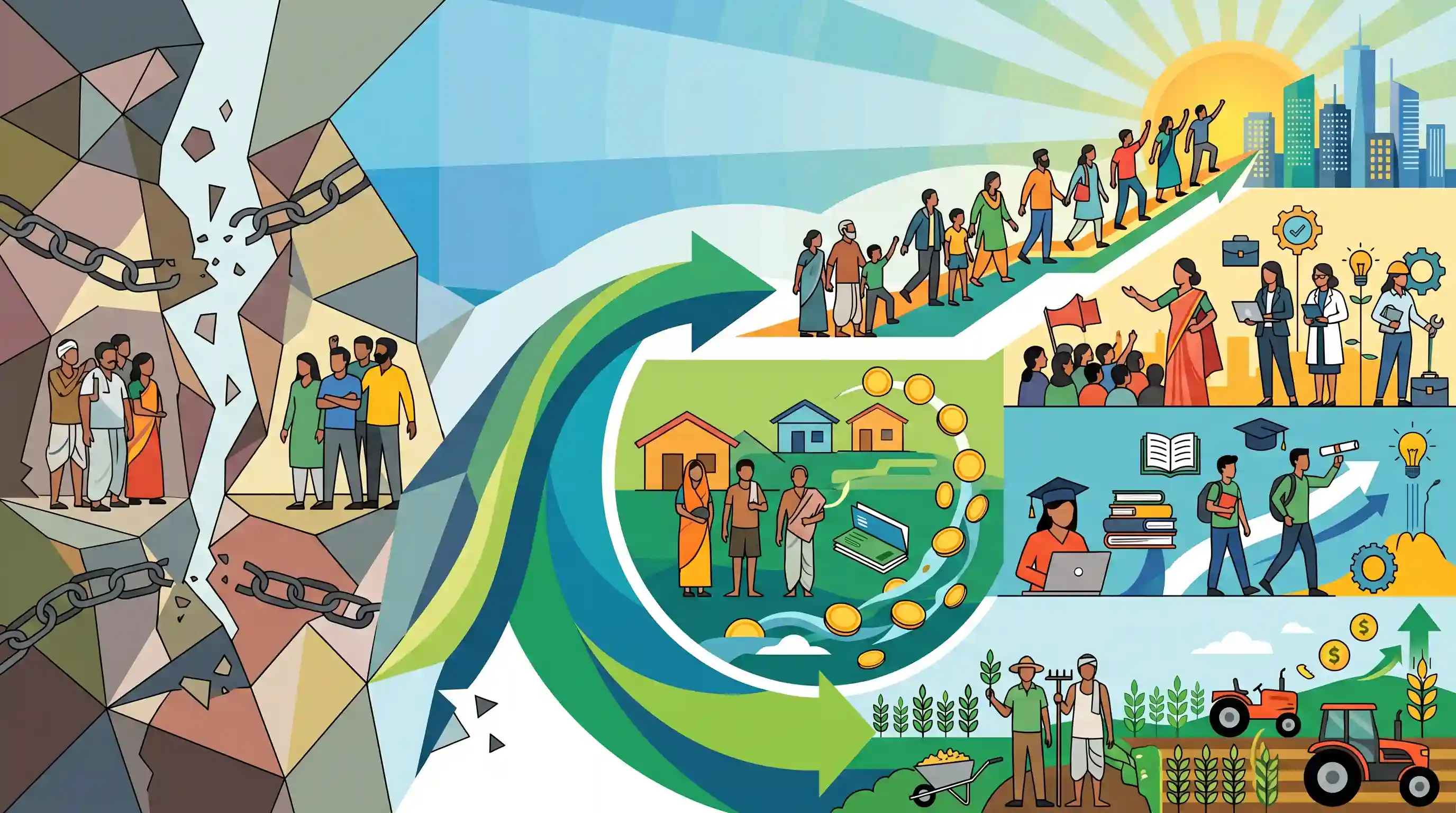
The article highlights a shift in Indian governance and political narratives, emphasizing a move away from traditional caste-based identity politics toward the empowerment of broader socio-economic demographics. This shift is encapsulated by the GYAN framework—focusing on the Poor (Garib), Youth (Yuva), Farmers (Annadata), and Women (Nari). By prioritizing targeted welfare, financial inclusion, and development schemes, the model aims to address marginalization and uplift vulnerable sections, including Dalits, through inclusive socio-economic growth rather than fractured caste dynamics.
Key Points
- There is a paradigm shift in Indian politics from traditional caste-based identity mobilization towards broad-based socio-economic empowerment.
- The GYAN framework—focusing on the Poor (Garib), Youth (Yuva), Farmers (Annadata), and Women (Nari)—serves as the central pillar for modern welfare and developmental policies.
- The empowerment of marginalized groups, including Dalits, is increasingly linked to economic schemes aimed at poverty alleviation, asset creation, and financial inclusion.
- By emphasizing overarching structural categories like poverty and gender, policymakers aim to dilute polarizing identity politics and promote inclusive growth.
Important Terms
GYAN (Garib, Yuva, Annadata, Nari)

Governance framework focusing on four socio-economic pillars: Garib (Poor), Yuva (Youth), Annadata (Farmers), and Nari (Women). It represents a shift towards targeted welfare for specific demographic groups.
UPSC context
GS Paper II (Governance) and III (Economy); tests understanding of evolving welfare models and budget priorities.
Inclusive Growth
Economic growth that is distributed fairly across society and creates opportunities for all, ensuring marginalized groups like Dalits and women participate as both beneficiaries and partners.
UPSC context
GS Paper III (Economic Development); core concept for questions on poverty alleviation and sustainable development.
Identity Politics
Political strategies based on shared social characteristics like caste or religion. Recent narratives suggest a move from traditional caste-based identity towards broader socio-economic demographics like GYAN.
UPSC context
GS Paper II (Polity/Society); critical for analyzing voting behavior, political mobilization, and social cohesion.
Social Justice
The principle of ensuring fair treatment and equal opportunity for all, particularly the poor and marginalized (SCs, STs, and Women), by eliminating disparities in wealth and status.
UPSC context
GS Paper II (Social Justice); essential for understanding welfare schemes and constitutional mandates like Articles 14-17.
Nari Shakti
Sanskrit/Hindi for 'women power,' symbolizing the shift from development of women to 'women-led development' through initiatives like the Nari Shakti Vandan Adhiniyam (Reservation Bill).
UPSC context
GS Paper I (Society) and II (Polity); central to women's empowerment and political representation themes.
Annadata
Meaning 'food provider,' this term is used for farmers in policies like PM-AASHA, which focuses on ensuring remunerative prices and financial security for the agricultural community.
UPSC context
GS Paper III (Agriculture); relevant for questions on doubling farmer's income and agricultural welfare schemes.
Prelims Trap
The GYAN framework officially replaces the constitutional classification of SC/ST/OBC for affirmative action in India.
GYAN is a governance and policy narrative for targeted socio-economic welfare. It does not alter or replace constitutional affirmative action (Articles 15 and 16) based on social and educational backwardness.
Static Concepts Connected
What are the two components of the Gender Budgeting Statement in India?
- Part A: Reflects schemes with 100% allocation for women (e.g., Mahila Samman Scheme, Nirbhaya Fund).
- Part B: Reflects schemes where at least 30% of the allocation is earmarked for women (e.g., PM Awas Yojana, MGNREGA).
How does the JAM trinity minimize leakages in targeted welfare schemes?
- Jan Dhan: Provides universal access to basic savings bank accounts for unbanked populations, ensuring direct routing of funds.
- Aadhaar: Acts as a unique biometric identifier to weed out ghost beneficiaries and duplicate accounts from the welfare rolls.
- Mobile: Facilitates digital transaction alerts, mobile banking, and real-time access to funds for the end-user.
Cross-Topic Patterns
Welfare targeting + Digital Public Infrastructure
The shift to GYAN relies heavily on India's Digital Public Infrastructure (Aadhaar, UPI) to accurately target beneficiaries, reducing the inclusion/exclusion errors traditionally seen in identity-based patronage politics.
Annadata + Nari: Feminization of Agriculture
The intersection of 'Nari' and 'Annadata' highlights a critical GS-3 theme: policies targeting the rising share of women in agriculture require focused asset-ownership (PM Awas) and targeted institutional credit.

Expect a GS-2 Mains question evaluating the shift from caste-based affirmative action to overarching socio-economic welfare models like GYAN.
Linked PYQs · 5
Linked PYQs · 5
- 2018MainsGS1
Caste system is assuming new identities and associational forms. Hence, caste system cannot be eradicated in India." Comment.
- 2024MainsGS1
Distinguish between gender equality, gender equity and women's empowerment. Why is it important to take gender concerns into account in programme design and implementation?
- 2019MainsGS2
Performance of welfare schemes that are implemented for vulnerable sections is not so effective due to absence of their awareness and active involvement at all stages of policy process. Discuss.
- 2022MainsGS2
Besides the welfare schemes, India needs deft management of inflation and unemployment to serve the poor and the underprivileged sections of the society. Discuss.
- 2022MainsGS3
Is inclusive growth possible under market economy ? State the significance of financial inclusion in achieving economic growth in India.
