External affairs ministry reaction to unrest in occupied region
Source:The Hindu ↗
Why It Matters
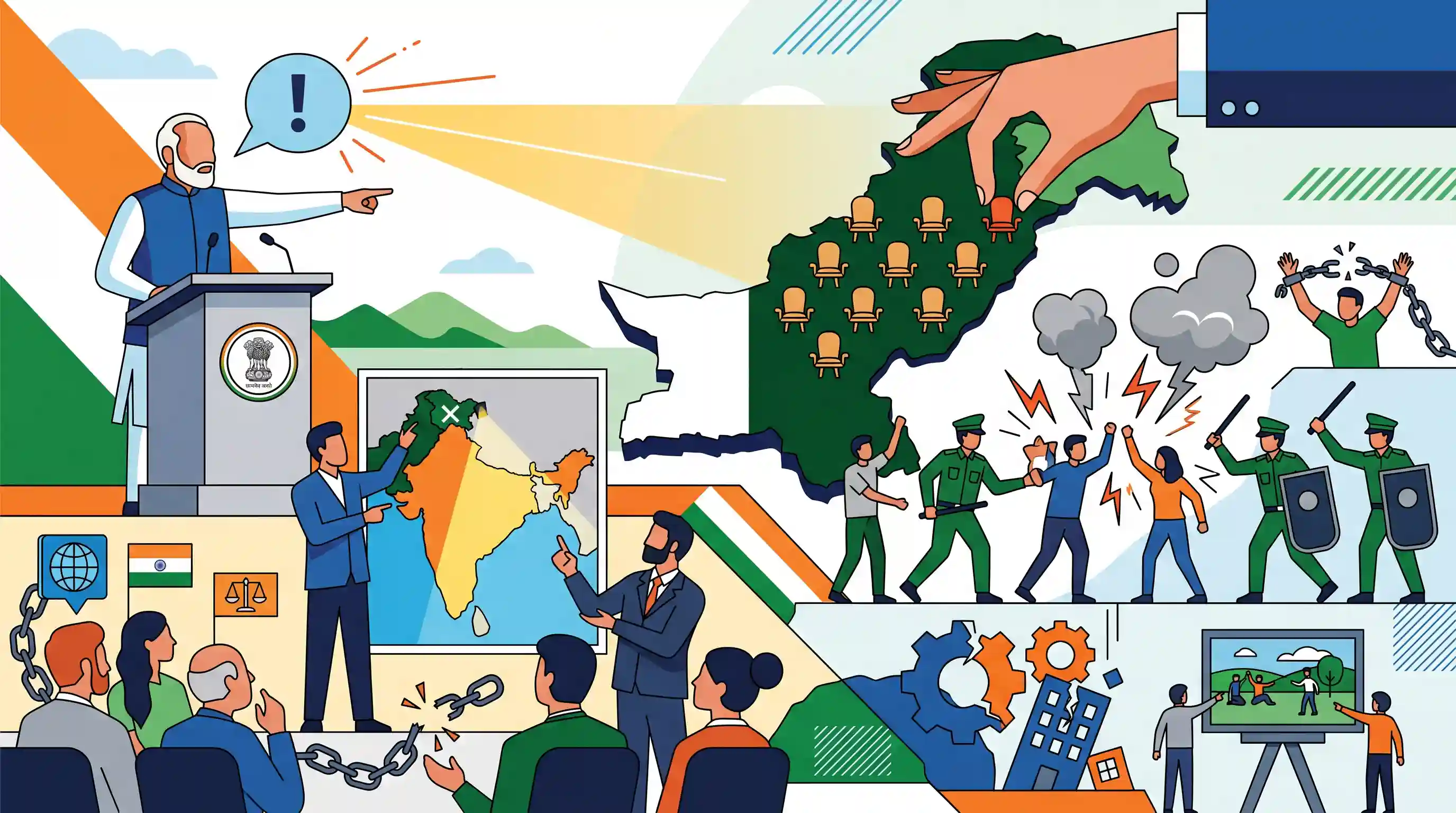
This development highlights the internal socio-political unrest within Pakistan-Occupied Kashmir (PoK) and illustrates India's diplomatic strategy of calling out Pakistan's human rights violations on international platforms while reasserting its sovereign claims over the region.
Summary
India has strongly condemned the recent violent police crackdown on protesters in Pakistan-Occupied Kashmir (PoK) and called upon the international community to hold Pakistan accountable for human rights abuses. The unrest in PoK is largely driven by the Joint Awami Action Committee (JAAC), which is protesting against the 12 "refugee seats" in the PoK Legislative Assembly that locals argue are used by Pakistan to manipulate regional government formation. The Ministry of External Affairs (MEA) reiterated India's firm stance that PoK is illegally occupied by Pakistan, accusing Islamabad of running a disinformation campaign to deflect attention from its systemic internal failures and state brutality.
Key Points
- The Ministry of External Affairs (MEA) urged the international community to hold Pakistan accountable for police brutality and human rights violations against protesters in Pakistan-Occupied Kashmir (PoK).
- Protests in the region are spearheaded by the Joint Awami Action Committee (JAAC), which has demanded the abolition of 12 "refugee seats" in the PoK Legislative Assembly.
- Locals allege these refugee seats are manipulated by mainstream Pakistani political parties to influence and control government formation in Muzaffarabad.
- The regional government in PoK has moved to proscribe the JAAC under anti-terrorism laws, a step criticized by the Human Rights Commission of Pakistan (HRCP).
- India reaffirmed its consistent diplomatic position that PoK is an integral part of India, currently under "illegal and forcible" occupation by Pakistan, and accused Pakistan of using disinformation to cover up its governance failures.
Important Terms
Pakistan-Occupied Kashmir (PoK)

Territory of the Indian Union Territory of Jammu and Kashmir illegally occupied by Pakistan since 1947, comprising "Azad Jammu and Kashmir" and Gilgit-Baltistan.
UPSC context
GS Paper II (India-Pakistan Relations). Central to India's territorial integrity and sovereignty claims under the 1994 Parliamentary Resolution.
Joint Awami Action Committee (JAAC)
A sociopolitical alliance of traders and civil society in PoK protesting economic hardship, lack of subsidies, and political disenfranchisement by the Pakistani establishment.
UPSC context
GS Paper II (Effect of politics of neighboring countries). Demonstrates local resistance to Pakistan's administrative control over occupied territories.
Refugee Seats (PoK Legislative Assembly)
Twelve reserved seats for migrants from J&K living in Pakistan, allegedly used by Islamabad to manipulate PoK government formation against local interests.
UPSC context
GS Paper II (Neighboring relations). Tests understanding of the political structures Pakistan uses to maintain control over PoK.
Ministry of External Affairs (MEA)
The Indian government ministry responsible for foreign relations and official diplomatic stances on international disputes, sovereignty, and regional stability.
UPSC context
GS Paper II (Important Ministries). Tests knowledge of India's diplomatic machinery and formal responses to neighborhood crises.
Human Rights Commission of Pakistan (HRCP)
An independent, non-profit human rights organization that monitors state violence and legal abuses within Pakistan and its administered territories.
UPSC context
GS Paper II (Human Rights). Relevant for evaluating third-party reports on the internal stability and civil liberties of India's neighbors.
Instrument of Accession
The legal document signed on October 26, 1947, by Maharaja Hari Singh, officially making the Princely State of Jammu and Kashmir an integral part of India.
UPSC context
GS Paper I (Post-independence consolidation) and Paper II (Sovereignty). The foundational legal basis for India’s claim over all of Kashmir.
Prelims Trap
India legally formalized its claim over PoK only through the Jammu and Kashmir Reorganisation Act, 2019.
India's firm political and constitutional claim over PoK actually traces back to the unanimous 1994 Parliament Resolution on J&K, long preceding the 2019 abrogation.
Static Concepts Connected
What is the 1994 Parliament Resolution on Jammu & Kashmir?
- Unanimous stance: Passed by both Houses in 1994, it explicitly asserts that the entire state of J&K, including PoK, has been, is, and shall be an integral part of India.
- Vacation of occupation: It officially demands that Pakistan must vacate the areas of the Indian State of Jammu and Kashmir which it has occupied through aggression.
- Countering interference: It firmly resolves that any attempt to interfere in the internal affairs of India will be met resolutely, forming the bedrock of India's PoK policy.
How does the Simla Agreement (1972) frame the Kashmir dispute?
- Bilateralism principle: It established that India and Pakistan will settle their differences by peaceful means through bilateral negotiations, legally binding them to exclude third-party mediation.
- Respect for LoC: Both countries agreed to respect the Line of Control (LoC) resulting from the December 17, 1971 ceasefire, without prejudice to either side's recognized position.
Cross-Topic Patterns
PoK unrest + Gilgit-Baltistan status
The JAAC protests in PoK mirror ongoing political alienation in Gilgit-Baltistan, where locals similarly protest against resource extraction and lack of full constitutional rights.
Offensive Human Rights Diplomacy
India's MEA highlighting PoK human rights globally marks a strategic shift from defensive bilateralism to offensive diplomacy, utilizing human rights as a geopolitical lever.

Expect a 2026 GS-2 mains question on India's shift from defensive bilateralism to proactive human rights diplomacy regarding PoK.
Linked PYQs · 2
Linked PYQs · 2
- 2015MainsGS2
Terrorist activities and mutual distrust have clouded India-Pakistan relations. To what extent the use of soft power like sports and cultural exchanges could help generate goodwill between the two countries? Discuss with suitable examples.
- 2016MainsGS2
Increasing cross-border terrorist attacks in India and growing interference in the internal affairs of several member-states by Pakistan are not conducive for the future of SAARC (South Asian Association for Regional Cooperation)." Explain with suitable examples.
