RBI Governor Affirms Stability of India Medium Term Macro Fundamentals
Source:Indian Express ↗
Why It Matters
The RBI Governor's outlook on the economy is a crucial indicator for India's monetary policy trajectory, impacting inflation control, investment climates, and overall economic stability. It provides critical insights for GS3 topics related to economic growth, planning, and resource mobilization.
Summary
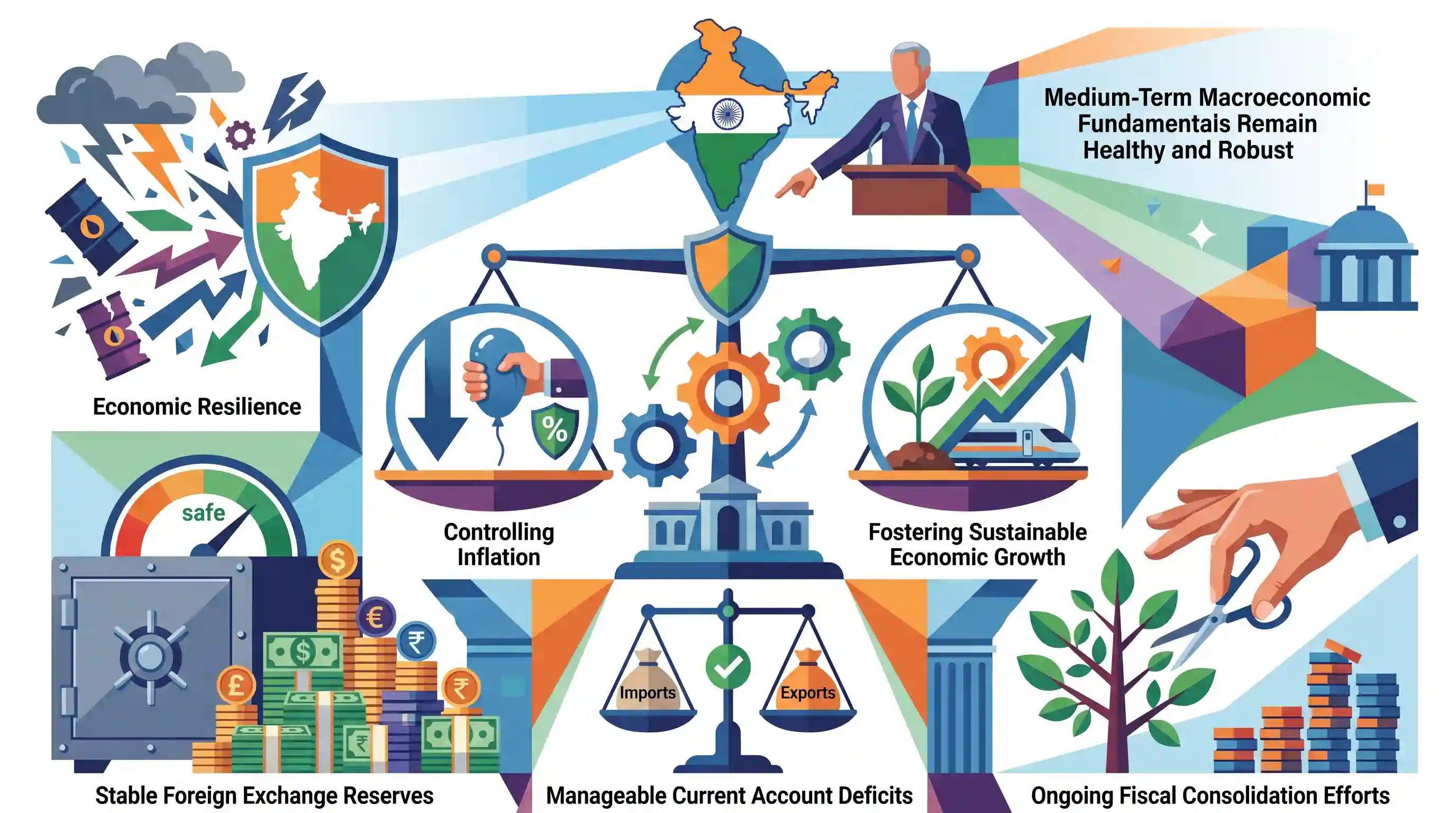
RBI Governor Sanjay Malhotra emphasized that India's medium-term macroeconomic fundamentals remain healthy and robust. The assessment underlines India's economic resilience in the face of global economic uncertainties. It signals the Reserve Bank of India's continued focus on maintaining a balance between controlling inflation and fostering sustainable economic growth, supported by manageable current account deficits, stable foreign exchange reserves, and ongoing fiscal consolidation efforts by the government.
Key Points
- India's medium-term macroeconomic fundamentals are deemed healthy and robust by the newly appointed RBI Governor, highlighting economic resilience.
- The central bank focuses on balancing inflation management with sustained economic growth amidst global uncertainties.
- Key macroeconomic indicators such as the current account deficit, fiscal deficit, and foreign exchange reserves remain stable and manageable.
- The ongoing fiscal consolidation aligns with the RBI's monetary management to ensure long-term macroeconomic stability.
Important Terms
Reserve Bank of India (RBI)

India's central bank and regulatory body responsible for regulating the banking system, issuing currency, and managing the country's monetary policy to ensure price stability and growth.
UPSC context
GS-III: Indian Economy. Essential for understanding central banking, monetary authority, and financial regulation.
Monetary Policy Committee (MPC)
A six-member statutory committee (3 RBI, 3 external) that fixes the benchmark interest rate (repo rate) to maintain inflation within the target of 4% (+/- 2%).
UPSC context
GS-III: Indian Economy. Tests knowledge of statutory bodies and the mechanism of inflation targeting.
Fiscal Consolidation
Government strategies aimed at reducing the fiscal deficit and public debt-to-GDP ratio to ensure long-term financial sustainability.
UPSC context
GS-III: Government Budgeting. Crucial for questions on fiscal policy and deficit management.
Current Account Deficit (CAD)
A measurement of a country's trade where the value of the goods and services it imports exceeds the value of the products it exports.
UPSC context
GS-III: External Sector. Important for understanding Balance of Payments and currency stability.
Foreign Exchange (Forex) Reserves
External assets held by the RBI, including foreign currencies, gold, and SDRs, used to back liabilities and influence the exchange rate of the Rupee.
UPSC context
GS-III: Indian Economy. Key indicator of economic resilience and external sector health.
Inflation Targeting
A monetary policy framework where the central bank uses interest rates to keep inflation within a specific target range to maintain price stability.
UPSC context
GS-III: Indian Economy. Tests understanding of RBI's mandate and the 4%+/-2% target.
Prelims Trap
The Reserve Bank of India is responsible for managing both inflation and fiscal consolidation to ensure macroeconomic stability.
Fiscal consolidation is strictly the domain of the Central Government under the FRBM Act. The RBI's statutory mandate is limited to monetary policy (price stability and growth).
Static Concepts Connected
How do fiscal and monetary policies interact to ensure macroeconomic stability?
- Inflation Management: Excessive fiscal deficits trigger demand-pull inflation. This forces the RBI to hike interest rates to maintain its statutory inflation target (4% +/- 2%), potentially neutralizing growth.
- Crowding Out Effect: High government borrowing (expansionary fiscal policy) increases bond yields. This raises capital costs for the private sector, undermining the RBI's attempts to lower rates (monetary transmission).
What are the primary components of a Current Account Deficit (CAD)?
- Trade Deficit: The shortfall between a country's merchandise (goods) exports and imports. For India, this structural deficit is the largest driver of the CAD.
- Net Invisibles: Includes services trade, net income (profits, interest), and transfers (remittances). India typically runs a large surplus in invisibles, which partially offsets the merchandise trade deficit.
Cross-Topic Patterns
Twin Deficits and Rupee stability
Elevated fiscal deficits often widen the CAD. This "twin deficit" puts depreciation pressure on the Rupee, triggering RBI intervention via foreign exchange reserves.
Sovereign Ratings & Fiscal Consolidation
Healthy macroeconomic fundamentals—specifically predictable fiscal consolidation—heavily influence global sovereign credit ratings, determining the external commercial borrowing (ECB) costs for Indian enterprises.

Expect a multi-statement Prelims question interlinking fiscal consolidation (FRBM), RBI's monetary stance, and their effect on bond yields.
Linked PYQs · 5
Linked PYQs · 5
- 2018MainsGS3
How would the recent phenomena of protectionism and currency manipulations in world trade affect macroeconomic stability of India?
- 2022MainsGS3
Economic growth in the recent past has been led by increase in labour productivity." Explain this statement. Suggest the growth pattern that will lead to creation of more jobs without compromising labour productivity.
- 2023MainsGS3
Faster economic growth requires increased share of the manufacturing sector in GDP, particularly of MSMEs. Comment on the present policies of the Government in this regard.
- 2022PrelimsGS1
With reference to the Indian economy, consider the following statements: 1. If the inflation is too high, Reserve Bank of India (RBI) is likely to buy government securities. 2. If the rupee is rapidly depreciating, RBI is likely to sell dollars in the market. 3. If interest rates in the USA or European Union were to fall, that is likely to induce RBI to buy dollars. Which of the statements given above are correct?
- 2021PrelimsGS1
With reference to Indian economy, demand-pull inflation can be caused/ increased by which of the following? 1. Expansionary policies 2. Fiscal stimulus 3. Inflation-indexing wages 4. Higher purchasing power 5. Rising interest rates Select the correct answer using the code given below.
