India Humanitarian Assistance to Afghanistan Amid Regional Conflict
Source:Indian Express ↗
Why It Matters
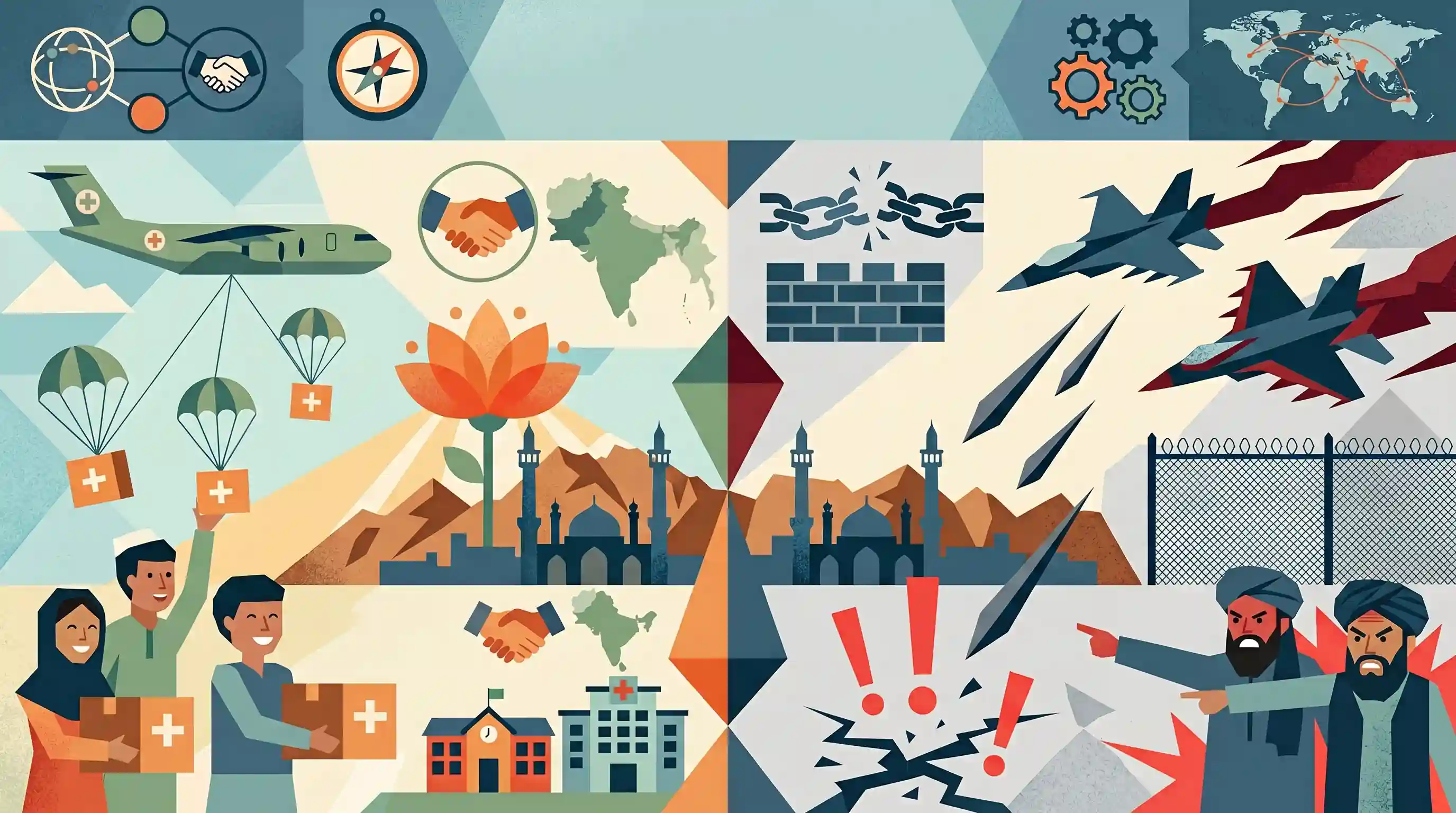
It illustrates the practical application of India's 'Neighbourhood First' policy and soft power strategy in a complex geopolitical environment. For UPSC aspirants, understanding the strategic contrast between India's humanitarian engagement and Pakistan's military approach is key to analyzing South Asian security dynamics and India's long-term diplomatic goals in Afghanistan.
Summary
Days after Pakistan launched cross-border airstrikes into Afghanistan, India dispatched a fresh consignment of emergency medical aid to Kabul. The timing of the humanitarian delivery highlights a stark contrast in how the two rival neighbors interact with the Taliban regime. While Pakistan's military actions have inflamed tensions and drawn condemnation from Kabul, India continues to utilize soft-power diplomacy by providing consistent developmental and humanitarian support. India's strategy reflects a pragmatic engagement to maintain historical ties with the Afghan people and protect its strategic interests in South Asia, even without extending formal diplomatic recognition to the Taliban.
Key Points
- India delivered a fresh tranche of medical aid to Kabul, continuing its humanitarian assistance to the Afghan people despite not officially recognizing the Taliban regime.
- The aid shipment arrived days after Pakistan conducted cross-border airstrikes in Afghanistan, which Pakistan claimed targeted militant hideouts.
- The incident highlights a contrast in regional strategies: India employing soft power through developmental and humanitarian support, while Pakistan relies on hard power and military interventions.
- India’s approach underscores its commitment to historical people-to-people ties and its strategic imperative to maintain a positive presence in Afghanistan amidst regional instability.
Important Terms
Ministry of External Affairs (MEA)

The Indian government ministry responsible for conducting foreign relations, implementing foreign policy, and representing India in international forums and diplomatic missions.
UPSC context
GS Paper II: International Relations. Tests the executive’s role in shaping foreign policy and managing bilateral ties with neighbors.
Taliban
A de facto political and military organization currently governing Afghanistan following their return to power in August 2021 after the withdrawal of Western forces.
UPSC context
GS Paper II: India and its neighborhood. Essential for analyzing regional security, counter-terrorism, and India’s 'pragmatic engagement' policy.
Soft Power Diplomacy
A strategy of influencing international actors through cultural influence, values, and developmental aid rather than military coercion or economic pressure.
UPSC context
GS Paper II: International Relations. Tests evaluation of non-military tools like medical aid and infrastructure in advancing national interests.
India-Afghanistan Relations
Bilateral ties historically built on civilizational links and developmental partnership, currently focused on a people-centric approach and humanitarian support.
UPSC context
GS Paper II: Bilateral relations. Examines how India maintains historical goodwill and infrastructure investments despite regime changes.
Humanitarian Aid
Material or logistical assistance, such as food and medicine, provided during crises to alleviate civilian suffering and maintain social stability.
UPSC context
GS Paper II: Effect of policies. Tests understanding of aid as a diplomatic tool to maintain ties with civilian populations.
Strategic Interest
Long-term security and economic goals, such as ensuring regional stability, counter-terrorism, and limiting the influence of hostile neighbors in the region.
UPSC context
GS Paper II: Regional groupings. Central to India's 'neighborhood first' policy and balancing power in South Asia.
Prelims Trap
India has officially recognized the Taliban government to facilitate the delivery of humanitarian and medical aid.
India maintains a 'technical mission' in Kabul for humanitarian assistance and pragmatic engagement, but has explicitly NOT extended formal diplomatic recognition to the Taliban regime.
Static Concepts Connected
What is Pakistan's 'Strategic Depth' doctrine regarding Afghanistan?
- Buffer State: Pakistan's military strategy to use Afghan territory as a pliable, subordinate buffer state.
- Avoiding Encirclement: Aimed at preventing a two-front war scenario (a hostile India on the east and a hostile Afghanistan on the west).
- Anti-India Focus: This doctrine drives Pakistan to actively sabotage Indian soft power and development projects in Afghanistan.
How does India geographically bypass Pakistan to access landlocked Afghanistan?
- Chabahar Port: India developed this Iranian port to secure a direct sea-land route to Afghanistan, circumventing Pakistan's denial of overland transit rights.
- Air Freight Corridor: Launched in 2017 to facilitate direct bilateral trade and rapid delivery of critical medical and humanitarian shipments.
Cross-Topic Patterns
Soft Power & Neighbourhood First
India's focus on medical aid and infrastructure (Salma Dam) contrasts with military interventions, reflecting the 'Neighbourhood First' policy via non-coercive capacity building.
Colonial mapping and the Durand Line
The 1893 British-drawn Durand Line remains unrecognized by Afghanistan. This historic colonial legacy continuously fuels Pak-Afghan border clashes and alters regional stability.

Expect a Prelims question testing the subtle distinction between India's 'technical mission' in Kabul and formal diplomatic recognition.
Linked PYQs · 3
Linked PYQs · 3
- 2022PrelimsGS1
Consider the following countries: 1. Azerbaijan 2. Kyrgyzstan 3. Tajikistan 4. Turkmenistan 5. Uzbekistan Which of the above have borders with Afghanistan ?
- 2015MainsGS2
Terrorist activities and mutual distrust have clouded India-Pakistan relations. To what extent the use of soft power like sports and cultural exchanges could help generate goodwill between the two countries? Discuss with suitable examples.
- 2020MainsGS3
Analyze internal security threats and transborder crimes along Myanmar, Bangladesh and Pakistan borders including Line of Control (LoC). Also discuss the role played by various security forces in this regard.
