India Manufacturing PMI Records Expansion on Strong Domestic Demand
Source:The Hindu ↗
Why It Matters
The article underscores the importance of high-frequency indicators like the PMI in tracking the real-time health of the economy. It highlights the direct correlation between structural tax reforms (GST) and manufacturing growth, a key priority area for UPSC aspirants studying the structural drivers of India's GDP, MSME growth, and industrial output.
Summary
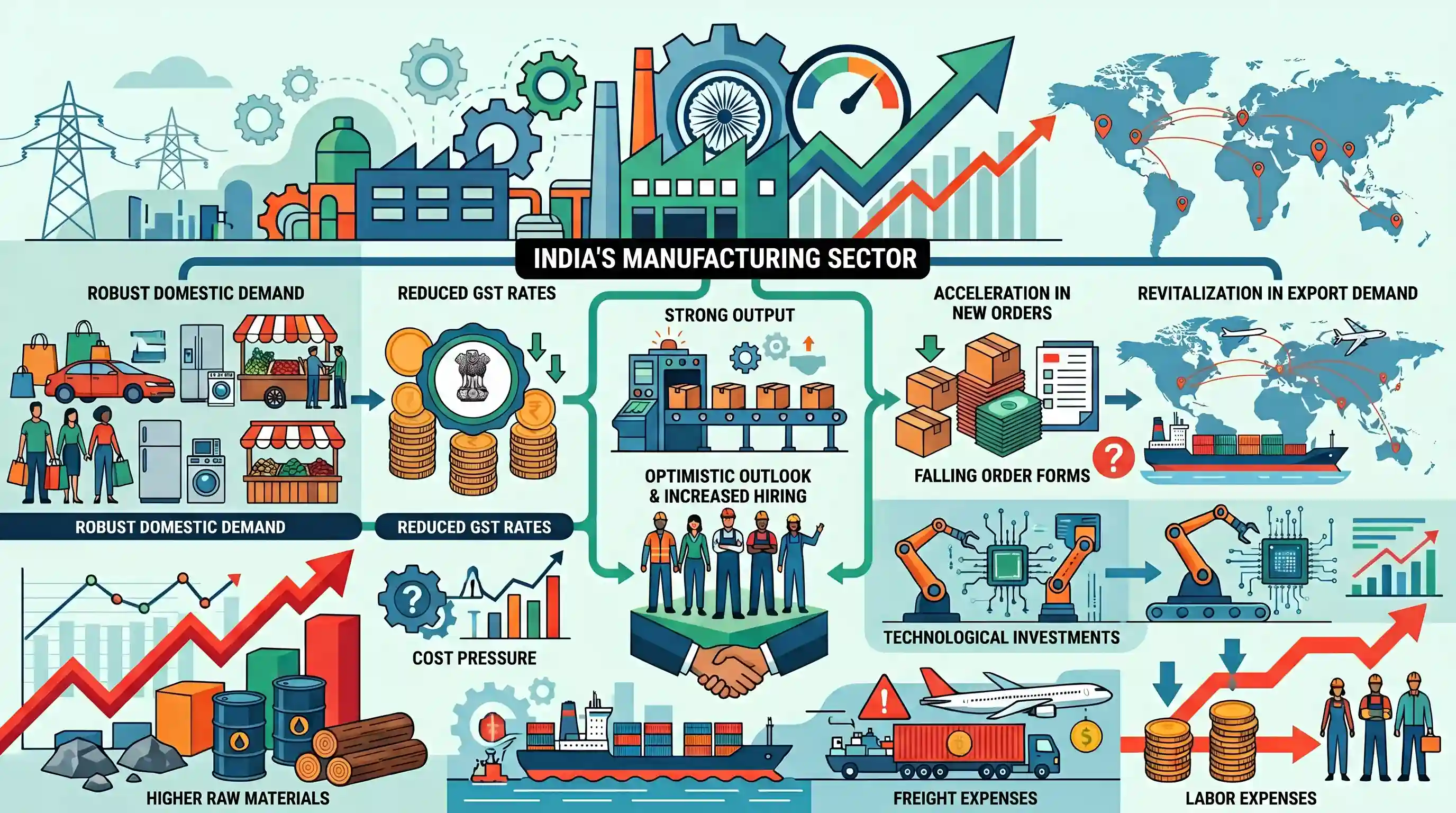
India's manufacturing sector experienced a significant rebound in October, as reflected by the HSBC India Manufacturing Purchasing Managers’ Index (PMI) surging to 59.2. This expansion was driven by robust domestic demand, favorable market dynamics, and reduced GST rates. The growth encompassed strong output, an acceleration in new orders across consumer and investment goods, and a revitalization in export demand from key global markets. While the optimistic outlook translated to increased hiring and technological investments by manufacturers, the sector concurrently grappled with accelerating cost pressures stemming from higher raw materials, freight, and labor expenses.
Key Points
- The HSBC India Manufacturing Purchasing Managers’ Index (PMI) jumped to 59.2 in October from 56.5 in September, pointing to a robust expansion in the sector.
- Growth was driven by strong domestic demand, favorable market conditions, successful product introductions, and reductions in GST rates.
- Output, new orders, and hiring all accelerated, with consumer and investment goods experiencing particularly strong momentum.
- New export orders rebounded, showing quicker growth from markets including Asia, Europe, and the U.S., ending a multi-month slowing trend.
- Despite optimistic business sentiment and job creation, manufacturers faced intensified cost pressures driven by higher raw material, freight, and wage costs.
Important Terms
Purchasing Managers' Index (PMI)

A survey-based economic indicator measuring month-over-month changes in business activity. A reading above 50 signifies expansion, while below 50 indicates contraction. It is a leading indicator of economic health.
UPSC context
GS Paper III (Economy); crucial for understanding high-frequency indicators, economic growth trends, and distinguishing between leading versus lagging economic measures.
Goods and Services Tax (GST)
A comprehensive, multi-stage, destination-based indirect tax levied on the supply of goods and services. Introduced via the 101st Constitutional Amendment Act to create a unified national market.
UPSC context
GS Paper III (Fiscal Policy/Taxation); tests knowledge of cooperative federalism, constitutional provisions (Article 279A), and impact on ease of doing business.
Index of Industrial Production (IIP)
A monthly index that tracks the actual production output of various industrial sectors in India. It is compiled and released by the National Statistical Office (NSO).
UPSC context
GS Paper III (Economy); frequently compared with PMI to assess the gap between business sentiment and actual industrial output.
Manufacturing Sector
The segment of the economy involved in the transformation of raw materials into finished goods. In India, it is a key focus under the 'Make in India' initiative.
UPSC context
GS Paper III (Industrial Policy); critical for discussions on job creation, GDP contribution, and the transition from an agrarian to an industrial economy.
Cost-Push Inflation
Inflation triggered by an increase in the prices of production inputs like raw materials, wages, and freight. This reduces the supply of goods, leading to higher consumer prices.
UPSC context
GS Paper III (Inflation/Economy); relevant for analyzing how supply-side shocks and rising commodity prices impact overall macroeconomic stability and monetary policy.
S&P Global
A major global financial information and analytics corporation. It compiles the India Manufacturing PMI (formerly compiled by IHS Markit) and provides critical data for global capital and commodity markets.
UPSC context
GS Paper III (Economy); relevant for identifying the sources of private-sector economic data used by policymakers and global investors.
Prelims Trap
"The Manufacturing PMI is published by the NSO and measures the actual volume of industrial output."
PMI is a private, survey-based leading indicator compiled by agencies like S&P Global. It measures sentiment and monthly change, not actual NSO volume.
Static Concepts Connected
What are the key differences between PMI and IIP?
- Leading vs Lagging: PMI is a survey-based leading indicator of business sentiment, whereas IIP measures actual physical volume after production occurs.
- Publishing Authority: PMI is compiled by private agencies (like S&P Global), while IIP is released monthly by the National Statistical Office (NSO) under MoSPI.
- Sectoral Coverage: PMI has separate indices for manufacturing and services. IIP covers only the industrial sector (mining, manufacturing, and electricity).
How do manufacturing cost pressures impact broader macroeconomic inflation?
- Cost-Push Mechanism: Rising expenses for raw materials, freight, and wages increase the cost of production, leading to squeezed corporate profit margins.
- Consumer Pass-Through: To protect margins, manufacturers pass these increased input costs onto end consumers, ultimately driving up headline retail inflation (CPI) with a lag.
Cross-Topic Patterns
PMI inflation signals + RBI monetary policy
Rising input costs noted in the PMI survey signal impending cost-push inflation. This forward-looking data heavily influences the RBI Monetary Policy Committee to potentially delay repo rate cuts.
Indirect tax rationalization + Sectoral growth
GST rate reductions act as a direct fiscal catalyst. Lowering indirect taxes reduces final consumer prices, stimulating the domestic consumption cycle that drives manufacturing sector expansion and job creation.

Expect a multi-statement Prelims 2026 question contrasting PMI (survey-based, private, >50 expansion) with IIP (volume-based, NSO).
Linked PYQs · 4
Linked PYQs · 4
- 2023MainsGS3
Faster economic growth requires increased share of the manufacturing sector in GDP, particularly of MSMEs. Comment on the present policies of the Government in this regard.
- 2019MainsGS3
Enumerate the indirect taxes which have been subsumed in the Goods and Services Tax (GST) in India. Also, comment on the revenue implications of the GST introduced in India since July 2017.
- 2015PrelimsGS1
In the 'Index of Eight Core Industries', which one of the following is given the highest weight?
- 2012PrelimsGS1
In India, in the overall Index of Industrial Production, the Indices of Eight Core Industries have a combined weight of 37.90%. Which of the following are among those Eight Core Industries? 1. Cement 2. Fertilizers 3. Natural gas 4. Refinery products 5. Textiles Select the correct answer using the codes given below:
