Exercise Ekuverin and Counter Terrorism Cooperation with Maldives
Source:Indian Express ↗
Why It Matters
Joint military exercises are vital components of India's defense diplomacy. In the context of the strategic and geopolitical significance of the Maldives, such exercises are crucial for maintaining maritime security, countering non-state threats, and asserting India's role as a net security provider in the Indian Ocean Region.
Summary
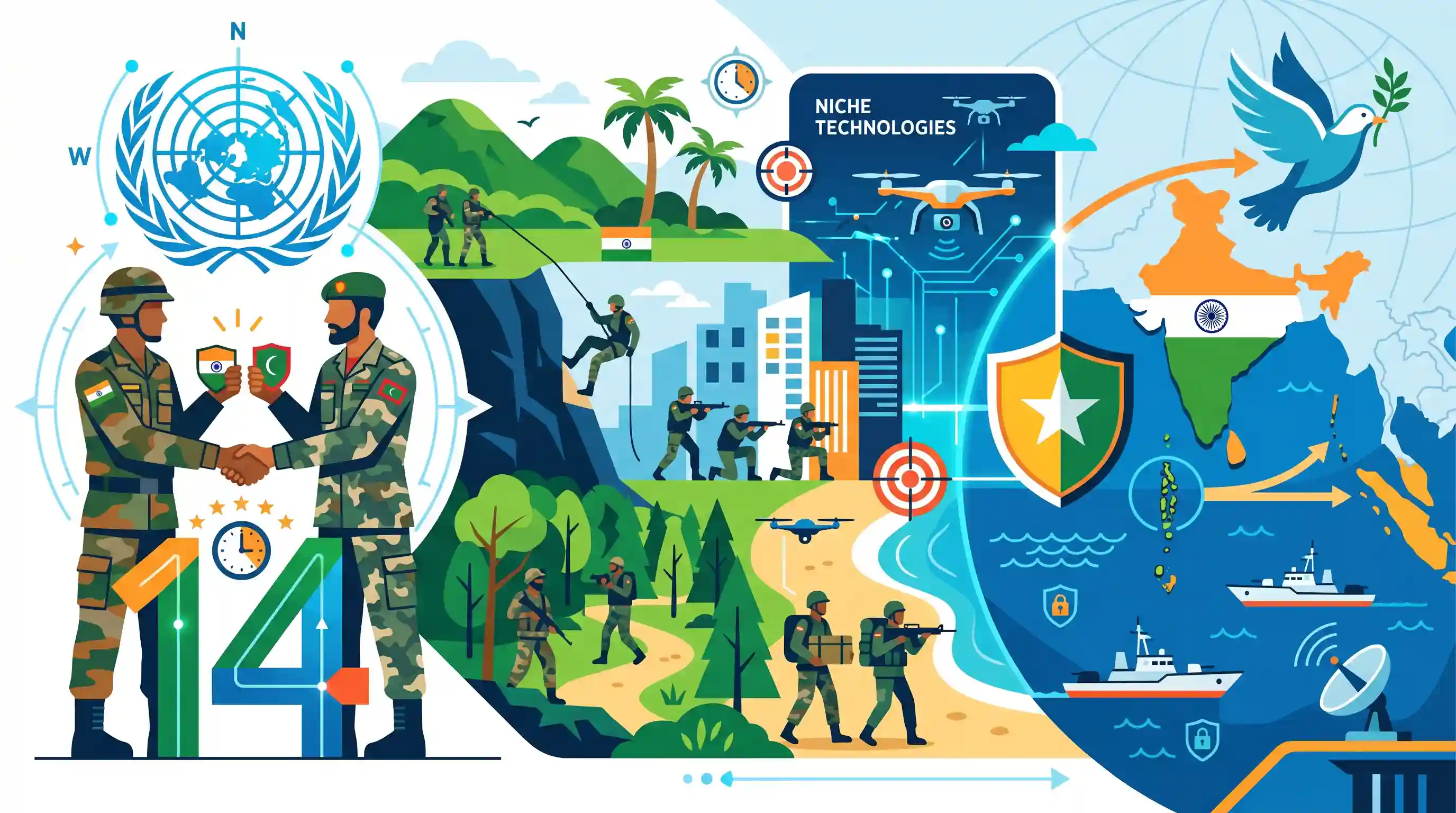
The 14th edition of the India-Maldives joint military exercise, 'Ekuverin', commenced in Thiruvananthapuram, Kerala, focusing on Counter-Insurgency and Counter-Terrorism operations across varied terrains under a UN mandate. Translating to 'Friends' in Dhivehi, this biennial exercise aims to bolster interoperability, share best practices, and integrate niche technologies between the Indian Army and the Maldives National Defence Force. It reflects India's robust 'Neighbourhood First Policy' and underscores mutual commitments toward ensuring peace, security, and stability in the strategic Indian Ocean Region.
Key Points
- The 14th edition of the joint military exercise 'Ekuverin' between the Indian Army and the Maldives National Defence Force commenced in Thiruvananthapuram, Kerala.
- The term 'Ekuverin' translates to 'Friends' in the Maldivian language Dhivehi; the exercise has been conducted as an alternative bilateral event since 2009.
- The primary focus of the exercise is on Counter-Insurgency and Counter-Terrorism (CI-CT) operations under a United Nations mandate across jungle, semi-urban, and coastal environments.
- The exercise demonstrates India's 'Neighbourhood First Policy' and serves as a tool for defense diplomacy, enhancing interoperability, tactical coordination, and overall security in the Indian Ocean Region.
Important Terms
Exercise Ekuverin

An annual bilateral military exercise between India and the Maldives, focusing on enhancing interoperability for counter-insurgency and counter-terrorism operations. 'Ekuverin' translates to 'Friends' in Dhivehi.
UPSC context
GS Paper II (International Relations); important for bilateral security cooperation and military exercises involving India.
Neighbourhood First Policy
A core pillar of India's foreign policy that prioritizes diplomatic, economic, and security relations with immediate neighbors to ensure regional stability, connectivity, and collective prosperity.
UPSC context
GS Paper II (Foreign Policy); tests understanding of regional diplomacy and India's strategic leadership in South Asia.
Maldives National Defence Force (MNDF)
The combined security organization responsible for defending the Maldives' sovereignty. India is its primary training partner, providing approximately 70% of its defense training requirements.
UPSC context
GS Paper II (Bilateral Relations); signifies India’s role as a net security provider in the Indian Ocean.
SAGAR (Security and Growth for All in the Region)
India's strategic vision for the Indian Ocean, emphasizing cooperative maritime security, sustainable economic growth, and collective action against non-traditional threats like piracy and terrorism.
UPSC context
GS Paper II (International Relations) & GS Paper III (Internal Security); relevant for maritime diplomacy and IOR security.
Counter-Insurgency and Counter-Terrorism (CI-CT)
Military and political actions taken to defeat an insurgency (CI) and tactics intended to prevent or respond to terrorist acts (CT), often conducted under a UN mandate.
UPSC context
GS Paper III (Internal Security); tests knowledge of operational doctrines and international security mandates.
Indian Ocean Region (IOR)
A strategically vital maritime zone where India seeks to maintain its influence as a first responder and stabilizer against regional security challenges and external power competition.
UPSC context
GS Paper II (IR) & Paper III (Security); critical for understanding maritime geopolitics and trade security.
Prelims Trap
"Exercise Ekuverin is a bilateral Naval exercise between India and Maldives for securing the Indian Ocean."
While Maldives is an island nation and maritime security is key, Ekuverin is strictly an Army exercise. The India-Maldives joint naval exercise is 'Ekatha'.
Static Concepts Connected
Why is the Maldives strategically vital for India's maritime security?
- SLOC Chokepoint: It acts as a 'toll gate' across critical Sea Lanes of Communication (SLOCs) from the Gulf of Aden to the Strait of Malacca.
- Geographic Proximity: Located barely 70 nautical miles from Minicoy (Lakshadweep), it forms India's first line of maritime defense against extra-regional powers.
- Net Security Provider: Crucial for implementing India's SAGAR doctrine and establishing India as the net security provider in the Indian Ocean Region.
Why are bilateral CI-CT exercises often conducted under a "UN Mandate"?
- SOP Standardization: Harmonizes Standard Operating Procedures (SOPs) and tactical coordination for joint multinational deployments under the UN flag.
- Legal Cover: Provides an internationally recognized framework validating the use of force and irregular warfare tactics in peacekeeping missions.
Cross-Topic Patterns
Minicoy's cultural link to Maldives
The exercise name 'Ekuverin' is Dhivehi. This language is natively spoken in Minicoy (Lakshadweep), structurally linking India's internal geography questions with its neighborhood diplomacy.
Military diplomacy amid political shifts
Military exercises provide strategic continuity and institutional buffering when political relations fluctuate, counterbalancing recent 'India Out' rhetoric or troop withdrawal demands in the Maldives.

Match-the-following Prelims question pairing IOR island nations with specific joint military exercises (Ekuverin, Mitra Shakti, Lamitye).
Linked PYQs · 1
Linked PYQs · 1
- 2024MainsGS2
Discuss the geopolitical and geostrategic importance of Maldives for India with a focus on global trade and energy flows. Further also discuss how this relationship affects India's maritime security and regional stability amidst international competition ?
