DRDO Conducts Maiden Tests of Integrated Air Defense System
Source:Indian Express ↗
Why It Matters
The integration of missile defense and directed energy weapons reflects India's modernization of its military architecture. It is highly relevant for GS-3 Security and Science & Tech sections, where questions frequently target DRDO's capabilities, multi-layered air defense systems, and Make in India initiatives.
Summary
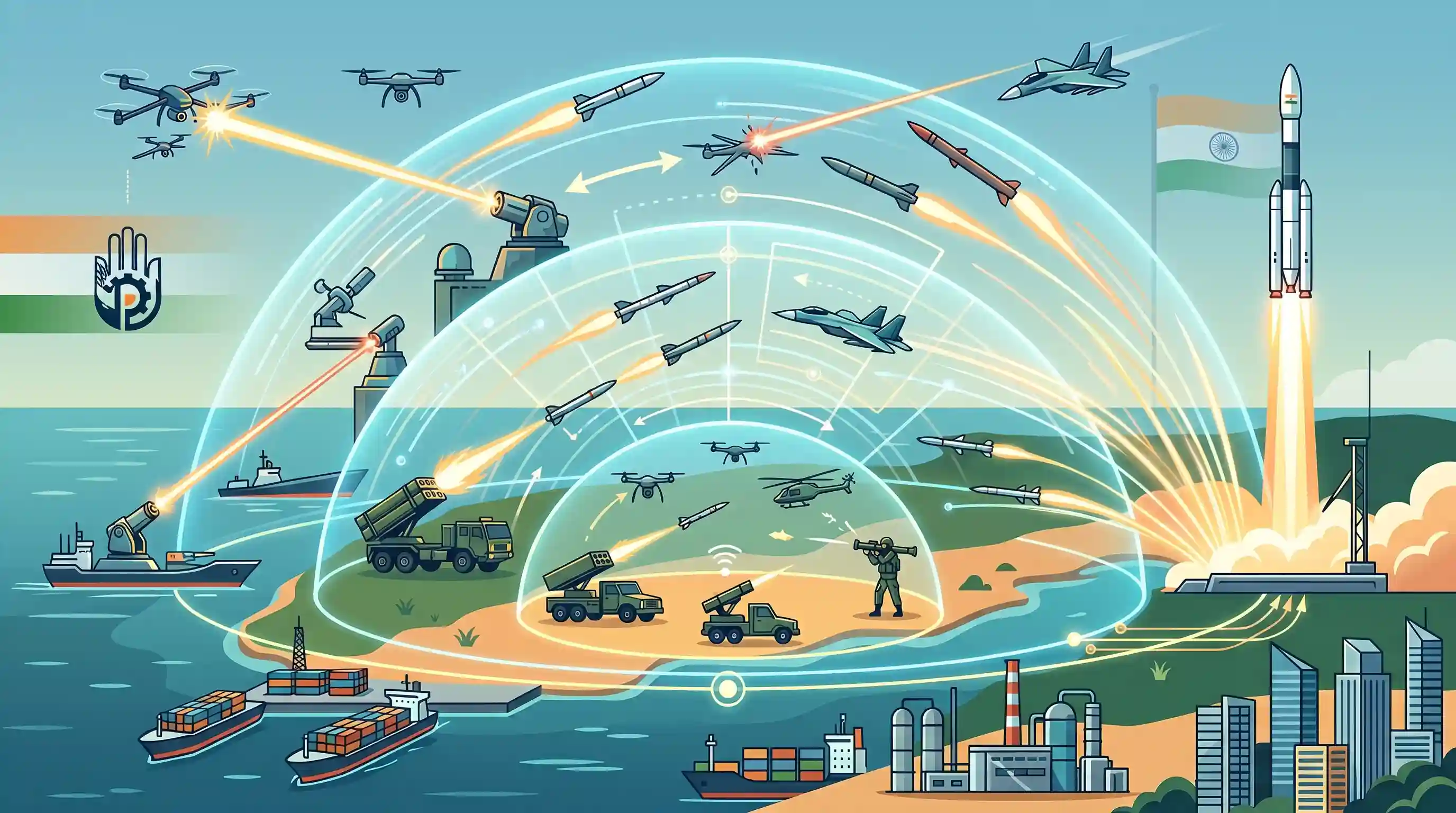
India successfully conducted the maiden flight tests of the indigenous Integrated Air Defence Weapon System (IADWS) off the coast of Odisha. Developed by the Defence Research and Development Organisation (DRDO), the multi-layered system integrates Quick Reaction Surface to Air Missiles (QRSAM), Very Short-Range Air Defence Systems (VSHORADS), and Directed Energy Weapons (DEW). It aims to fortify the country's defense architecture, protecting vital installations and assets from diverse enemy aerial threats, including drones and missiles.
Key Points
- DRDO successfully conducted the maiden flight tests of the Integrated Air Defence Weapon System (IADWS) off the Odisha coast.
- The IADWS employs a multi-layered architecture combining Quick Reaction Surface to Air Missiles (QRSAM), VSHORADS, and high-power laser Directed Energy Weapons (DEW).
- The system is designed to provide comprehensive area defense for critical facilities and installations against various hostile aerial threats.
- These flight tests follow 'Operation Sindoor', reflecting India's continuous push towards self-reliance (Aatmanirbharta) in advanced defense technologies.
Important Terms
Integrated Air Defence Weapon System (IADWS)

An indigenous multi-layered shield integrating QRSAM, VSHORADS, and Directed Energy Weapons under centralized command to protect critical installations from drones and missiles.
UPSC context
GS III: Science & Technology (Indigenisation); tests awareness of multi-layered defense and self-reliance in military infrastructure.
Operation Sindoor
A 2025 large-scale counter-terror campaign that demonstrated India's indigenous defense synergy, utilizing home-grown missiles, drones, and NavIC systems for precision strikes.
UPSC context
GS III: Internal Security; GS II: IR. Analyzes shifts in security posture and the combat-proven status of indigenous tech.
Quick Reaction Surface to Air missiles (QRSAM)
A short-range (3–30 km) SAM system designed by DRDO to provide a protective shield for moving Army armored columns against aerial attacks.
UPSC context
GS III: Defence Technology. Evaluates technical knowledge of tactical weapon systems and mobile air defense capabilities.
Very Short Range Air Defence System (VSHORADS)
A lightweight, man-portable air defense system (MANPADS) used to neutralize low-altitude threats like drones and helicopters within a 6 km range.
UPSC context
GS III: Science & Technology. Focuses on indigenization and countermeasures against asymmetrical aerial threats.
Directed Energy Weapons (DEW)
Advanced systems using concentrated electromagnetic energy (lasers/microwaves) to disable targets at the speed of light with high precision and low per-shot costs.
UPSC context
GS III: Science & Technology. Tests awareness of emerging disruptive military technologies and modern electronic warfare.
Mission Sudarshan Chakra
A strategic national project aiming to establish a multi-layered, networked indigenous air defense shield by 2035 to protect critical infrastructure.
UPSC context
GS III: Internal Security; GS III: Defence Indigenisation. Important for long-term strategic planning and national security architecture.
Prelims Trap
"Directed Energy Weapons (DEWs) used in the IADWS rely on kinetic projectiles to neutralize targets."
DEWs use non-kinetic concentrated electromagnetic energy (lasers or microwaves) that travel at the speed of light, not physical/kinetic solid-mass projectiles.
Static Concepts Connected
How do Directed Energy Weapons (DEWs) differ from conventional weapons?
- Electromagnetic energy: They utilize highly focused lasers or high-power microwaves to destroy targets or disrupt electronics, rather than using physical mass.
- Speed of light: They strike instantaneously, offering rapid engagement without the physical flight time required by traditional interceptor missiles.
- Infinite magazine: As long as electrical power is supplied, DEWs can fire continuously, lowering the cost-per-shot drastically against cheap drones.
What are the key operational differences between QRSAM and VSHORADS?
- QRSAM mobility: A canister-based short-range missile system offering "search-on-move" and "track-on-move" radar capabilities up to 30km.
- VSHORADS portability: A 4th-generation Man-Portable Air Defence System (MANPADS) designed to be carried by troops to neutralize low-altitude threats within 6km.
Cross-Topic Patterns
Asymmetric warfare & drone swarms
The integration of Directed Energy Weapons into IADWS addresses the modern threat of cheap drone swarms, correcting the skewed cost-exchange ratio of using expensive missiles against inexpensive UAVs.
Indigenization vs. imported shields
Developing an indigenous "Iron Dome-like" architecture reduces India's historical reliance on foreign anti-access/area-denial (A2/AD) umbrellas like the Russian S-400 or Israeli Spyder.

A multi-statement Prelims question comparing kinetic (QRSAM) vs. non-kinetic (DEW) interception, or matching MANPADS to ranges, is likely.
Linked PYQs · 2
Linked PYQs · 2
- 2007PrelimsGS1
Consider the following statements: 1. In November, 2006, DRDO successfully conducted the interception test using Prithvi-II missile. 2. Prithvi-II is a surface-to-surface missile and can be deployed to guard the metros against air attacks. Which of the statements given above is/are correct?
- 2023PrelimsGS1
Consider the following statements: 1. Ballistic missiles are jet-propelled at subsonic speeds throughout their flights, while cruise missiles are rocket-powered only in the initial phase of flight. 2. Agni-V is a medium-range supersonic cruise missile, while BrahMos is a solid-fuelled intercontinental ballistic missile. Which of the statements given above is/are correct?
