भारत-चीन आर्थिक संबंध और प्रत्यक्ष विदेशी निवेश प्रतिबंध
स्रोत:इंडियन एक्सप्रेस ↗
क्यों मायने रखता है
The potential reversal or easing of the 2020 FDI curbs on China highlights the complex trade-off between national security and economic growth. For UPSC aspirants, this illustrates the challenges in decoupling from global supply chains and the practical requirements for success in schemes like 'Make in India' and PLI.
सारांश
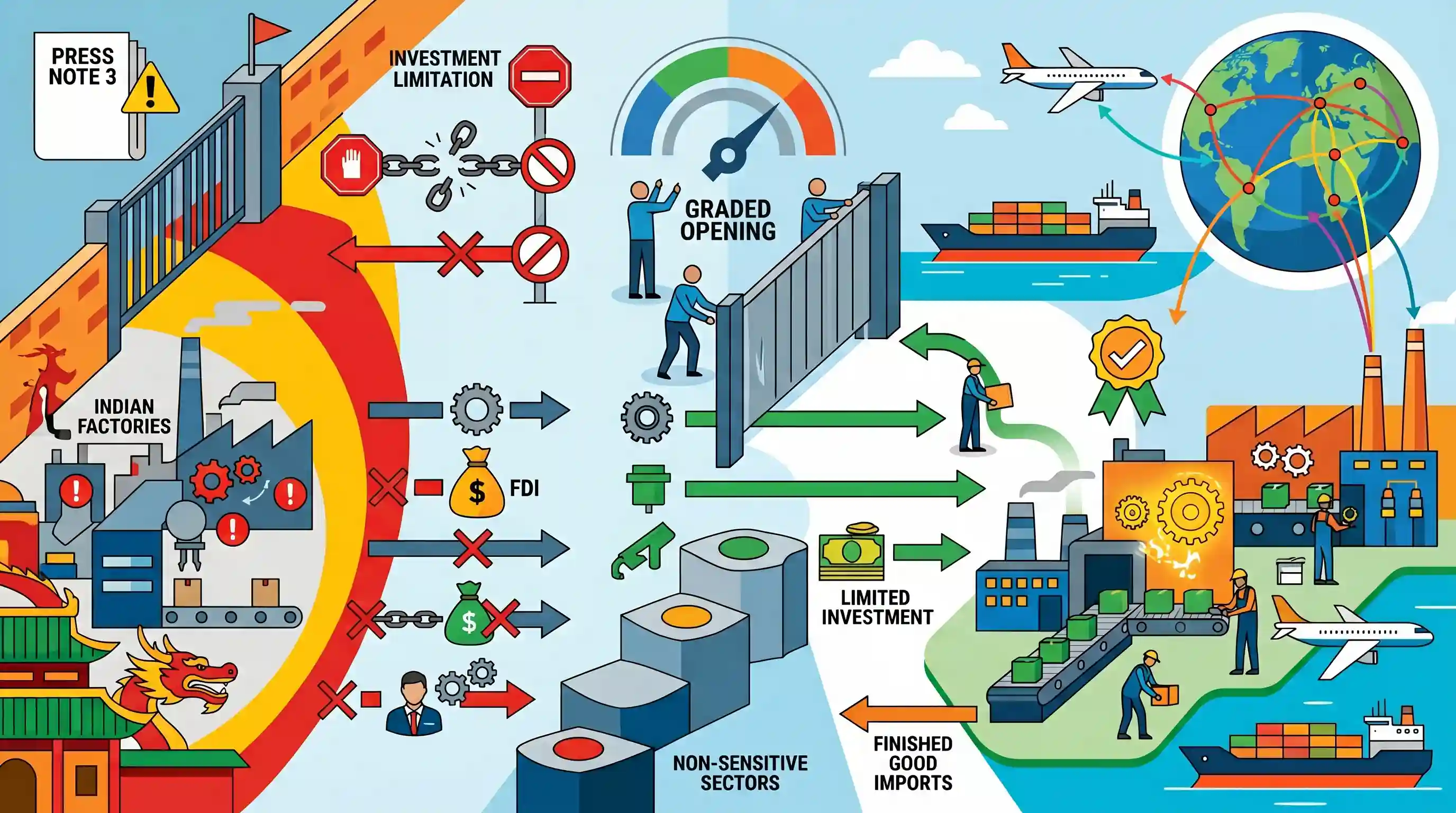
India is reportedly evaluating a graded opening of its economy to China by easing certain restrictions on trade, visas, and investments that were implemented after the 2020 Galwan border clash. The move comes as tight regulations, notably Press Note 3, have inadvertently hindered India's domestic manufacturing ambitions and Production Linked Incentive (PLI) schemes by blocking necessary Chinese components, capital, and technical expertise. The graded approach will likely focus on non-sensitive sectors, aiming to boost local manufacturing capabilities, reduce finished good import dependencies, and help India integrate more effectively into global supply chains.
मुख्य बिंदु
- India is considering a 'graded' or phased easing of economic restrictions imposed on China following the 2020 border clashes.
- The potential easing may include relaxing visa curbs on Chinese technicians and fast-tracking approvals for joint ventures in non-sensitive sectors.
- प्रेस नोट 3 (2020) के तहत FDI के कड़े नियमों (जिसने सीमा साझा करने वाले देशों से निवेश के लिए पूर्व अनुमोदन अनिवार्य कर दिया था) ने भारतीय विनिर्माण में बाधाएं उत्पन्न कीं, जिससे तकनीकी विशेषज्ञता और आपूर्ति श्रृंखला इनपुट की कमी के कारण विशेष रूप से PLI योजना प्रभावित हुई।
- इस रणनीतिक बदलाव का उद्देश्य घरेलू विनिर्माण को बढ़ावा देना, विदेशी पूंजी को आकर्षित करना और चीनी सप्लाई चेन की दक्षता का उपयोग करके ग्लोबल वैल्यू चेन (GVCs) में भारत के गहरे एकीकरण को सुगम बनाना है।
महत्वपूर्ण शब्द
Press Note 3 (2020)

2020 का एक FDI नीति संशोधन जिसके तहत भारत के साथ भूमि सीमा साझा करने वाले देशों से होने वाले निवेश के लिए सरकार की पूर्व अनुमति अनिवार्य है। इसका मुख्य उद्देश्य अवसरवादी अधिग्रहण (opportunistic takeovers) को रोकने के लिए विशेष रूप से चीनी पूंजी को लक्षित करना है।
UPSC context
GS पेपर II और III। आर्थिक सुरक्षा, निवेश प्रतिबंधों और भारत-चीन द्विपक्षीय संबंधों के ज्ञान का परीक्षण करता है।
Production Linked Incentive (PLI) Scheme
केंद्र सरकार की एक पहल जो विनिर्माण को बढ़ावा देने और आयात निर्भरता को कम करने के लिए घरेलू इकाइयों में निर्मित उत्पादों की वृद्धिशील बिक्री के आधार पर कंपनियों को वित्तीय प्रोत्साहन प्रदान करती है।
UPSC context
GS पेपर III (अर्थव्यवस्था)। औद्योगिक नीति, विनिर्माण वृद्धि और आत्मनिर्भर भारत पहल से संबंधित है।
Department for Promotion of Industry and Internal Trade (DPIIT)
वाणिज्य और उद्योग मंत्रालय के तहत वह नोडल विभाग जो औद्योगिक नीति तैयार करने, FDI को सुगम बनाने और भारत में ईज़ ऑफ डूइंग बिजनेस (Ease of Doing Business) में सुधार करने के लिए उत्तरदायी है।
UPSC context
GS Paper III (Economy/Governance). Essential for understanding the executive machinery managing India’s trade landscape.
प्रत्यक्ष विदेशी निवेश (FDI)
किसी एक देश की इकाई द्वारा दूसरे देश में स्थित किसी व्यवसाय में किया गया निवेश, जिसका उद्देश्य दीर्घकालिक हित और प्रबंधन नियंत्रण स्थापित करना होता है।
UPSC context
GS Paper III (Economy). Tests concepts of capital inflows, investment routes, and economic growth drivers.
Beneficial Ownership
The ultimate person or entity that exercises control over an investment or legal entity, regardless of the intermediate jurisdictions used for the transaction.
UPSC context
GS पेपर III (सुरक्षा)। मनी लॉन्ड्रिंग विरोधी (PMLA) नियमों और रणनीतिक पूंजी प्रवाह की निगरानी को समझने के लिए महत्वपूर्ण।
स्वचालित मार्ग
एक FDI प्रवेश मार्ग जहाँ विदेशी निवेशकों को विशिष्ट क्षेत्रों में निवेश करने से पहले सरकार या RBI से पूर्व अनुमति की आवश्यकता नहीं होती है।
UPSC context
GS Paper III (Economy). Tests understanding of investment liberalization and regulatory frameworks for foreign capital.
प्रारंभिक ट्रैप
प्रेस नोट 3 (2020) भारत के साथ भूमि सीमा साझा करने वाले देशों से होने वाले सभी प्रत्यक्ष विदेशी निवेश (FDI) को प्रतिबंधित करता है।
यह FDI को प्रतिबंधित या बैन नहीं करता है। यह अवसरवादी अधिग्रहणों (opportunistic takeovers) को रोकने के लिए केवल सीमा साझा करने वाले देशों से होने वाले निवेश को ऑटोमैटिक रूट (automatic route) से सरकारी मंजूरी मार्ग (government approval route) में स्थानांतरित करता है।
संबंधित अवधारणाएँ
What are the two entry routes for Foreign Direct Investment (FDI) in India?
- स्वचालित मार्ग: Does not require prior approval from the Government of India or RBI. This applies to most non-strategic sectors like agriculture and standard manufacturing.
- Government Route: Requires prior approval from the respective Ministry/Department via the Foreign Investment Facilitation Portal (FIFP). Mandatory for border-sharing nations under Press Note 3.
How do backward and forward linkages function in Global Value Chains (GVCs)?
- बैकवर्ड लिंकेज: Importing foreign intermediate goods or raw materials to assemble or produce finished products domestically. India needs this efficiently from China to boost its manufacturing.
- Forward Linkages: Exporting domestically produced intermediate goods that are subsequently used in other countries' exports.
अंतर-विषय पैटर्न
PLI targets vs. Component Dependency
India's PLI schemes heavily rely on imported active components. Immediate decoupling from China stalls domestic scale-up targets, highlighting the tension between Atmanirbhar Bharat and global manufacturing realities.
'चाइना प्लस वन' रणनीति का विरोधाभास
To benefit from the global "China Plus One" diversification trend, India paradoxically requires Chinese capital goods, JVs, and technical experts to build its initial factory capacity.

Press Note 3 nuances + PLI's backward linkage dependency will likely form a complex, multi-statement economy question in Prelims 2026.
संबद्ध PYQ · 4
संबद्ध PYQ · 4
- 2024MainsGS2
‘The West is fostering India as an alternative to reduce dependence on China's supply chain and as a strategic ally to counter China's political and economic dominance.’ Explain this statement with examples.
- 2025MainsGS3
Discuss the rationale of the Production Linked Incentive (PLI) scheme. What are its achievements? In what way can the functioning and outcomes of the scheme be improved?
- 2016MainsGS3
Justify the need for FDI for the development of the Indian economy. Why there is gap between MOUs signed and actual FDIs? Suggest remedial steps to be taken for increasing actual FDIs in India.
- 2020PrelimsGS1
With reference to Foreign Direct Investment in India, which one of the following is considered its major characteristic?
