India China Economic Relations and Foreign Direct Investment Curbs
Source:Indian Express ↗
Why It Matters
The potential reversal or easing of the 2020 FDI curbs on China highlights the complex trade-off between national security and economic growth. For UPSC aspirants, this illustrates the challenges in decoupling from global supply chains and the practical requirements for success in schemes like 'Make in India' and PLI.
Summary
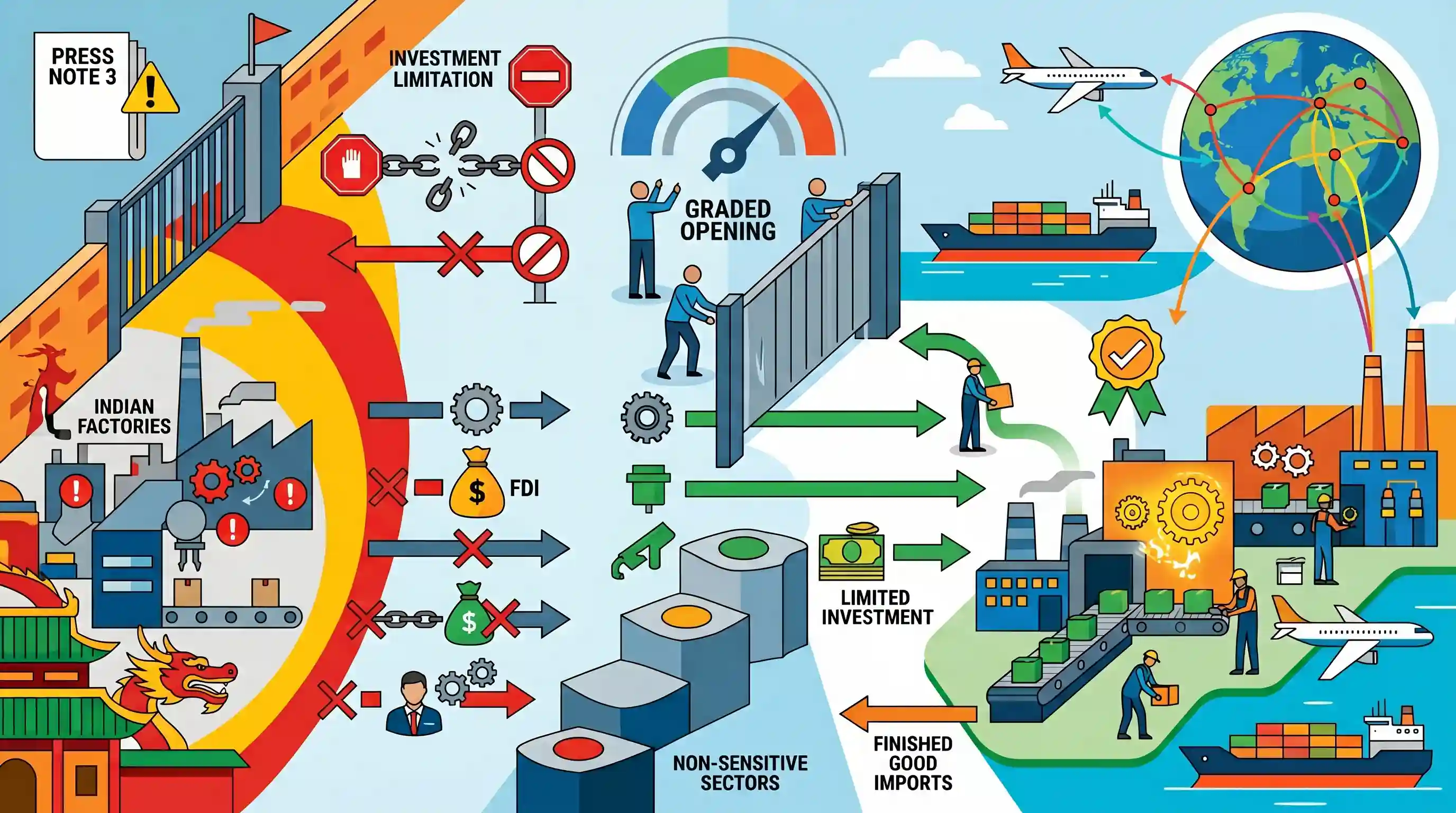
India is reportedly evaluating a graded opening of its economy to China by easing certain restrictions on trade, visas, and investments that were implemented after the 2020 Galwan border clash. The move comes as tight regulations, notably Press Note 3, have inadvertently hindered India's domestic manufacturing ambitions and Production Linked Incentive (PLI) schemes by blocking necessary Chinese components, capital, and technical expertise. The graded approach will likely focus on non-sensitive sectors, aiming to boost local manufacturing capabilities, reduce finished good import dependencies, and help India integrate more effectively into global supply chains.
Key Points
- India is considering a 'graded' or phased easing of economic restrictions imposed on China following the 2020 border clashes.
- The potential easing may include relaxing visa curbs on Chinese technicians and fast-tracking approvals for joint ventures in non-sensitive sectors.
- Strict FDI rules under Press Note 3 of 2020 (mandating prior approval for investments from border-sharing nations) caused bottlenecks in Indian manufacturing, specifically impacting the PLI scheme due to a lack of technical expertise and supply chain inputs.
- The strategic pivot aims to boost domestic manufacturing, attract foreign capital, and facilitate India's deeper integration into Global Value Chains (GVCs) by utilizing Chinese supply chain efficiencies.
Important Terms
Press Note 3 (2020)

A 2020 FDI policy amendment requiring prior government approval for investments from countries sharing a land border with India, primarily targeting Chinese capital to prevent opportunistic takeovers.
UPSC context
GS Papers II & III. Tests knowledge of economic security, investment curbs, and India-China bilateral relations.
Production Linked Incentive (PLI) Scheme
A central government initiative offering financial incentives to companies based on incremental sales from products manufactured in domestic units to boost manufacturing and reduce import dependency.
UPSC context
GS Paper III (Economy). Relates to industrial policy, manufacturing growth, and the Atmanirbhar Bharat initiative.
Department for Promotion of Industry and Internal Trade (DPIIT)
The nodal department under the Ministry of Commerce and Industry responsible for formulating industrial policy, facilitating FDI, and improving the Ease of Doing Business in India.
UPSC context
GS Paper III (Economy/Governance). Essential for understanding the executive machinery managing India’s trade landscape.
Foreign Direct Investment (FDI)
Investment made by an entity from one country into a business located in another, aiming to establish a lasting interest and management control.
UPSC context
GS Paper III (Economy). Tests concepts of capital inflows, investment routes, and economic growth drivers.
Beneficial Ownership
The ultimate person or entity that exercises control over an investment or legal entity, regardless of the intermediate jurisdictions used for the transaction.
UPSC context
GS Paper III (Security). Vital for understanding anti-money laundering (PMLA) rules and monitoring strategic capital flows.
Automatic Route
An FDI entry path where foreign investors do not require prior approval from the government or the Reserve Bank of India before investing in specific sectors.
UPSC context
GS Paper III (Economy). Tests understanding of investment liberalization and regulatory frameworks for foreign capital.
Prelims Trap
Press Note 3 (2020) prohibits all Foreign Direct Investment from countries sharing a land border with India.
It does not prohibit or ban FDI. It merely shifts investments from border-sharing nations from the automatic route to the government approval route to prevent opportunistic takeovers.
Static Concepts Connected
What are the two entry routes for Foreign Direct Investment (FDI) in India?
- Automatic Route: Does not require prior approval from the Government of India or RBI. This applies to most non-strategic sectors like agriculture and standard manufacturing.
- Government Route: Requires prior approval from the respective Ministry/Department via the Foreign Investment Facilitation Portal (FIFP). Mandatory for border-sharing nations under Press Note 3.
How do backward and forward linkages function in Global Value Chains (GVCs)?
- Backward Linkages: Importing foreign intermediate goods or raw materials to assemble or produce finished products domestically. India needs this efficiently from China to boost its manufacturing.
- Forward Linkages: Exporting domestically produced intermediate goods that are subsequently used in other countries' exports.
Cross-Topic Patterns
PLI targets vs. Component Dependency
India's PLI schemes heavily rely on imported active components. Immediate decoupling from China stalls domestic scale-up targets, highlighting the tension between Atmanirbhar Bharat and global manufacturing realities.
The paradox of China Plus One strategy
To benefit from the global "China Plus One" diversification trend, India paradoxically requires Chinese capital goods, JVs, and technical experts to build its initial factory capacity.

Press Note 3 nuances + PLI's backward linkage dependency will likely form a complex, multi-statement economy question in Prelims 2026.
Linked PYQs · 4
Linked PYQs · 4
- 2024MainsGS2
‘The West is fostering India as an alternative to reduce dependence on China's supply chain and as a strategic ally to counter China's political and economic dominance.’ Explain this statement with examples.
- 2025MainsGS3
Discuss the rationale of the Production Linked Incentive (PLI) scheme. What are its achievements? In what way can the functioning and outcomes of the scheme be improved?
- 2016MainsGS3
Justify the need for FDI for the development of the Indian economy. Why there is gap between MOUs signed and actual FDIs? Suggest remedial steps to be taken for increasing actual FDIs in India.
- 2020PrelimsGS1
With reference to Foreign Direct Investment in India, which one of the following is considered its major characteristic?
