Ministry of Ayush Launches Specialized Yoga Protocols for NCDs
Source:The Hindu ↗
Why It Matters
Integrating traditional practices like Yoga into standardized medical protocols demonstrates a low-cost, preventive approach to public health. This is highly relevant for GS-2 questions evaluating strategies to enhance the reach of India's primary healthcare network and tackle the epidemic of lifestyle diseases.
Summary
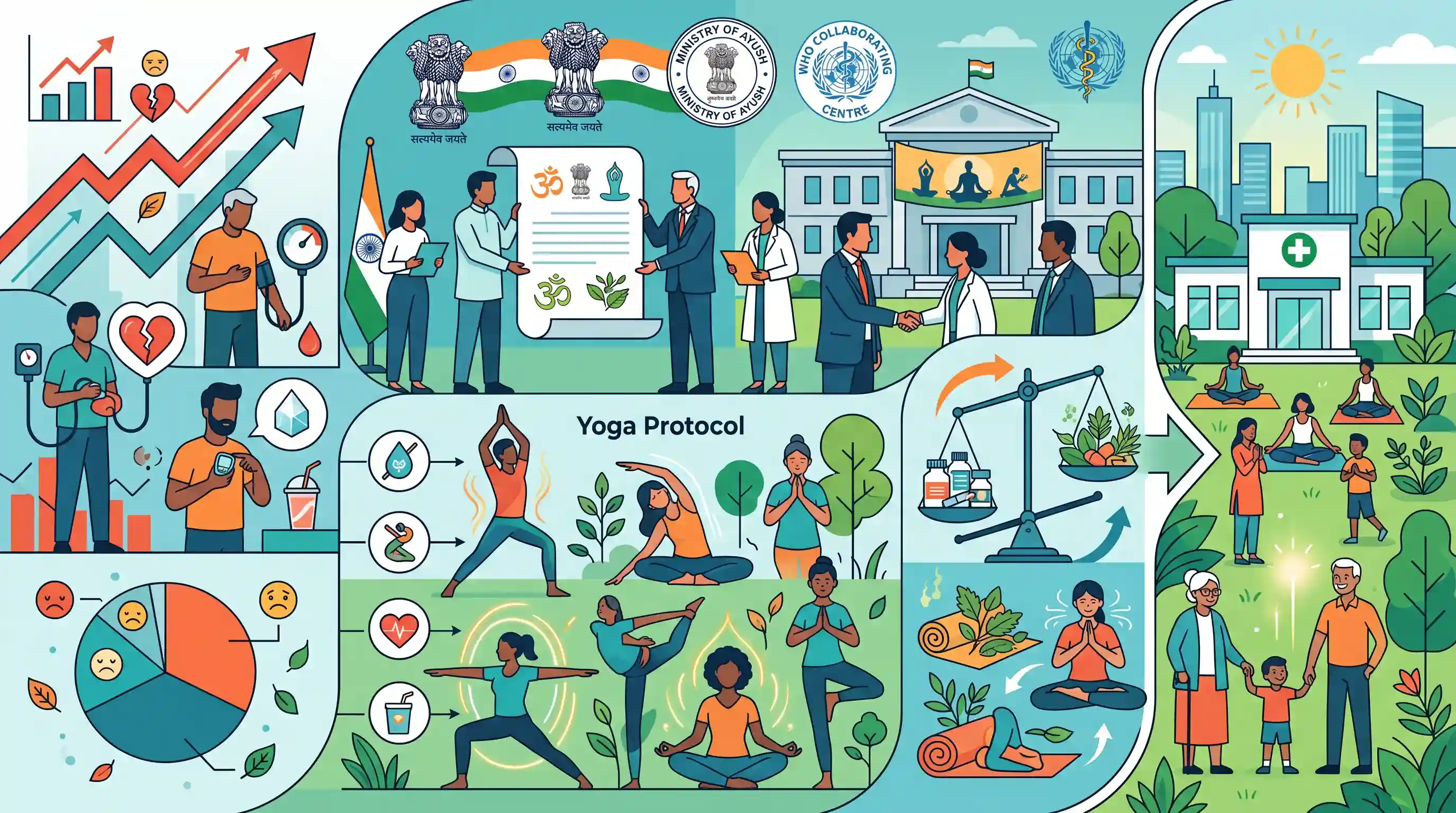
The Union Ministry of Ayush has introduced a new 'Yoga Protocol for Non-Communicable Diseases (NCDs) and Target Groups' to combat the rising incidence of lifestyle diseases in India. Developed in collaboration with the WHO Collaborating Centre for Traditional Medicine (Yoga) at the Morarji Desai National Institute of Yoga, the protocol provides specialized yoga routines for managing conditions like diabetes, hypertension, and cardiovascular ailments, which account for nearly two-thirds of deaths in the country. The initiative underscores a shift from curative to preventive healthcare, promoting the integration of traditional medicine (AYUSH) into mainstream public health strategies to improve grassroots healthcare reach and manage India's disease burden effectively.
Key Points
- The Union Ministry of Ayush has launched a comprehensive 'Yoga Protocol for Non-Communicable Diseases (NCDs) and Target Groups'.
- The protocol was developed by the WHO Collaborating Centre for Traditional Medicine (Yoga) at the Morarji Desai National Institute of Yoga.
- It targets major non-communicable diseases (NCDs) such as diabetes, hypertension, cardiovascular ailments, respiratory conditions, and mental health disorders, which are responsible for nearly 66% of all deaths in India.
- The initiative marks a strategic shift towards preventive healthcare by offering tailored yoga routines for specific demographics, including children, the elderly, and pregnant women.
- By integrating traditional systems of medicine into public health strategies, the government aims to reduce the massive burden on India's curative and tertiary healthcare infrastructure.
Important Terms
Yoga Protocol for Non-Communicable Diseases (NCDs) and Target Groups

A standardized set of evidence-based yoga routines launched in 2026 to manage lifestyle diseases (diabetes, hypertension). It includes lifecycle-oriented modules for children, women, and the elderly to enhance preventive healthcare.
UPSC context
GS2: Health/Social Justice. Tests understanding of preventive healthcare strategies and the epidemiological shift towards lifestyle diseases in India.
Union Ministry of Ayush
The nodal central ministry responsible for the development, education, and research of traditional medicine systems, including Ayurveda, Yoga, Naturopathy, Unani, Siddha, and Homeopathy, aimed at holistic health.
UPSC context
GS2: Government Policies. Relevant for questions on healthcare infrastructure and the integration of traditional medicine into the National Health Mission.
World Health Organization (WHO) Collaborating Centre for Traditional Medicine (Yoga)
A designation for MDNIY (2025-2029) as a global hub for evidence-based yoga research. It supports WHO in creating international standards and clinical guidelines for traditional medicine.
UPSC context
GS2: International Institutions. Highlights India's leadership in global health diplomacy and the scientific validation of traditional practices.
Morarji Desai National Institute of Yoga (MDNIY)
An autonomous nodal agency under the Ministry of Ayush responsible for planning and coordinating yoga education, training, and research. It develops standardized protocols for public health interventions.
UPSC context
GS2: Institutional Framework. Important for understanding the role of specialized institutes in achieving public health goals and wellness.
Prelims Trap
The WHO Global Centre for Traditional Medicine is located at the Morarji Desai National Institute of Yoga in New Delhi.
MDNIY in Delhi is a WHO Collaborating Centre. The WHO Global Centre for Traditional Medicine (WHO GCTM)—the UN outpost—is located in Jamnagar, Gujarat.
Static Concepts Connected
What is India's Epidemiological Transition?
- Definition: The shift in disease burden from communicable, maternal, and nutritional diseases to Non-Communicable Diseases (NCDs).
- Current Burden: NCDs, including cardiovascular ailments, diabetes, and cancer, now account for roughly 66% of all deaths in India.
- Key Drivers: Rapid urbanization, sedentary lifestyles, dietary changes, and increasing life expectancy are the primary catalysts.
How does the National Health Policy (NHP) 2017 integrate AYUSH?
- Pluralistic Approach: NHP 2017 mandates a pluralistic healthcare system, encouraging cross-referrals between conventional allopathy and AYUSH systems.
- Preventive Focus: It strongly emphasizes utilizing Yoga and Ayurveda for preventive and promotive healthcare, specifically targeting lifestyle diseases.
- Infrastructure Co-location: The policy encourages co-locating AYUSH facilities within existing Primary Health Centres (PHCs) and district hospitals.
Cross-Topic Patterns
AYUSH Integration & SDG 3.4
Yoga protocols for NCDs directly align with Sustainable Development Goal (SDG) 3.4, which aims to reduce premature mortality from non-communicable diseases by one-third by 2030 through prevention and treatment.
Soft Power & Health Diplomacy
The WHO partnership elevates Yoga from a domestic health initiative to a global standard-setting framework, reinforcing India's cultural diplomacy and soft power expansion.

Expect a multi-statement Prelims question pairing India's NCD mortality burden (>60%) with the exact locations of WHO AYUSH centers.
Linked PYQs · 3
Linked PYQs · 3
- 2024MainsGS2
In a crucial domain like the public healthcare system the Indian State should play a vital role to contain the adverse impact of marketisation of the system. Suggest some measures through which the State can enhance the reach of public healthcare at the grassroots level.
- 2021MainsGS2
“Besides being a moral imperative of a Welfare State, primary health structure is a necessary precondition for sustainable development.” Analyze.
- 2020MainsGS2
In order to enhance the prospects of social development, sound and adequate health care policies are needed particularly in the fields of geriatric and maternal health care. Discuss.
