Business visa framework for Chinese technical experts
Source:The Hindu ↗
Why It Matters
This development is highly relevant for GS Paper 2 (Bilateral Relations) and GS Paper 3 (Economy). It highlights the delicate balance India must maintain between national security concerns arising from border disputes and the economic necessity of engaging with Chinese technical expertise to bolster domestic manufacturing and FDI.
Summary
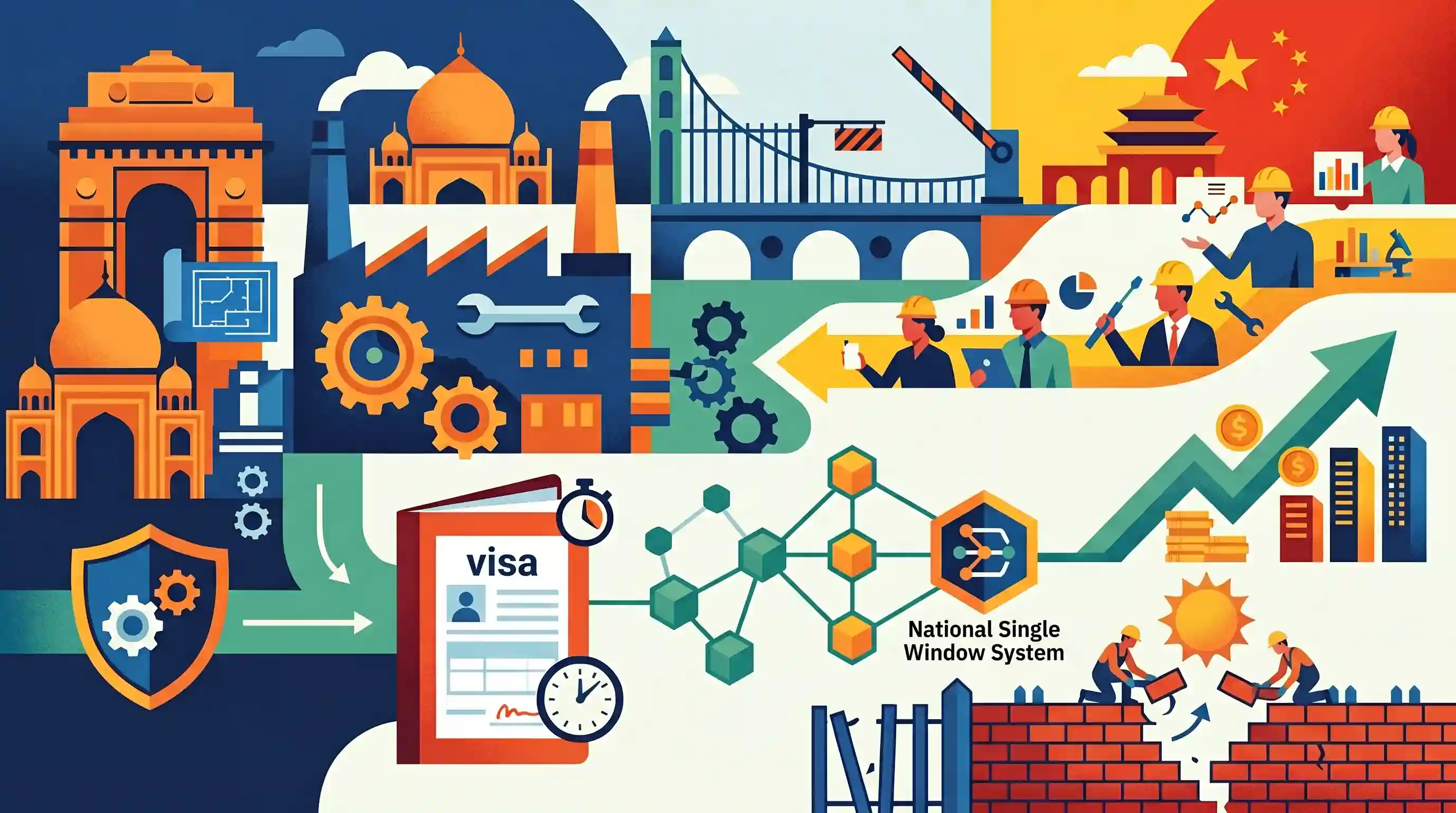
India has launched a new e-Business visa category, known as the e-B-4 Visa or e-Production Investment Business Visa, exclusively for Chinese nationals. The policy allows Indian firms to sponsor Chinese experts for up to six months for critical industrial tasks such as equipment installation, maintenance, and supply chain development. Applications are routed through the Department for Promotion of Industry and Internal Trade's (DPIIT) National Single Window System. This move signals a calibrated thaw in India-China economic relations post the 2020 border clashes, prioritizing domestic manufacturing growth, foreign direct investment (FDI), and the mitigation of supply chain bottlenecks while maintaining oversight.
Key Points
- India has introduced a new e-Business visa (e-B-4 Visa) specifically for Chinese nationals to ease the entry of technical and business professionals.
- The visa allows Indian companies to invite Chinese experts for tasks such as equipment installation, maintenance, quality checks, ERP ramp-up, and supply chain development.
- Processing time for the visa is set at 45 to 50 days, allowing a maximum stay of six months.
- Indian sponsor companies must apply via the DPIIT's National Single Window System (NSWS) prior to individual visa portal submission.
- This step indicates a strategic easing of the strict curbs placed on Chinese businesses following the 2020 border clashes, aimed at boosting India's manufacturing capabilities and FDI inflows.
Important Terms
e-B-4 Visa (e-Production Investment Business Visa)

A specialized e-visa sub-category for Chinese nationals to facilitate technical tasks like equipment installation, maintenance, and supply chain development in Indian industrial units.
UPSC context
GS II (India-China Relations) & GS III (Manufacturing); tests understanding of economic diplomacy and industrial bottlenecks.
National Single Window System (NSWS)
A unified digital platform providing a 'one-stop shop' for investors to identify and apply for all required central and state-level business clearances.
UPSC context
GS III (Indian Economy); focuses on "Ease of Doing Business" and administrative reforms in industrial development.
Department for Promotion of Industry and Internal Trade (DPIIT)
The nodal department under the Ministry of Commerce and Industry responsible for industrial policy, FDI regulations, and promoting internal trade and investment.
UPSC context
GS III (Economy); core executive body for industrial growth, startups, and intellectual property rights.
Press Note 3 (2020)
A 2020 regulation requiring mandatory government approval for FDI from countries sharing a land border with India, primarily targeting strategic oversight of Chinese investments.
UPSC context
GS II & III; crucial for understanding security-linked economic policies and post-Galwan trade restrictions.
Production Linked Incentive (PLI) Scheme
A central scheme offering financial incentives to manufacturers based on incremental production, designed to boost domestic manufacturing and reduce import dependencies.
UPSC context
GS III (Economy); a flagship initiative for 'Atmanirbhar Bharat' and global supply chain integration.
Prelims Trap
"The e-B-4 visa is a general category for all foreign technicians and is processed solely through the Ministry of External Affairs."
The e-B-4 visa is exclusively for Chinese nationals, not all foreigners. Furthermore, sponsorship requires prior clearance routed through DPIIT's National Single Window System (NSWS).
Static Concepts Connected
What are the FDI rules for countries sharing a land border with India?
- Prior Approval: Entities from countries sharing a land border must obtain mandatory government approval before investing in India, regardless of the sector.
- Beneficial Ownership: The rule strictly applies even if the ultimate beneficial owner of the investment is situated in or is a citizen of such a bordering country.
- Press Note 3: Introduced via Press Note 3 in 2020 to prevent opportunistic takeovers of Indian firms by Chinese entities during the COVID-19 pandemic.
What is the National Single Window System (NSWS) and who administers it?
- Digital Platform: Acts as a one-stop digital point of clearance for investors to obtain central and state-level business approvals and registrations.
- Nodal Agency: It is spearheaded and managed by the Department for Promotion of Industry and Internal Trade (DPIIT) under the Ministry of Commerce.
Cross-Topic Patterns
PLI Bottlenecks & Foreign Tech Transfers
India's ambitious Production Linked Incentive (PLI) schemes heavily rely on timely plant commissioning. Delays in getting Chinese technical staff hampered this technology transfer, forcing an economic visa policy recalibration.
Decoupling vs. De-risking Strategy
This signals a shift from post-Galwan absolute "decoupling" to a pragmatic "de-risking" approach, balancing national security with a structural reliance on Chinese capital goods and expertise to scale domestic output.

Expect a multi-statement question linking PLI scheme bottlenecks, Press Note 3 (2020) border rules, and the new e-B-4 visa for Chinese technicians.
Linked PYQs · 3
Linked PYQs · 3
- 2024MainsGS2
‘The West is fostering India as an alternative to reduce dependence on China's supply chain and as a strategic ally to counter China's political and economic dominance.’ Explain this statement with examples.
- 2014MainsGS2
With respect to the South China sea, maritime territorial disputes and rising tension affirm the need for safeguarding maritime security to ensure freedom of navigation and over flight throughout the region. In this context, discuss the bilateral issues between India and China.
- 2016MainsGS3
Justify the need for FDI for the development of the Indian economy. Why there is gap between MOUs signed and actual FDIs? Suggest remedial steps to be taken for increasing actual FDIs in India.
