Parakram Diwas Celebrated with Focus on Defence Indigenisation
Source:The Hindu ↗
Why It Matters
The article provides a multidimensional perspective useful for UPSC, linking the historical contributions of Netaji Subhas Chandra Bose (GS1) with modern defence indigenization, exports, and self-reliance (GS3), as well as the geographical and strategic significance of the Andaman and Nicobar Islands (Prelims/GS1).
Summary
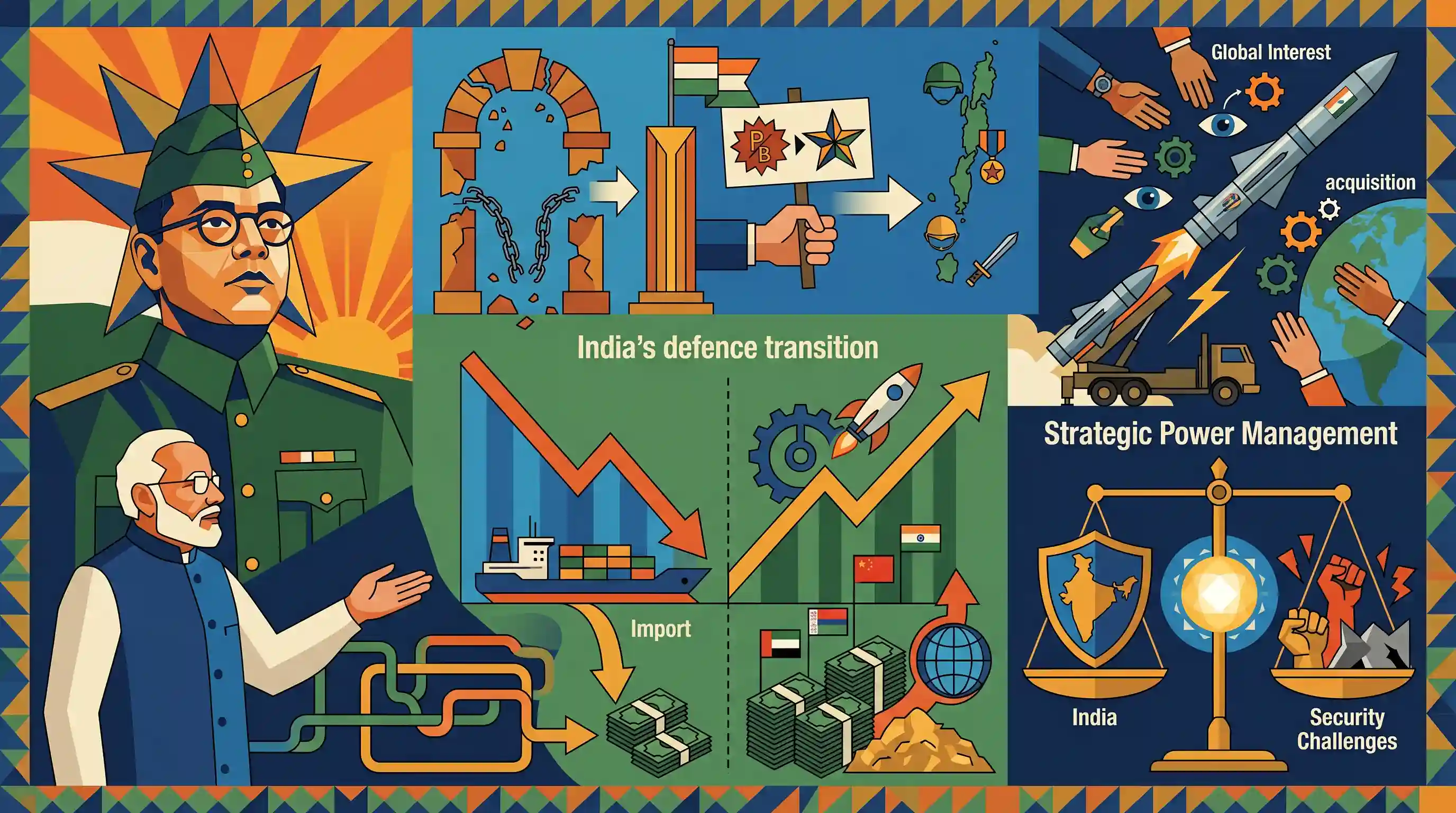
On the occasion of Parakram Diwas, marking Netaji Subhas Chandra Bose’s birth anniversary, PM Modi emphasized India's strategic autonomy, responsible power management, and growing defence self-reliance. He highlighted India's transition from a defence importer to an exporter, citing ₹23,000 crore in defence exports and global interest in the BrahMos missile. Furthermore, the PM highlighted the ongoing effort to decolonize Indian history, pointing to the renaming of Port Blair to Shri Vijaypuram and other Andaman islands to honor Netaji and India's military heroes.
Key Points
- Parakram Diwas is celebrated to commemorate the birth anniversary of Netaji Subhas Chandra Bose.
- PM Modi highlighted India's responsible management of power, referencing cross-border retaliatory actions like 'Operation Sindoor'.
- India's defence sector is advancing toward self-reliance (Aatmanirbharta), with defence exports crossing ₹23,000 crore and indigenous systems like BrahMos gaining global demand.
- To erase colonial legacy, islands in the Andaman and Nicobar archipelago have been renamed, including Port Blair to 'Shri Vijaypuram', alongside the naming of 21 islands after Param Vir Chakra awardees.
Important Terms
Parakram Diwas

Celebrated annually on January 23 to commemorate Netaji Subhas Chandra Bose’s birth anniversary, honoring his indomitable spirit and contribution to India's freedom struggle.
UPSC context
GS Paper I: Modern Indian History (Freedom Struggle) and GS Paper II: Governance (Important Days).
BrahMos missile
A supersonic cruise missile developed as a joint venture between India (DRDO) and Russia (NPO Mashinostroyeniya), capable of being launched from land, sea, and air.
UPSC context
GS Paper III: Science and Technology (Indigenization) and Security Challenges.
Operation Sindoor
A tri-service military response conducted in May 2025 following a major terror attack in Pahalgam, showcasing India’s shift toward 'offensive-defense' and indigenous precision strike capabilities.
UPSC context
GS Paper III: Security Challenges and their Management on Borders.
Param Vir Chakra
India's highest wartime gallantry award for most conspicuous bravery. In 2023, 21 unnamed islands in Andaman & Nicobar were named after its recipients to honor their sacrifice.
UPSC context
GS Paper I: Post-Independence India and GS Paper III: Security Forces and their Mandate.
Shri Vijaypuram
The newly announced name for Port Blair, intended to remove colonial imprints and honor the historical naval influence of the Chola Empire and India’s freedom struggle.
UPSC context
GS Paper I: Modern Indian History and GS Paper II: Governance.
Strategic Autonomy
A doctrine of sovereign decision-making in foreign policy and defense, allowing India to engage with multiple global powers based on national interest without formal alliance obligations.
UPSC context
GS Paper II: International Relations (Effect of policies of developed and developing countries on India’s interests).
Prelims Trap
BrahMos is a 100% indigenous supersonic cruise missile.
BrahMos is a joint venture between India (DRDO) and Russia (NPOM). While a poster child for defense exports, it is not entirely indigenous.
Static Concepts Connected
What was the significance of the Andamans for the Azad Hind Government?
- Japanese Handover: The islands were captured by Japan during WWII and formally handed over to Netaji's Provisional Government of Free India in 1943.
- Shaheed and Swaraj: Netaji hoisted the tricolor at Port Blair on Dec 30, 1943, and notably renamed the Andaman islands as 'Shaheed' and Nicobar as 'Swaraj' Dweep.
How did the Chola Dynasty interact with the Srivijaya Empire?
- Trade Route Competition: Srivijaya (modern Indonesia/Malaysia) controlled the Malacca Strait, creating friction with the Cholas over lucrative maritime trade routes to China.
- Rajendra I's Expedition: In 1025 CE, Chola emperor Rajendra I launched a highly successful naval expedition against Srivijaya to break its monopoly and secure Southeast Asian trade for Indian merchants.
Cross-Topic Patterns
Decolonization + Ancient Maritime History
Renaming Port Blair to Shri Vijaypuram links modern anti-colonial initiatives directly to India's historical maritime dominance under the Cholas and their interaction with the Srivijaya Empire.
Tech self-reliance + Indo-Pacific Diplomacy
Defence indigenization (like BrahMos exports to the Philippines) transitions India from a net security consumer to a provider in the Indo-Pacific, establishing strategic leverage against regional adversaries.
Operation Sindoor + Non-contact Warfare
The shift to tech-driven, cross-border drone strikes ('Operation Sindoor') links internal security doctrines to emerging disruptive technologies (EDTs) and 'non-contact' warfare in modern military strategy.

Expect a multi-statement Prelims question linking Netaji's INA activities in the Andamans with recent geographical renaming in 2026.
Linked PYQs · 4
Linked PYQs · 4
- 2016MainsGS1
Highlight the differences in the approach of Subhash Chandra Bose and Mahatma Gandhi in the struggle for freedom.
- 2014MainsGS3
Foreign Direct Investment (FDI) in the defence sector is now set to be liberalized. What influence this is expected to have on Indian defence and economy in the short and long run?
- 2014PrelimsGS1
Which one of the following pairs of islands is separated from each other by the "Ten Degree Channel?"
- 2017PrelimsGS1
Which of the following is geographically closest to Great Nicobar?
