Evolution of India Japan Strategic Partnership and Indo Pacific Ties
Source:The Hindu ↗
Why It Matters
Evaluates the transformation of the India-Japan strategic partnership towards emerging technologies and maritime security, providing essential context for questions regarding the Indo-Pacific architecture, the Quad, and supply chain resilience.
Summary
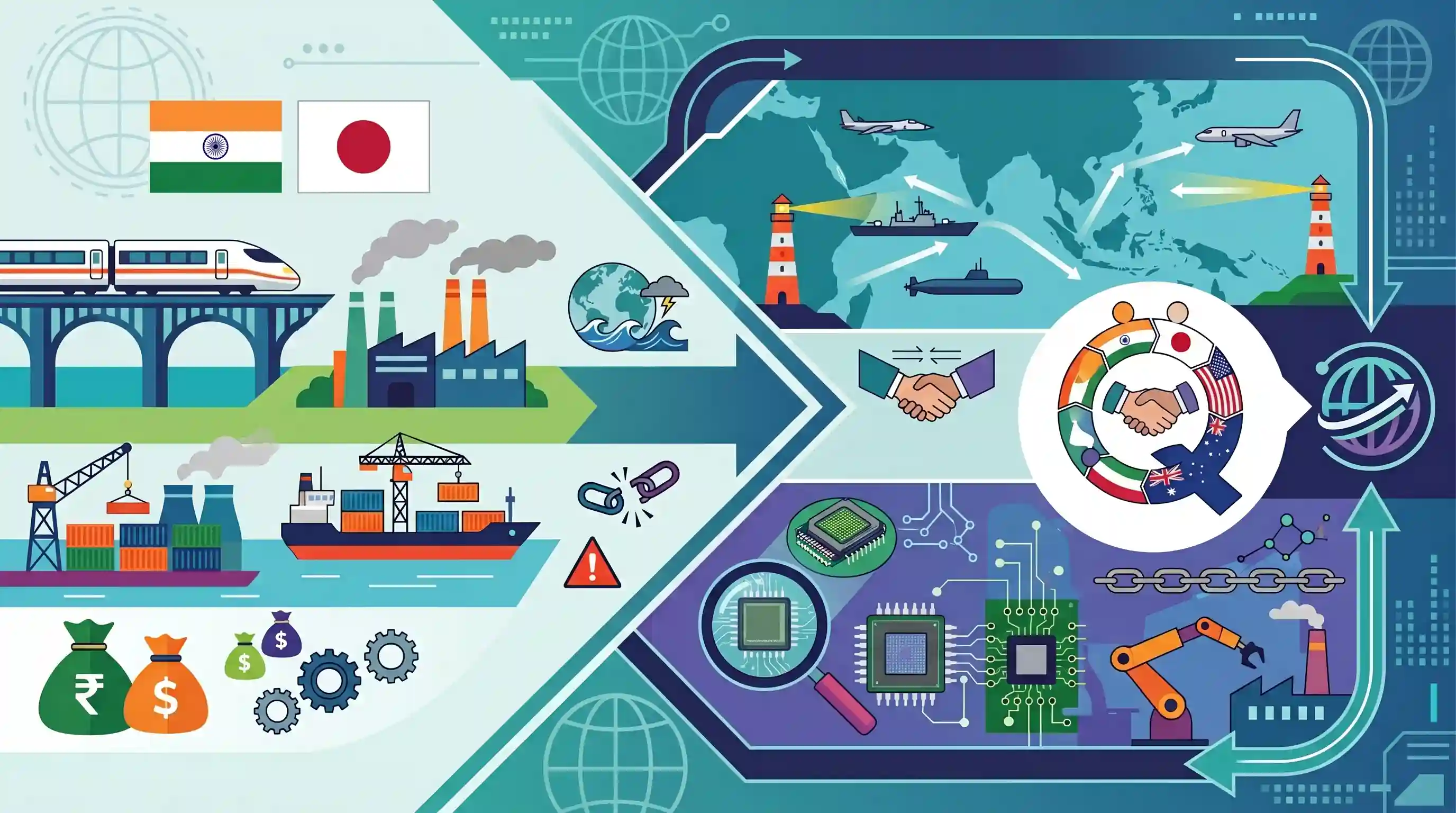
The article analyzes the evolving landscape of India-Japan relations, highlighting a strategic shift from traditional economic and infrastructural cooperation towards new priorities. Key contemporary focus areas include securing a Free and Open Indo-Pacific, enhancing maritime security, and building resilient supply chains in critical technologies such as semiconductors. Driven by shared concerns over regional stability and supply chain vulnerabilities, both nations are leveraging bilateral mechanisms and minilateral platforms like the Quad to modernize their Special Strategic and Global Partnership.
Key Points
- India-Japan bilateral relations are evolving from traditional developmental and economic ties to strategic alignments in contemporary domains.
- The partnership increasingly focuses on the Free and Open Indo-Pacific (FOIP) vision, emphasizing maritime security and regional stability.
- Cooperation in critical and emerging technologies, including semiconductor supply chain resilience and clean energy transitions, forms a vital new pillar of engagement.
- Multilateral frameworks such as the Quad enhance the strategic depth of their ties, allowing both nations to address shared geopolitical vulnerabilities and maintain a rules-based international order.
Important Terms
Special Strategic and Global Partnership

The upgraded status of India-Japan relations established in 2014, expanding cooperation into deep defense, high-tech, and strategic sectors to address regional challenges and ensure global stability.
UPSC context
GS Paper-II (International Relations); tests knowledge of major bilateral milestones and strategic shifts under India's Act East policy.
Comprehensive Economic Partnership Agreement (CEPA)
A broad-based bilateral trade agreement (effective 2011) that goes beyond traditional FTAs to cover trade in goods, services, investments, intellectual property, and regulatory cooperation.
UPSC context
GS Paper-II & III; relevant for India’s trade architecture, economic diplomacy, and bilateral trade volume analysis.
Free and Open Indo-Pacific (FOIP)
A strategic vision pioneered by Japan advocating for a rules-based maritime order, freedom of navigation, and inclusive regional development, largely to balance growing regional assertiveness.
UPSC context
GS Paper-II (International Relations); essential for discussing maritime security, regional stability, and Indo-Pacific geopolitics.
Quad (Quadrilateral Security Dialogue)
An informal strategic forum comprising India, Japan, Australia, and the US, focused on ensuring a free, open, and inclusive Indo-Pacific through cooperation on security, climate, and technology.
UPSC context
GS Paper-II (International Relations); critical for topics on minilateralism, global groupings, and regional power balancing.
ASEAN Centrality
The diplomatic principle that the Association of Southeast Asian Nations (ASEAN) must remain the primary institutional driver and focal point for the Indo-Pacific's security and economic architecture.
UPSC context
GS Paper-II (International Relations); significant for questions on regional architecture and India’s approach to inclusive regional diplomacy.
Prelims Trap
"The Supply Chain Resilience Initiative (SCRI) is a flagship trade initiative of the Quad."
SCRI is often mistaken for a Quad initiative. It is actually a trilateral framework (India, Japan, Australia) launched to reduce reliance on China, excluding the US.
Static Concepts Connected
What is India's Indo-Pacific Oceans Initiative (IPOI)?
- Origin: Proposed by India at the 2019 East Asia Summit, it serves as an open global initiative.
- Seven Pillars: Built on seven pillars including Maritime Security, Marine Ecology, and Capacity Building.
- Open Architecture: Unlike closed alliances, IPOI allows countries to lead specific pillars; Japan leads the Connectivity pillar.
How does a CEPA differ from standard Free Trade Agreements (FTAs)?
- Broader Scope: While traditional FTAs primarily restrict themselves to reducing tariffs on goods, a CEPA goes further.
- Inclusions: Includes trade in services, investments, competition, and intellectual property rights (IPR).
- India-Japan CEPA: India and Japan operationalized their Comprehensive Economic Partnership Agreement (CEPA) in 2011.
Cross-Topic Patterns
Semiconductor diplomacy (S&T + IR)
India's domestic Semiconductor Mission relies on global frameworks (like the Japan MoC and US iCET) to bypass deep-tech IP monopolies and secure critical fab equipment.
Minilaterals replacing Multilaterals
The shift from broad ASEAN-led multilaterals to issue-specific minilaterals (Quad, SCRI) reflects a targeted, pragmatic approach to bypass consensus bottlenecks on Chinese containment.

Expect a 2026 Prelims multi-statement question mapping Indo-Pacific initiatives (IPOI, FOIP, SCRI) to exact member states.
Linked PYQs · 3
Linked PYQs · 3
- 2019MainsGS2
‘The time has come for India and Japan to build a strong contemporary relationship, one involving global and strategic partnership that will have a great significance for Asia and the world as a whole.’ Comment.
- 2021MainsGS2
The newly tri-nation partnership AUKUS is aimed at countering China's ambitions in the Indo-Pacific region. Is it going to supersede the existing partnerships in the region? Discuss the strength and impact of AUKUS in the present scenario.
- 2020MainsGS2
What is the significance of Indo-US defence deals over Indo-Russian defence deals? Discuss with reference to stability in the Indo-Pacific region.
