Strategic significance of India Japan partnership in Indo Pacific
Source:The Hindu ↗
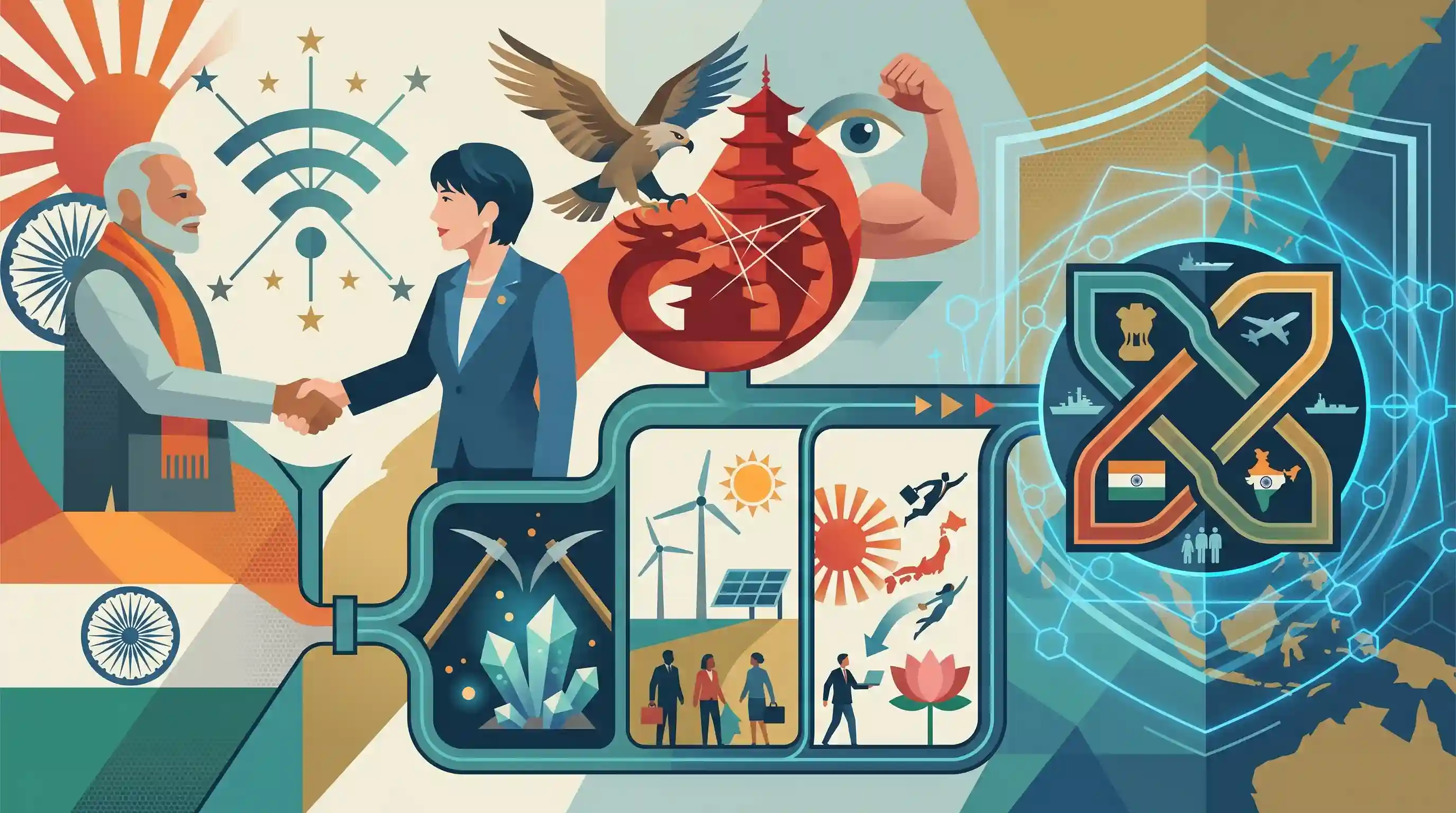
Why It Matters
Leadership transitions in key partner nations directly impact India's strategic calculations. Japan's internal political shifts, particularly towards a more hawkish foreign policy and militaristic posture, will critically shape the trajectory of the Quad, Indo-Pacific maritime security, and India's economic security partnerships (e.g., semiconductor supply chains and critical minerals).
Summary
Prime Minister Narendra Modi extended his congratulations to Sanae Takaichi, newly elected as Japan's first female Prime Minister, highlighting the significance of the India-Japan 'Special Strategic and Global Partnership' for Indo-Pacific stability. Takaichi, a close associate of the late Shinzo Abe, is known for her assertive foreign policy and hawkish stance on China. Her election comes as India and Japan expand their strategic framework beyond traditional defence to include an 'Economic Security Partnership' covering critical minerals, clean energy, and human resource mobility. Takaichi's leadership is expected to influence the strategic direction of the Quad and broader security architecture in the Indo-Pacific region.
Key Points
- PM Modi congratulated Sanae Takaichi on becoming Japan's first female Prime Minister, underscoring the India-Japan Special Strategic and Global Partnership.
- Both nations emphasized that their bilateral ties are pivotal for peace, security, and prosperity in the Indo-Pacific region.
- The leadership change follows recent milestones like the 2+2 ministerial meeting in Delhi and the signing of the 'Economic Security Partnership' focusing on critical minerals, clean energy, and human resource mobility.
- Takaichi's hawkish stance on China and militaristic foreign policy, echoing late PM Shinzo Abe's vision, could significantly influence future Quad dynamics and regional geopolitics.
Important Terms
Special Strategic and Global Partnership

A high-level bilateral framework (upgraded in 2014) encompassing defense, high-quality infrastructure (e.g., Bullet Train), and strategic alignment to ensure a stable, rules-based Indo-Pacific region.
UPSC context
GS-II: Bilateral relations. Vital for analyzing India's deepest strategic bond in Asia and maritime security cooperation.
Quad (Quadrilateral Security Dialogue)
An informal strategic forum of India, USA, Japan, and Australia dedicated to a "Free and Open Indo-Pacific," focusing on maritime security, climate action, and technology standards.
UPSC context
GS-II: Global groupings. Key for questions on multilateral diplomacy and balancing regional power dynamics.
Economic Security Partnership
A strategic framework prioritizing supply chain resilience, critical minerals (rare earths), semiconductors, and clean energy to "de-risk" economies and secure essential technological infrastructure.
UPSC context
GS-II/III: IR and Economy. Tests knowledge of contemporary de-risking strategies and critical technology diplomacy.
Indo-Pacific
A unified geopolitical and maritime space stretching from the east coast of Africa to the Pacific, serving as the epicenter of global trade and strategic competition.
UPSC context
GS-II: Regional geography/International Relations. The core geographical framework for India’s "Act East" and maritime policies.
Supply Chain Resilience Initiative (SCRI)
A trilateral initiative (India, Japan, Australia) launched to diversify global value chains and reduce over-dependence on single sources, specifically aimed at mitigating disruptions from China.
UPSC context
GS-II/III: International trade and security. Relevant for manufacturing resilience and trade diversification strategies.
Prelims Trap
India shares a 'Special Strategic and Global Partnership' with Russia and the United States.
UPSC frequently tests exact bilateral nomenclature. Russia holds a 'Special and Privileged Strategic Partnership', whereas Japan uniquely holds the 'Special Strategic and Global Partnership'.
Static Concepts Connected
What is the 2+2 Ministerial Dialogue framework?
- Structure: A joint meeting of Foreign and Defence Ministers from two countries to align diplomatic, strategic, and military policies.
- India's Partners: India currently holds this apex ministerial-level dialogue with all Quad members (Japan, US, Australia), as well as Russia and the UK.
How did the 'Free and Open Indo-Pacific' (FOIP) concept originate?
- Abe's Vision: Conceptualized by late Japanese PM Shinzo Abe in 2007 during his "Confluence of the Two Seas" speech to the Indian Parliament.
- Core Objective: It aims to ensure a rule-based maritime order, freedom of navigation, and secure supply chains, providing a democratic alternative to China's hegemony.
Cross-Topic Patterns
Critical minerals + Strategic partnerships
The 'Economic Security Partnership' links IR with economic geography. Expect questions pairing strategic alliances with rare earth supply chain resilience against Chinese export curbs.
Constitutional pacifism + Indo-Pacific security
Japan's pivot away from its post-WWII pacifist constitution directly enables its defense technology transfers to India, altering the Quad's regional military weight.

Expect a 2026 multi-statement question mapping India's specific strategic pacts (like Economic Security) to respective Quad nations.
Linked PYQs · 3
Linked PYQs · 3
- 2019MainsGS2
‘The time has come for India and Japan to build a strong contemporary relationship, one involving global and strategic partnership that will have a great significance for Asia and the world as a whole.’ Comment.
- 2014MainsGS2
With respect to the South China sea, maritime territorial disputes and rising tension affirm the need for safeguarding maritime security to ensure freedom of navigation and over flight throughout the region. In this context, discuss the bilateral issues between India and China.
- 2020MainsGS2
What is the significance of Indo-US defence deals over Indo-Russian defence deals? Discuss with reference to stability in the Indo-Pacific region.
