India Japan Strategic Summit Focuses on Defense and Economic Security
Source:Indian Express ↗
Why It Matters
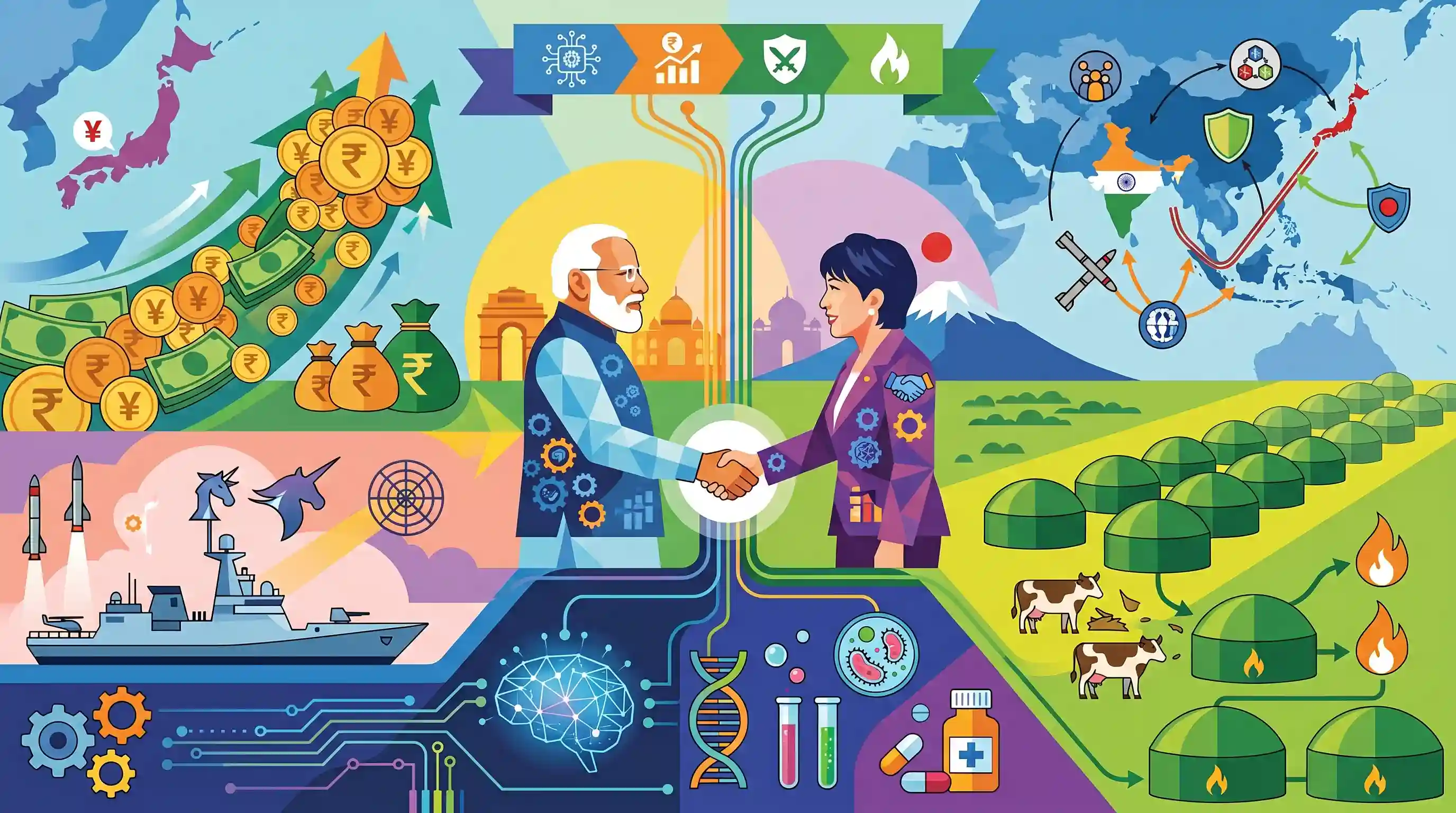
This summit marks a critical evolution in India-Japan ties from traditional infrastructure financing and joint military exercises to deep co-development in high-tech defense systems (like the 'Unicorn' antenna), semiconductor supply chains, AI, and biotechnology. It shows how the two nations are integrating economic security, renewable energy (Biogas Initiative), and defense to build a resilient, multi-dimensional partnership in the Indo-Pacific region.
Summary
At the 16th India-Japan Annual Summit in New Delhi, PM Narendra Modi and Japanese PM Sanae Takaichi established a comprehensive roadmap for economic security, defense co-development, and technology. Underlining bilateral trust as a critical strategic asset, Japan announced a 10 trillion yen investment over the next decade. Landmark pacts were signed to co-develop the Naval Radio Antenna 'Unicorn', issue a joint statement on AI, partner in biotechnology and pharmaceuticals, and launch the India-Japan Biogas Initiative to establish 1,000 biogas plants in India.
Key Points
- 16th India-Japan Annual Summit: PM Narendra Modi and Japanese PM Sanae Takaichi held talks positioning economic security and energy security as the central pillars of the bilateral strategic partnership.
- Investment and Trade: Japan committed to investing 10 trillion yen in India over the next 10 years and announced plans to double the number of Japanese companies operating in India.
- Defense Technology Pact: The two countries signed their first defense co-development agreement, launching with the Naval Radio Antenna 'Unicorn' project to bolster maritime security and regional stability.
- Technology and AI Cooperation: Issued a joint statement on Artificial Intelligence (AI), aiming to merge Japan's precision technology with India's software capabilities to advance global AI development.
- Healthcare and Clean Energy Pacts: Agreed to bolster global health security via partnerships in pharmaceuticals, medical devices, and biotechnology. Under the new 'India-Japan Biogas Initiative', 1,000 biogas and organic fertilizer plants will be set up in India.
Important Terms
16th India-Japan Annual Summit

A July 2026 bilateral meeting in New Delhi between Prime Ministers Narendra Modi and Sanae Takaichi, formalizing pacts on economic security, clean energy, and launching their first defense co-development project.
UPSC context
GS Paper II: Bilateral relations involving India; tests bilateral cooperation and diplomatic strategies in the Indo-Pacific.
India-Japan Biogas Initiative
A clean energy partnership launched in 2026 to set up 1,000 biogas plants in India, utilizing rural biomass to boost rural livelihoods, energy security, and expand the market for CNG vehicles.
UPSC context
GS Paper III: Sustainable development and energy infrastructure; tests bilateral clean energy initiatives and rural developmental growth.
Naval Radio Antenna UNICORN
An advanced Japanese-designed unified communication mast (NORA-50) co-developed with India. It integrates multiple antennas inside a single low-signature dome, significantly enhancing naval warship stealth and communication security.
UPSC context
GS Paper III: Security, defense technology, and indigenization; tests technical defense partnerships and indigenous manufacturing under 'Make in India'.
Sanae Takaichi
The first female Prime Minister of Japan (elected October 2025). Her 2026 visit to India marked her first official state visit, resulting in key defense, economic security, and technology-sharing pacts.
UPSC context
GS Paper II: Effect of policies and politics of developed countries on India's interests; tests foreign leadership dynamics and bilateral alignment.
Special Strategic and Global Partnership
The comprehensive diplomatic and economic framework governing India-Japan relations, emphasizing maritime security, regional stability, technological co-development, and a Free and Open Indo-Pacific.
UPSC context
GS Paper II: Bilateral agreements involving India; tests strategic alignments and geopolitics in the Indo-Pacific region.
Prelims Trap
The UNICORN initiative under the India-Japan pact is a financial fund to support deep-tech startups with valuation above one billion dollars.
It is actually the Unified Complex Radio Antenna, a joint defense hardware technology project for stealth warships, not a venture startup fund.
Static Concepts Connected
What is the structure and significance of India-Japan institutionalized security mechanisms?
- 2+2 Ministerial: Features joint meetings of Foreign and Defense Ministers to align strategic Indo-Pacific policies and defense equipment cooperation.
- ACSA Agreement: Allows reciprocal access to military bases for logistics, supplies, and provisioning during joint exercises and humanitarian relief operations.
- Joint Exercises: Encompasses JIMEX (navy), Dharma Guardian (army), Shinyuu Maitri (air force), and multilateral Malabar exercises.
How does a Local Currency Settlement System (LCSS) impact bilateral economic security?
- De-dollarization Impact: Eliminates dependence on third-party reserve currencies (like USD), insulating bilateral trade from exchange-rate volatility and external geopolitical sanctions.
- Transaction Efficiency: Reduces currency conversion fees and hedging expenses, making bilateral transactions cheaper and faster for businesses.
- Banking Integration: Strengthens local banking linkages through direct correspondent accounts and clearing systems between the Reserve Bank of India and Bank of Japan.
Cross-Topic Patterns
Defense indigenisation + bilateral co-development
The UNICORN antenna project marks a pivot from technology imports to joint defense production, directly advancing India's defense indigenisation (Aatmanirbhar Bharat) goals.
Circular economy + bilateral green pacts
The Biogas Initiative directly feeds into India's SATAT scheme, linking Japanese technology with domestic goals of waste-to-energy and sustainable fuel production.

Bilateral currency swaps and defense co-development (like UNICORN) will likely be framed against Indo-Pacific supply chain resilience in 2026.
Linked PYQs · 2
Linked PYQs · 2
- 2019MainsGS2
‘The time has come for India and Japan to build a strong contemporary relationship, one involving global and strategic partnership that will have a great significance for Asia and the world as a whole.’ Comment.
- 2025MainsGS3
India aims to become a semiconductor manufacturing hub. What are the challenges faced by the semiconductor industry in India? Mention the salient features of the India Semiconductor Mission.
