GDP Ranking Milestone and Innovation Imperatives for India
Source:Indian Express ↗
Why It Matters
Provides a critical counter-narrative to celebrations of India's aggregate GDP growth, emphasizing that true development requires per-capita gains, human capital investments, and a shift towards an innovation-led economy. Highly relevant for GS3 Growth vs. Development questions and GS2 Human Resources questions.
Summary
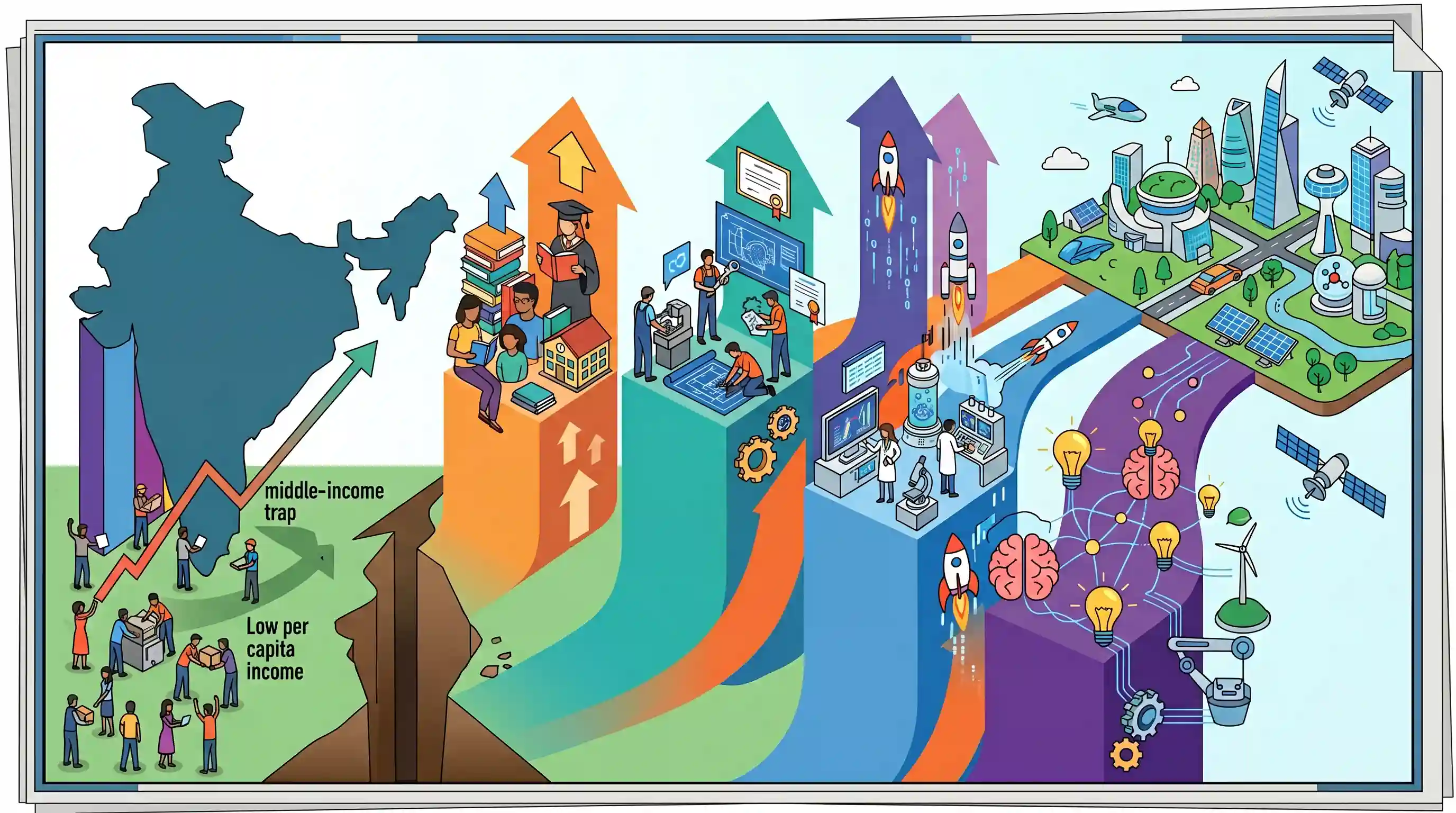
The article contextualizes India's rise in global GDP rankings—particularly its trajectory to overtake Japan and Germany—as a milestone that should not induce complacency. It argues that aggregate economic size often obscures structural weaknesses, most notably low per capita income. The true challenge for India is to transition from relying on cheap labor to fostering a robust innovation ecosystem. To avoid the middle-income trap and genuinely capitalize on its demographic dividend, India must urgently prioritize human resource development, significantly boost its research and development (R&D) expenditure, and cultivate an economy driven by cutting-edge ideas and technological breakthroughs.
Key Points
- While India's aggregate GDP is set to overtake Japan, focusing solely on macroeconomic size masks significant gaps in per capita income and living standards compared to developed nations.
- To transition to a fully developed economy, India must shift from low-cost manufacturing and imitation to leading globally in ideas, R&D, and technological innovation.
- India's R&D expenditure as a percentage of GDP remains severely low (historically under 1%), which poses a major hurdle to escaping the middle-income trap.
- Realizing the much-touted demographic dividend requires a massive, sustained overhaul of human capital, particularly through quality education, skill development, and improved employability.
Prelims Trap
"India's Gross Expenditure on R&D (GERD) has steadily increased as a percentage of GDP over the last decade."
While absolute expenditure has grown, GERD as a percentage of GDP has remained stagnant between 0.64% and 0.7% for the last decade.
Static Concepts Connected
What characterizes the 'Middle-Income Trap' in developing economies?
- Definition: A situation where a rapidly growing economy stagnates at middle-income levels, failing to transition to a high-income status.
- Primary Cause: Usually caused by rising wages that erode competitiveness in low-cost manufacturing, coupled with an inability to compete with advanced economies in high-skill innovations.
- Escape Mechanism: Requires shifting from factor-accumulation growth (cheap labor/capital) to productivity-driven growth through massive investments in human capital and R&D.
What constitutes India's Demographic Dividend window?
- Core Concept: The economic growth potential resulting from a population's age structure shifting, where the working-age population (15-64) outnumbers non-working dependents.
- Timeline: According to the UNFPA, India's demographic dividend window spans 50 years, from 2005-06 to 2055-56, after which the aging population burden increases.
- Conditionality: Without adequate skill development (currently only ~3% formally skilled) and job creation, the dividend risks becoming a demographic disaster.
Cross-Topic Patterns
Macro Growth vs. HDI Stagnation
While India climbs absolute GDP rankings, its Human Development Index and per capita metrics lag, frequently tested in Mains GS3 in the context of jobless growth and inequality.
GERD Stagnation & Patent Filings
India's low R&D spending (0.7% of GDP) directly limits its global intellectual property footprint, a frequent linkage in GS3 questions analyzing the National IPR Policy.

Expect a GS3 Mains question analyzing the 'Middle-Income Trap' in the context of India's demographic dividend window closing by 2055.
Linked PYQs · 4
Linked PYQs · 4
- 2014MainsGS3
While we flaunt India's demographic dividend, we ignore the dropping rates of employability. What are we missing while doing so? Where will the jobs that India desperately needs come from? Explain.
- 2023MainsGS2
The crucial aspect of development process has been the inadequate attention paid to Human Resource Development in India. Suggest measures that can address this inadequacy.
- 2022MainsGS3
Economic growth in the recent past has been led by increase in labour productivity." Explain this statement. Suggest the growth pattern that will lead to creation of more jobs without compromising labour productivity.
- 2023MainsGS2
Skill development programmes have succeeded in increasing human resources supply to various sectors. In the context of the statement analyse the linkages between education, skill and employment.
