India Japan Strategic Partnership Advances Indo Pacific Defence Ties
Source:The Hindu ↗
આ શા માટે મહત્વનું છે
India-Japan bilateral relations are a cornerstone of India's Act East Policy and Indo-Pacific strategy, making an understanding of their defence partnership crucial for aspirants tackling International Relations and regional security questions in GS Paper 2.
સારાંશ
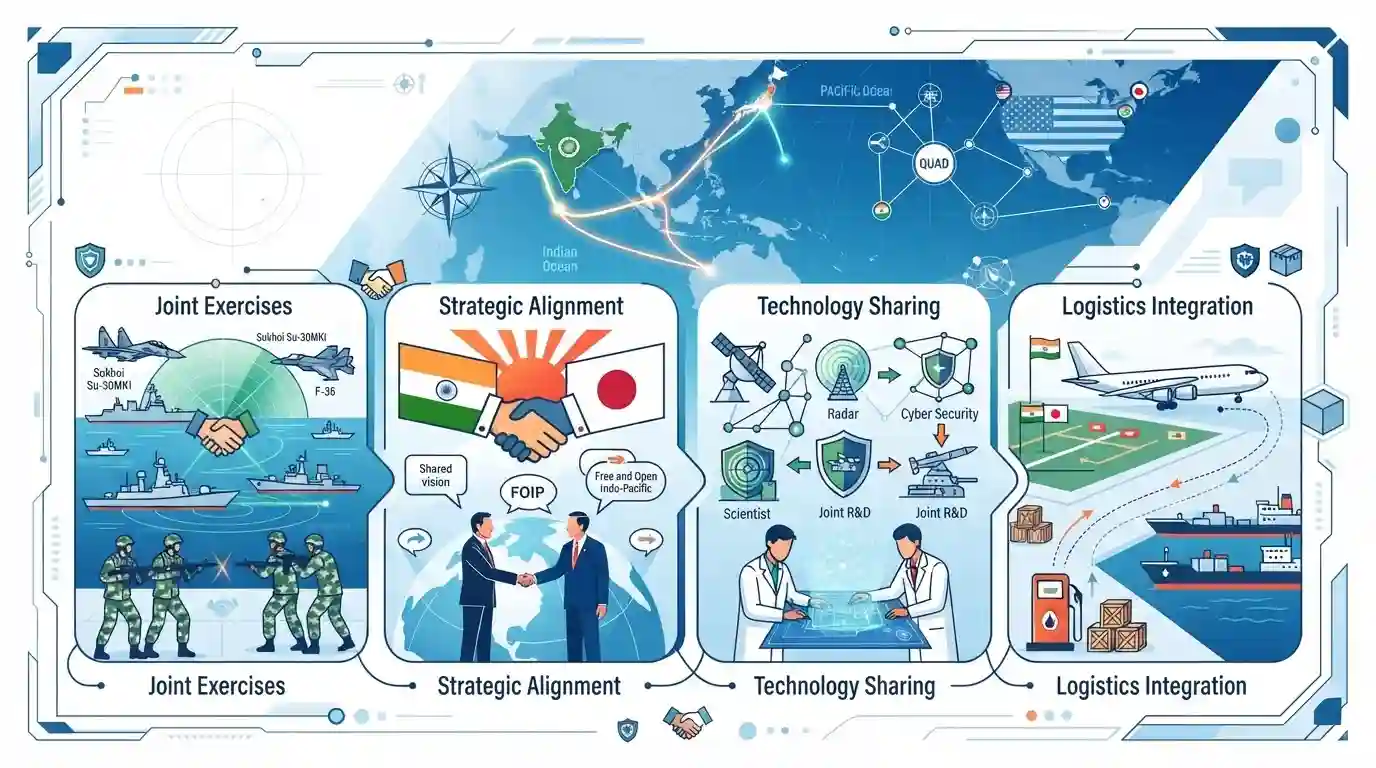
The article explores the evolving landscape of India-Japan defence cooperation, emphasizing its growing depth from joint exercises to strategic alignment, technology sharing, and logistics integration within the broader framework of Indo-Pacific security.
મુખ્ય મુદ્દા
- India-Japan defence cooperation is evolving beyond traditional exercises into deeper strategic alignment and technology co-development.
- The partnership is critical for maintaining a free, open, and inclusive Indo-Pacific region in the face of changing geopolitical dynamics.
- Logistics agreements like the ACSA facilitate joint operational readiness and mutual military support between Indian and Japanese armed forces.
- Collaborative efforts in maritime security, defence manufacturing, and critical technologies are strengthening bilateral ties.
મહત્વપૂર્ણ શબ્દો
Acquisition and Cross-Servicing Agreement (ACSA)

A bilateral logistics pact signed in 2020 enabling the armed forces of India and Japan to exchange supplies, fuel, and services during joint exercises and humanitarian missions.
UPSC context
GS Paper II (International Relations): Tests bilateral defence pacts, strategic partnerships, and logistical interoperability in the Indo-Pacific.
Quad
An informal strategic forum comprising India, the US, Japan, and Australia focused on ensuring a free, open, and inclusive Indo-Pacific region.
UPSC context
GS Paper II (International Relations): Crucial for minilateralism, regional security architecture, and balancing geopolitics in the Indo-Pacific.
પ્રિલિમ્સ ટ્રેપ
The Acquisition and Cross-Servicing Agreement (ACSA) creates a formal mutual defense alliance requiring automatic military intervention.
Aspirants often assume ACSA allows permanent stationing of troops or mutual defense obligations akin to a formal military alliance, whereas it only provides a framework for reciprocal logistics and operational support.
સંલગ્ન સ્થિર ખ્યાલો
What are the key bilateral and multilateral defense institutional mechanisms between India and Japan?
- Strategic Umbrella: Special Strategic and Global Partnership established in 2014 sets the overarching bilateral framework.
- 2+2 Dialogue: 2+2 Ministerial Dialogue involving Foreign and Defence Ministers aligns strategic and security perceptions.
- Joint Exercises: Tri-service exercises include Dharma Guardian (Army), Veer Guardian (Air Force), and JIMEX (Navy).
- Logistics Pact: Acquisition and Cross-Servicing Agreement (ACSA) enables reciprocal provision of supplies and services.
આંતર-વિષય પેટર્ન
Defense Indigenization + Indo-Pacific Tech Partnerships
India-Japan tech co-development in naval communications (UNICORN masts) mirrors broader Atmanirbhar Bharat push for defense indigenization and critical technology partnerships with Western allies.
Quad Interoperability + Reciprocal Logistics Pacts
Bilateral logistics pacts like ACSA parallel LEMOA with the US and similar reciprocal arrangements with Australia, institutionalizing the Quad's military interoperability network.

India-Japan defense tech sharing (UNICORN) + ACSA logistics framework are prime targets for matching/statement-based Prelims questions.
સંલગ્ન PYQ · 2
સંલગ્ન PYQ · 2
- 2019MainsGS2
‘The time has come for India and Japan to build a strong contemporary relationship, one involving global and strategic partnership that will have a great significance for Asia and the world as a whole.’ Comment.
- 2025MainsGS3
Why is maritime security vital to protect India's sea trade? Discuss maritime and coastal security challenges and the way forward.
