India Japan Bilateral Defence Cooperation and Indo Pacific Security
Source:The Hindu ↗
हे का महत्त्वाचे आहे
Crucial for understanding India's strategic partnerships in the Indo-Pacific, countering regional hegemony, and advancing defence manufacturing and tech collaboration with key democratic allies like Japan.
सारांश
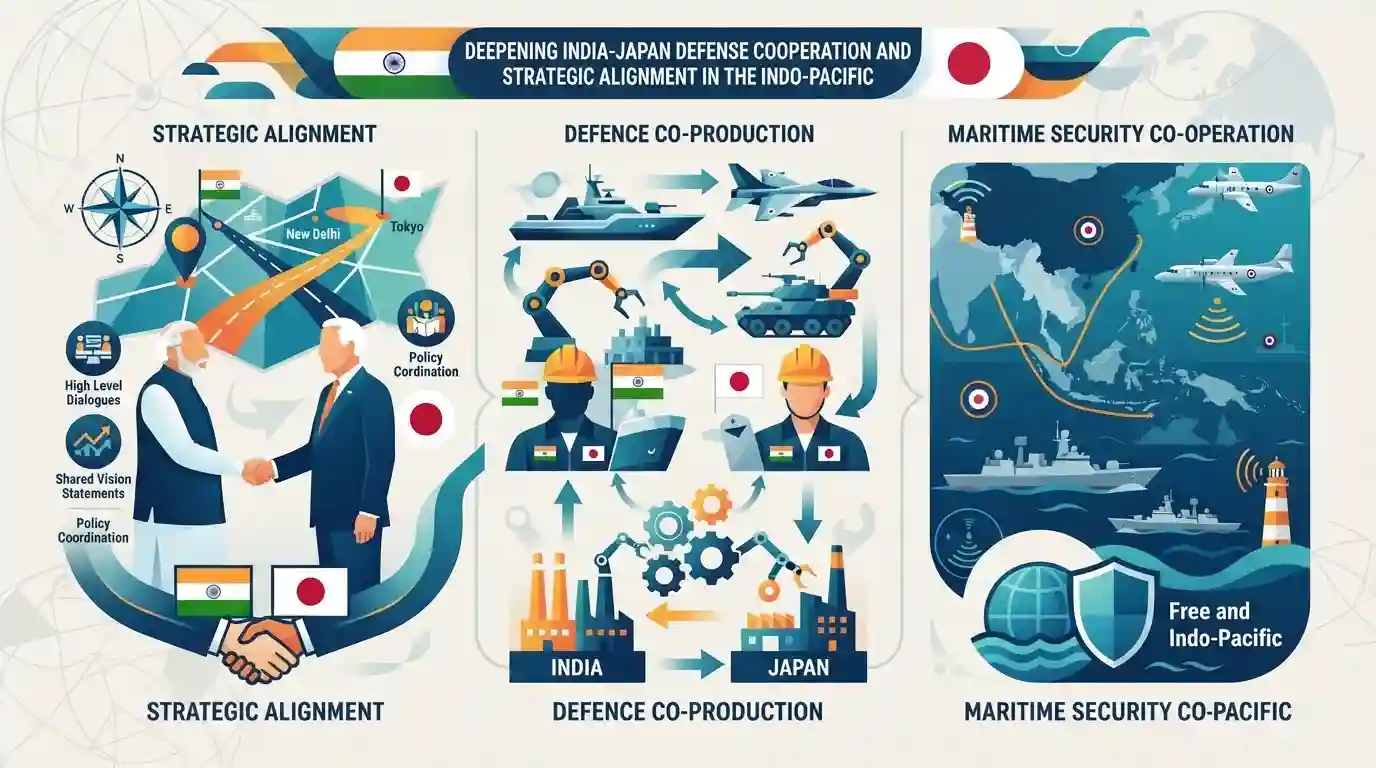
The article explores the deepening contours of India-Japan defence cooperation, highlighting its transition toward modern strategic alignment, co-production of defence equipment, and enhanced maritime security cooperation to safeguard a free and open Indo-Pacific.
मुख्य मुद्दे
- India-Japan defence cooperation is evolving beyond traditional bilateral exercises toward deep strategic integration, co-development, and co-production of military hardware.
- The evolving partnership serves as a vital anchor for regional stability, security architecture, and freedom of navigation in the Indo-Pacific region.
- Closer synergy addresses shared geopolitical challenges, including changing power dynamics and maritime security concerns in Asia.
महत्त्वाच्या संज्ञा
Indian Armed Forces

The unified military forces of India, comprising the Army, Navy, and Air Force, tasked with defending the nation's territorial integrity and sovereignty.
UPSC context
UPSC GS Paper III (Security): Evaluates India's defense posture, modernization, and bilateral strategic exercises with major partner nations like Japan.
Japanese Self-Defense Forces
The military forces of Japan, constrained by Article 9 of its pacifist constitution to act strictly for self-defense, but increasingly engaging in international strategic partnerships.
UPSC context
UPSC GS Paper II (International Relations): Important for understanding Japan's evolving security policy and bilateral defense frameworks with India in the Indo-Pacific.
पूर्वपरीक्षा सापळा
Japan's domestic constitution prevents it from ever engaging in joint defence equipment co-production or military hardware exports with foreign partners.
Japan's post-WWII pacifist constitution (Article 9) historically barred lethal weapons exports, but recent revisions permit co-development and export of defence equipment under strict joint oversight.
संबंधित स्थिर संकल्पना
What are the key institutional mechanisms and foundational agreements driving India-Japan strategic relations?
- Security Declaration: Joint Declaration on Security Cooperation signed in 2008 laid the institutional foundation for bilateral strategic and security partnership.
- 2+2 Dialogue: 2+2 Ministerial Dialogue involving Foreign and Defence Ministers institutionalizes regular high-level strategic consultations between the two nations.
- ACSA Pact: Acquisition and Cross-Servicing Agreement (ACSA) signed in 2020 enables reciprocal provision of supplies and services between defence forces.
आंतर-विषय नमुने
Defence Co-production + Make in India
Bilateral technology co-production agreements with Indo-Pacific partners test India's Make in India defence export ambitions and intellectual property sharing frameworks.
Indo-Pacific Security + Quad Minilateralism
Security alignment in the Indo-Pacific reinforces minilateral minilaterals like the Quad, shifting reliance from bilateral pacts to networked regional security.

India-Japan strategic convergence + defence co-development likely to feature in IR/Security multi-statement prelims questions.
संबंधित PYQ · 1
संबंधित PYQ · 1
- 2019MainsGS2
‘The time has come for India and Japan to build a strong contemporary relationship, one involving global and strategic partnership that will have a great significance for Asia and the world as a whole.’ Comment.
