India Adopts New Consumer Price Index Series with Updated Base
Source:The Hindu ↗
Why It Matters
CPI is the RBI's primary gauge for inflation targeting. Changes to its base year, basket items, and weightages critically influence how inflation is measured in India, which directly affects interest rates, fiscal policy, and macroeconomic planning.
Summary
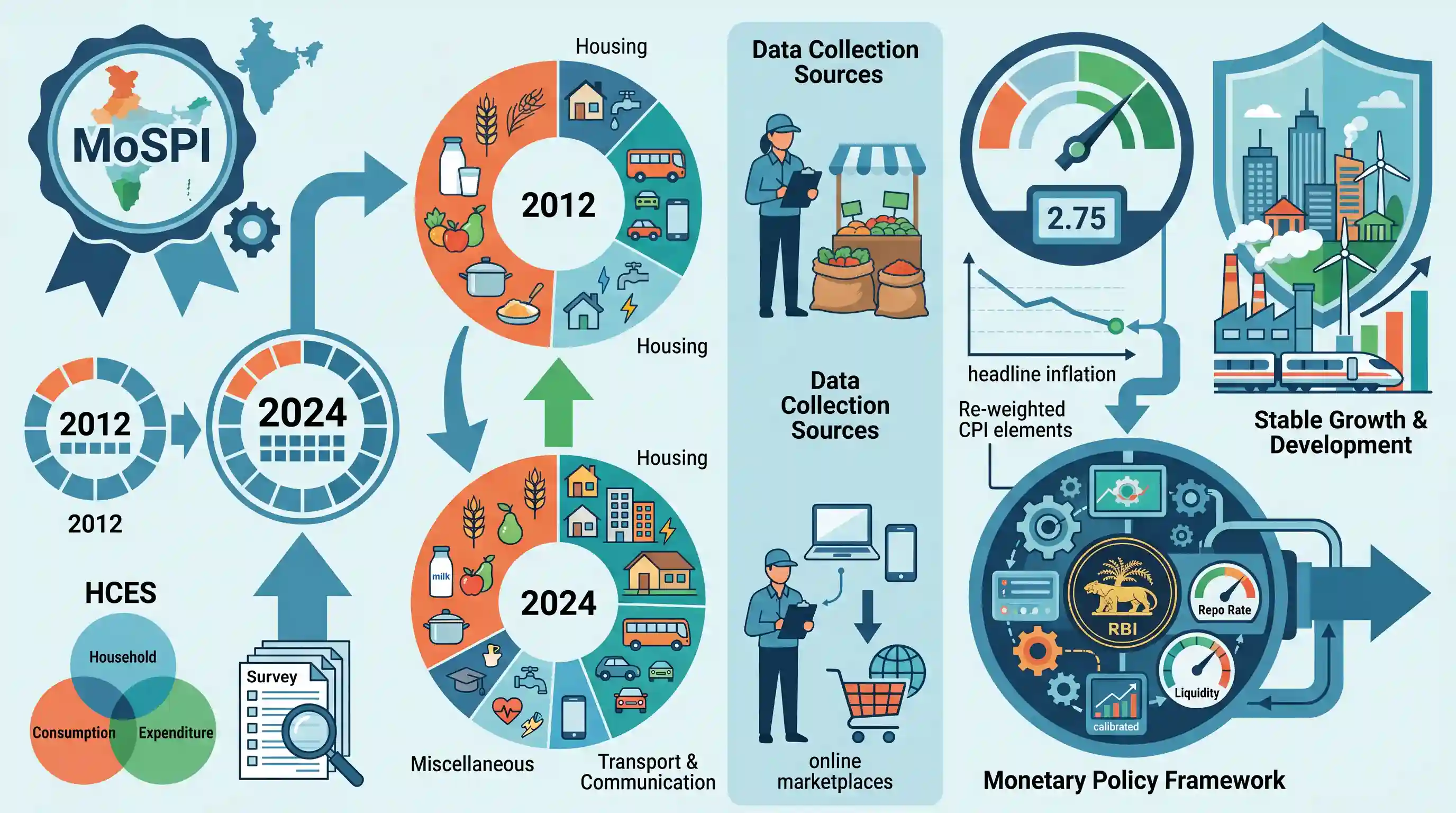
The Ministry of Statistics and Programme Implementation (MoSPI) has introduced a new Consumer Price Index (CPI) series, updating the base year from 2012 to 2024 based on the latest Household Consumption Expenditure Survey (HCES). The revamped CPI basket expands to 358 items and significantly alters weightages to reflect modern spending habits. Notably, the weight of food and beverages has decreased to 36.75%, while housing-related expenses have increased to 17.67%. Data collection sources now formally include online marketplaces. January 2026 retail inflation under the new series stood at 2.75%, providing the RBI with updated metrics for its monetary policy framework.
Key Points
- The government launched a new Consumer Price Index (CPI) series, shifting the base year from 2012 to 2024.
- The new index weightages are derived from the Household Consumption Expenditure Survey (HCES) 2023-24, capturing contemporary consumption shifts.
- The weight of 'food and beverages' in the CPI basket has been reduced from 45.86% to 36.75%.
- The weightage of 'housing'—now clubbed with water, electricity, gas, and other fuels—has increased to 17.67%.
- The total items in the CPI basket rose from 299 to 358, with services increasing from 40 to 50 items.
- Data collection has expanded to include 12 online marketplaces alongside 1,465 rural and 1,395 urban markets.
- Under the new 2024 base series, India's retail inflation for January 2026 was recorded at 2.75%.
Important Terms
Consumer Price Index (CPI)

A measure examining the weighted average of prices of a basket of consumer goods and services purchased by households to track retail-level inflation.
UPSC context
GS Paper III - Economy; core metric for retail inflation and RBI's monetary policy decisions.
Household Consumption Expenditure Survey (HCES)
A periodic survey conducted by the National Statistical Office (NSO) to collect detailed data on household spending patterns across rural and urban India.
UPSC context
GS Paper III - Economy; used to revise the CPI basket, weights, and estimate poverty levels.
Ministry of Statistics and Programme Implementation (MoSPI)
The nodal Indian ministry responsible for the coverage and quality aspects of official statistics released, including GDP, CPI, and IIP data.
UPSC context
GS Paper II & III; key institution for official data, national income accounting, and economic planning.
Flexible Inflation Targeting (FIT)
A monetary policy framework where the central bank aims to maintain inflation within a specific target range (4% ±2%) while supporting growth.
UPSC context
GS Paper III - Economy; governs the RBI's interest rate decisions and statutory accountability for price stability.
Base Year
A specific benchmark year used as a reference point (index = 100) to measure relative changes in economic variables like inflation or GDP.
UPSC context
GS Paper III - Economy; vital for removing price distortions and reflecting contemporary consumption or production habits.
Monetary Policy Committee (MPC)
A six-member statutory body within the Reserve Bank of India that determines the benchmark policy (repo) rate to achieve the inflation target.
UPSC context
GS Paper III - Economy; central to macroeconomic management, price stability, and credit availability in the economy.
Prelims Trap
The new CPI series significantly increased the weight of food items to reflect rising agricultural prices.
The 2024 base actually decreases the food and beverages weight from 45.86% to 36.75%, reflecting higher income and a structural shift toward non-food consumption.
Static Concepts Connected
What is the RBI's Flexible Inflation Targeting (FIT) framework?
- The Target: Retail CPI (Combined) inflation is targeted at 4%, with a tolerance band of +/- 2% (i.e., 2% to 6%).
- The Anchor: Headline CPI serves as the nominal anchor for the Monetary Policy Committee (MPC) decisions.
- Failure Condition: If average inflation breaches the 2-6% band for three consecutive quarters, the RBI must submit a report to the Central Government explaining the failure.
How do CPI and WPI fundamentally differ?
- Basket Items: CPI includes both goods and services (like housing, education), while WPI tracks only physical goods.
- Publishing Body: CPI is released by the NSO (under MoSPI); WPI is released by the Office of Economic Adviser (under Ministry of Commerce & Industry).
- Price Stage: WPI measures wholesale/factory-gate prices; CPI measures the final prices paid by end-consumers at retail markets.
Cross-Topic Patterns
Inflation tracking meets e-commerce
Including 12 online marketplaces in CPI data formally integrates the digital economy into macroeconomic metrics, linking inflation to India's shifting retail landscape.
HCES driving poverty estimation
The Household Consumption Expenditure Survey 2023-24, which generated these new CPI weights, is also the foundational dataset for redrawing India's poverty estimates and welfare paradigms.

Expect a 2026 Prelims multi-statement question on CPI weight shifts, specifically targeting the drop in food and inclusion of e-commerce.
Linked PYQs · 3
Linked PYQs · 3
- 2020PrelimsGS1
Consider the following statements: 1. The weightage of food in Consumer Price Index (CPI) is higher than that in Wholesale Price Index (WPI). 2. The WPI does not capture changes in the prices of services, which CPI does. 3. Reserve Bank of India has now adopted WPI as its key measure of inflation and to decide on changing the key policy rates. Which of the statements given above is/are correct?
- 2010PrelimsGS1
With reference to India, consider the following statements : 1. The Wholesale Price Index (WPI) in India is available on a monthly basis only. 2. As compared to Consumer Price Index for Industrial Workers (CPI(IW)), the WPI gives less weight to food articles. Which of the statements given above is/are correct ?
- 2024MainsGS3
What are the causes of persistent high food inflation in India? Comment on the effectiveness of the monetary policy of the RBI to control this type of inflation.
