India Israel Relations and Strategic Partnership
Source:The Hindu ↗
Why It Matters
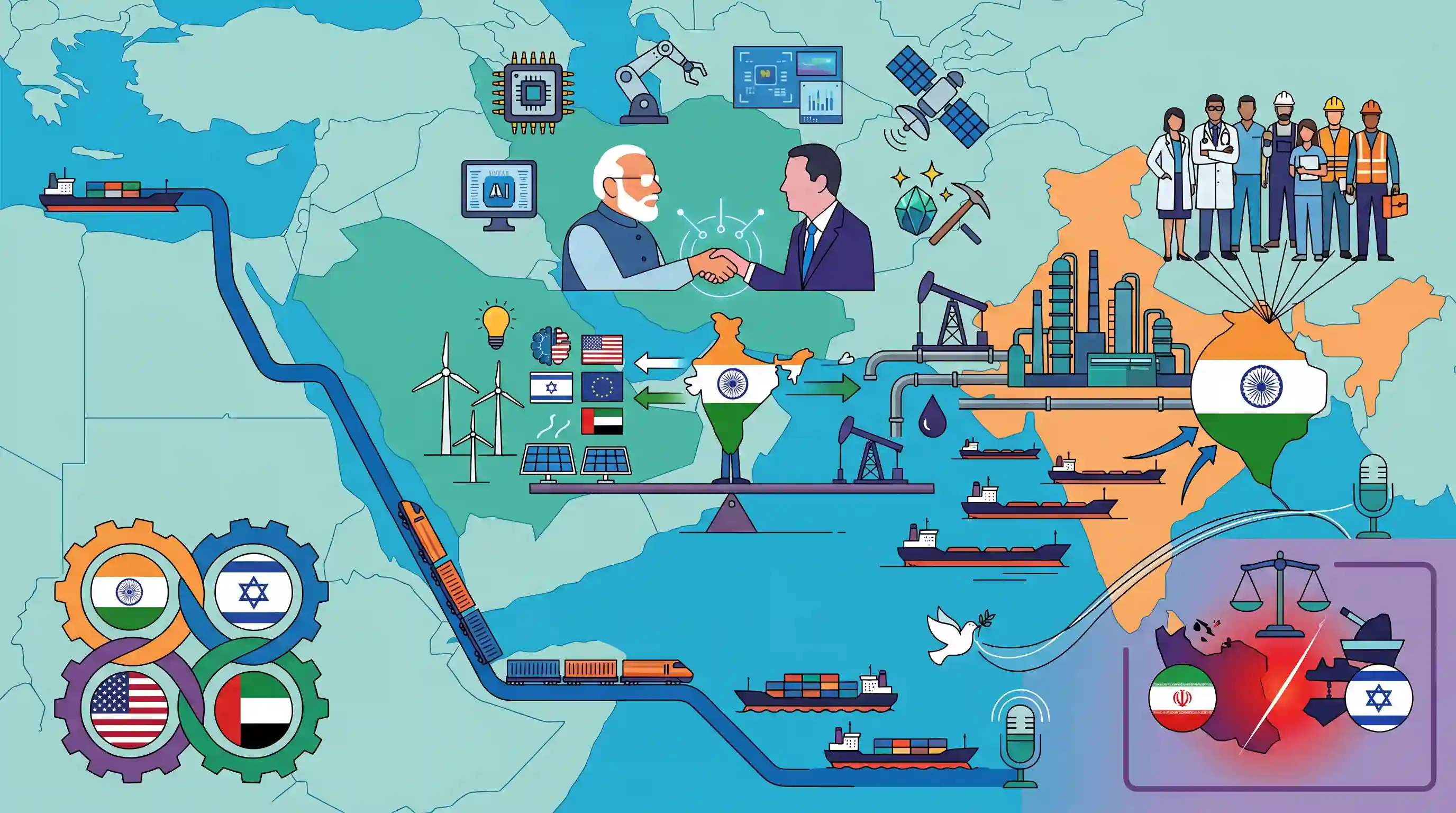
West Asia is a critical theater for Indian diplomacy. This article perfectly illustrates India's de-hyphenated Middle East policy: simultaneously deepening strategic/tech/trade partnerships with Israel while protecting core interests (energy and diaspora) tied to the broader Gulf region and Iran. It covers major UPSC themes like connectivity corridors (IMEC), minilateral groupings (I2U2), and energy security dynamics.
Summary
Prime Minister Narendra Modi’s visit to Israel highlighted a deepening bilateral relationship alongside India’s high-stakes balancing act in West Asia. While advancing ties with Israel through a prospective Free Trade Agreement (FTA), technological cooperation (including AI in mineral exploration), and connectivity initiatives like IMEC and I2U2, India firmly tied its own security interests to regional stability. The talks addressed escalating tensions between Iran and the U.S.-Israel coalition, where India emphasized dialogue, driven by its vital need for energy security from the Gulf and the safety of its vast diaspora in the GCC.
Key Points
- PM Modi visited Israel, reaffirming the "special strategic partnership" and calling for an early conclusion of a bilateral Free Trade Agreement (FTA).
- Both sides pledged to advance the IMEC and I2U2 connectivity projects, though regional geopolitical headwinds—such as stalled Saudi-Israel normalization—continue to weigh on progress.
- India underscored its direct security interests in West Asian peace, primarily driven by energy security reliance and the presence of over one crore Indian diaspora workers in GCC countries.
- Amid escalating tensions between Iran and the U.S.-Israel coalition over nuclear capabilities, India advocated for diplomacy and offered its support in finding a peaceful resolution.
- New areas of collaboration were identified, including a signed MoU for mineral exploration using AI and advanced geophysical technologies.
Important Terms
India-Middle East-Europe Economic Corridor (IMEC)

A ship-to-rail transit network connecting India to Europe via the Arabian Gulf. Launched at the 2023 G20, it aims to reduce logistics costs and serve as a strategic alternative to China's Belt and Road Initiative.
UPSC context
GS Paper 2 (International Relations) & GS 3 (Infrastructure). Tests knowledge of regional connectivity and India’s strategic autonomy.
I2U2
A strategic minilateral group comprising India, Israel, the UAE, and the USA. It promotes geoeconomic cooperation in six sectors: water, energy, transportation, space, health, and food security.
UPSC context
GS Paper 2 (International Relations). Tests understanding of India’s "West Asian Quad" and minilateralism.
Gulf Cooperation Council (GCC)
A political and economic alliance of six Middle Eastern countries: Saudi Arabia, UAE, Qatar, Kuwait, Oman, and Bahrain. It is India's largest trading partner bloc and crucial for energy security.
UPSC context
GS Paper 2 (Bilateral/Regional groups). Focuses on energy security, diaspora remittances, and the "Act West" policy.
Global South
Broadly refers to developing or less-developed nations in Africa, Asia, and Latin America. India positions itself as the "voice" of this bloc, advocating for equitable global governance and climate justice.
UPSC context
GS Paper 2 (International Relations). Tests knowledge of India's leadership in the developing world and multilateral reforms.
Free Trade Agreement (FTA)
A formal pact between countries to reduce or eliminate trade barriers like tariffs and quotas. It aims to enhance market access, boost exports, and foster deeper economic and technological integration.
UPSC context
GS Paper 3 (Economy) and GS 2. Tests trade policy knowledge and India’s integration into global supply chains.
Prelims Trap
India's 'de-hyphenation' policy requires balancing ties by linking its relations with Israel and Palestine into a single diplomatic track.
De-hyphenation is the exact opposite. It means maintaining mutually independent, standalone relationships with rival West Asian nations (like Israel and Palestine) without linking them.
Static Concepts Connected
What are the core objectives and memberships of the I2U2 and IMEC initiatives?
- I2U2 Membership: Comprises India, Israel, UAE, and USA; focuses on joint private-sector investments in six areas: water, energy, transport, space, health, and food security.
- IMEC Vision: Launched at G20, it aims to connect India to Europe via the Middle East (UAE, Saudi Arabia, Jordan, Israel) through integrated rail and shipping networks.
What is the strategic and economic significance of the GCC for India?
- Energy & Trade: The bloc is a primary source of India's crude oil and LNG imports, serving as an irreplaceable pillar of India's macroeconomic and energy security.
- Diaspora Remittances: Hosts over 8.5 million Indians who contribute nearly 50% of total inward remittances, providing crucial support to India's Current Account.
- GCC Membership: Comprises Saudi Arabia, UAE, Bahrain, Oman, Qatar, and Kuwait. Aspirants must remember that Iran and Iraq are NOT members.
Cross-Topic Patterns
Minilateralism replacing mega-agreements
IMEC and I2U2 reflect India's shift towards issue-specific, flexible coalitions in West Asia, closely mirroring its Quad strategy in the Indo-Pacific region.
Deep Tech in strategic minerals
The India-Israel MoU on AI for mineral exploration connects IR to Science & Tech, matching India's recent critical mineral diplomacy with Australia and the US.
Diaspora as a macroeconomic buffer
West Asian geopolitics directly impacts India's Balance of Payments, as massive GCC remittances are non-negotiable for offsetting India's structural merchandise trade deficit.

Expect a 2026 multi-statement question linking India’s 'De-hyphenation' policy, IMEC transit nodes, and GCC's impact on India's BoP.
Linked PYQs · 3
Linked PYQs · 3
- 2018MainsGS2
“India’s relations with Israel have, of late, acquired a depth and diversity, which cannot be rolled back.” Discuss.
- 2022MainsGS2
How will I2U2 (India, Israel, UAE and USA) grouping transform India's position in global politics?
- 2025MainsGS2
"Energy security constitutes the dominant kingpin of India's foreign policy, and is linked with India's overarching influence in Middle Eastern countries.” How would you integrate energy security with India's foreign policy trajectories in the coming years?
