India and Israel Elevate Bilateral Ties to Special Partnership Level
Source:Indian Express ↗
Why It Matters
The deepening of India-Israel relations is highly relevant for GS Paper 2 (International Relations). UPSC frequently asks about bilateral ties that have strategic depth, such as the evolving nature of India-Israel cooperation, and their broader geopolitical implications, including initiatives like I2U2 in West Asia.
Summary
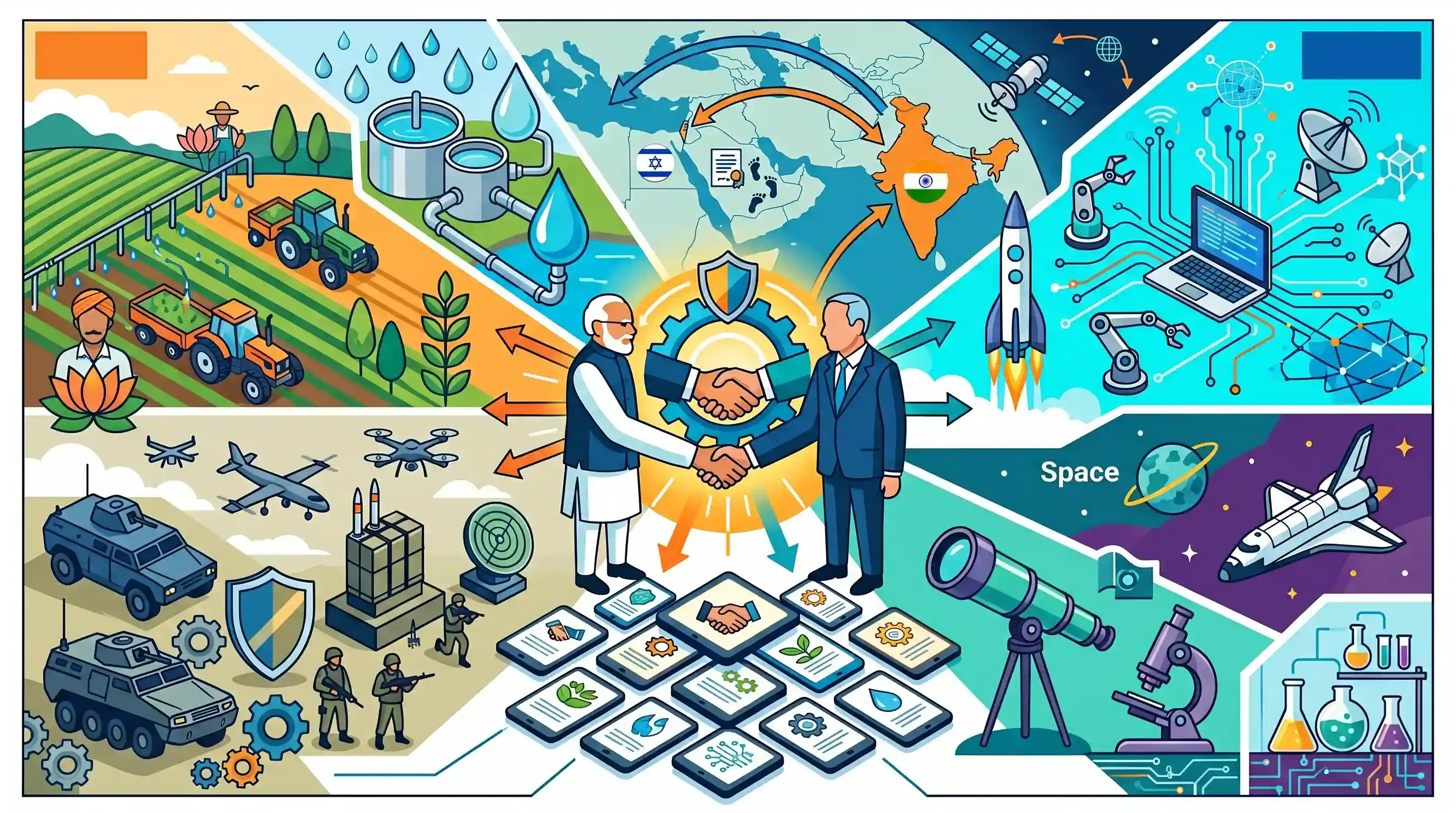
India and Israel have elevated their bilateral relationship to a 'Special Partnership', signing 17 pacts during a high-level meeting between Prime Minister Narendra Modi and Israeli Prime Minister Benjamin Netanyahu. Described as 'extraordinarily productive', this development marks a significant deepening of ties, expanding cooperation beyond defense and security into critical sectors such as agriculture, water management, and technological innovation. This milestone highlights Israel's strategic importance to India's foreign policy and reflects India's evolving and robust diplomatic footprint in the Middle East.
Key Points
- India and Israel have formally elevated their bilateral relations to a 'Special Partnership'.
- The leaders signed 17 new pacts to expand cooperation across multiple sectors beyond traditional defense ties.
- Enhanced collaboration focuses on critical areas including agriculture, water management, and technological innovation.
- This diplomatic shift underscores the growing depth and strategic diversity of the India-Israel relationship in the context of West Asian geopolitics.
Important Terms
Special Strategic Partnership

The elevated status of India-Israel ties (2026) focusing on peace, innovation, and prosperity. It marks a shift from transactional defense deals to broad-based, high-tech, and institutionalized cooperation.
UPSC context
GS Paper II (International Relations). Tests knowledge of bilateral frameworks and the evolution of strategic ties with key global partners.
De-hyphenation Policy
India’s foreign policy approach of treating its relations with Israel and Palestine as separate and independent, based on national interests rather than regional rivalries.
UPSC context
GS Paper II (International Relations). Evaluates understanding of India’s diplomatic balancing act and strategic autonomy in West Asian geopolitics.
I2U2 Grouping
A quadrilateral grouping of India, Israel, the UAE, and the USA (West Asian Quad) focused on joint investments in water, energy, transportation, space, health, and food security.
UPSC context
GS Paper II (Bilateral, regional and global groupings). Tests awareness of new mini-lateralism and regional connectivity initiatives involving India.
India-Middle East-Europe Economic Corridor (IMEC)
A planned multi-modal trade route connecting India to Europe via West Asia. Israel serves as a critical transit hub (Haifa port) for this strategic corridor.
UPSC context
GS Paper II & III (Connectivity and Infrastructure). Tests understanding of strategic trade routes and competition with China’s BRI.
Critical and Emerging Technologies (iCET)
A 2026 initiative between India and Israel to accelerate collaboration in Artificial Intelligence, quantum computing, semiconductors, biotechnology, and cybersecurity.
UPSC context
GS Paper III (Science & Tech; Security). Tests knowledge of international technology transfers and defense innovation.
Centres of Excellence (CoE)
Agricultural hubs established with Israeli expertise to help Indian farmers adopt advanced technologies like drip irrigation, protected cultivation, and precision farming.
UPSC context
GS Paper III (Agriculture). Focuses on international cooperation in sustainable farming and water-use efficiency.
Prelims Trap
India's 'de-hyphenation' policy means India has abandoned its traditional support for the Palestinian cause.
De-hyphenation means treating relations with Israel and Palestine independently based on mutual merits, not zero-sum. India continues to support a negotiated two-state solution for Palestine.
Static Concepts Connected
What is India's 'De-hyphenation' policy in its West Asia diplomacy?
- Definition: Formally treating bilateral relations with Israel and Palestine as independent, standalone engagements rather than linking them.
- Merit-based ties: Allowing partnerships (e.g., with Israel) to grow rapidly on strategic and economic merits without being restricted by or holding hostage ties with the other entity.
- Diplomatic milestone: PM Modi's standalone visit to Israel in 2017, followed by a separate visit to Ramallah (Palestine) in 2018.
How does the Indo-Israel Agricultural Project (IIAP) function?
- Centres of Excellence: Establishment of advanced, high-tech agricultural hubs across various Indian states to demonstrate and train farmers in precision agriculture.
- Tech transfer: Facilitating the rapid adoption of Israeli micro-irrigation (drip irrigation) and intensive greenhouse farming suited for arid and semi-arid Indian climates.
- Water management: Leveraging Israeli expertise in wastewater recycling and reverse-osmosis desalination to combat chronic water scarcity in Indian agriculture and municipalities.
Cross-Topic Patterns
Minilaterals: I2U2 and IMEC linkages
The 'Special Partnership' solidifies Israel's role in India's broader West Asian geo-economic strategy, acting as a crucial technological node for both the I2U2 grouping and the proposed IMEC.
Defense to dual-use tech transition
Bilateral ties are shifting from pure defense imports to dual-use co-development, structurally supported by the India-Israel Industrial R&D and Technological Innovation Fund (I4F) focusing on AI and clean energy.

Expect a 2026 Prelims question combining India-Israel agricultural Centres of Excellence (IIAP) with I2U2/IMEC minilateral objectives.
Linked PYQs · 2
Linked PYQs · 2
- 2018MainsGS2
“India’s relations with Israel have, of late, acquired a depth and diversity, which cannot be rolled back.” Discuss.
- 2022MainsGS2
How will I2U2 (India, Israel, UAE and USA) grouping transform India's position in global politics?
