India and Israel Sign Multiple Bilateral Pacts
Source:Indian Express ↗
Why It Matters
The deepening of India-Israel ties represents a key pillar in India's West Asia policy. Understanding the multi-sectoral nature of this partnership (defense, water, agriculture, innovation) is critical for Mains GS-2, as it illustrates how bilateral relations acquire strategic depth.
Summary
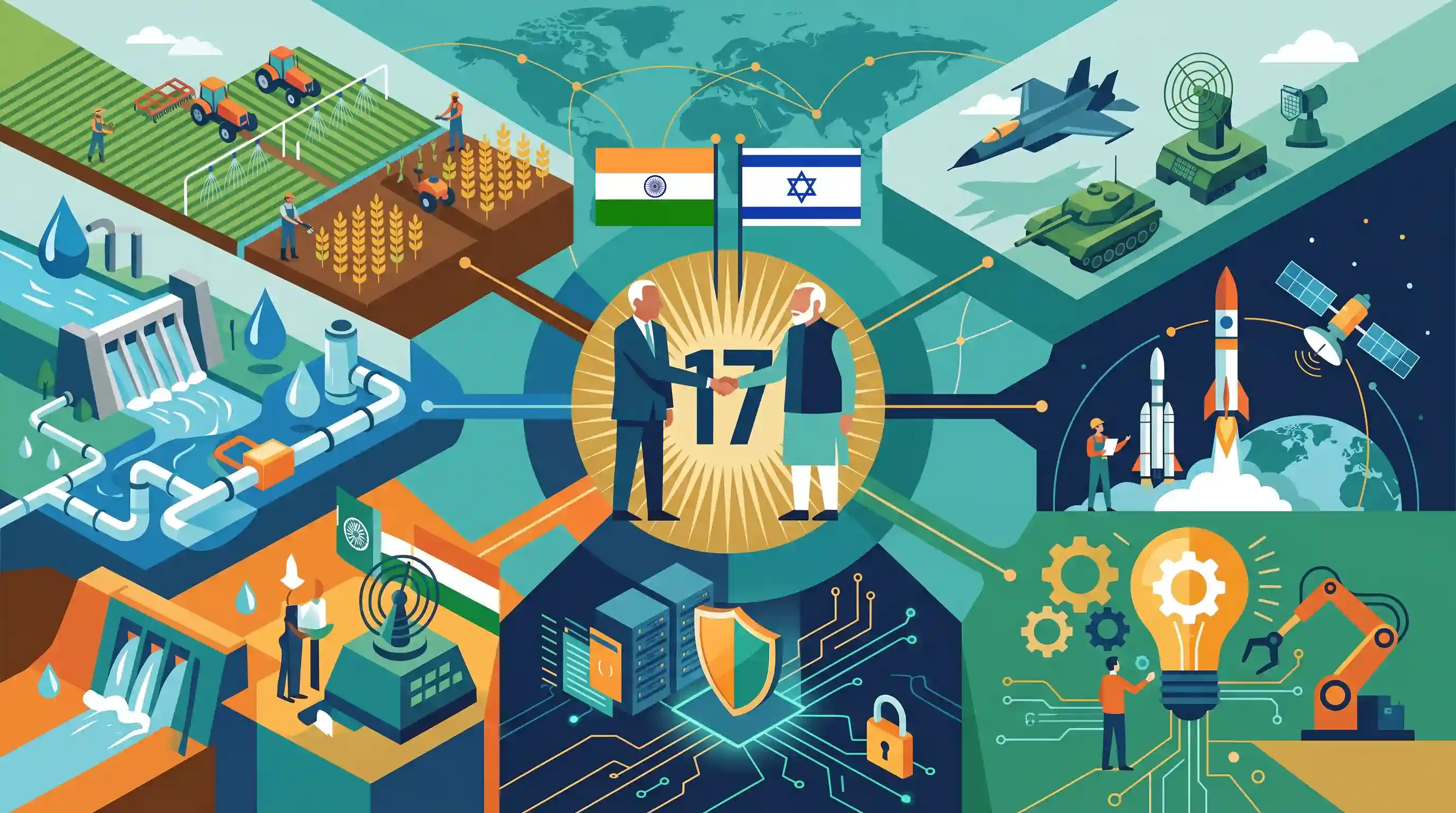
India and Israel have significantly elevated their bilateral relationship by signing 17 new agreements during a meeting between Prime Minister Narendra Modi and Israeli Prime Minister Benjamin Netanyahu. The pacts span vital sectors including defense, agriculture, water management, space, cyber security, and innovation. This development highlights the growing depth and diversity of the India-Israel Strategic Partnership, demonstrating a shift toward comprehensive cooperation beyond traditional defense and security ties.
Key Points
- India and Israel elevated their bilateral ties by signing 17 agreements across various sectors.
- The pacts cover crucial areas such as defense, homeland security, agriculture, water management, space, and innovation.
- The development underscores the transition of India-Israel relations from a buyer-seller defense dynamic to a comprehensive strategic partnership.
- Cooperation in agriculture and water management remains vital for India's domestic development goals.
Important Terms
India-Israel Special Strategic Partnership

A high-level framework upgraded in 2026 prioritizing cooperation in defense, innovation, water management, and emerging technologies like AI and semiconductors.
UPSC context
GS Paper II (International Relations); signifies transition from transactional defense ties to multidimensional technological integration.
De-hyphenation Policy
A foreign policy approach where India maintains independent, bilateral relationships with Israel and Palestine without letting one relationship dictate the other.
UPSC context
GS Paper II (International Relations); central to understanding India's pragmatic and multi-aligned West Asia diplomacy.
I2U2 Grouping
An economic forum of India, Israel, UAE, and USA focused on joint investments in water, energy, transportation, space, and food security.
UPSC context
GS Paper II (Regional Groupings); highlights India's strategic geo-economic role in West Asia.
Indian Space Research Organisation (ISRO)
India’s national space agency, collaborating with Israel on satellite miniaturization, radar imaging, and specialized research missions.
UPSC context
GS Paper III (Science & Technology); relevant for international space diplomacy and technological co-development.
Israel Space Agency (ISA)
Israel's governmental space body supervising civil space activities, known for high-resolution imaging and satellite technology partnerships with India.
UPSC context
GS Paper III (Science & Technology); key partner for India in high-end surveillance and miniaturized satellite tech.
Centres of Excellence (CoE) in Agriculture
High-tech agricultural hubs across India using Israeli expertise in drip irrigation and precision farming to enhance yield and productivity.
UPSC context
GS Paper III (Agriculture); provides specific examples of technology-led rural development in bilateral relations.
Prelims Trap
"I2U2 is a Middle-Eastern strategic security alliance designed to counter regional maritime threats."
While sometimes called the 'West Asian Quad', I2U2 strictly focuses on economic cooperation (water, energy, health, food security), not military alliances.
Static Concepts Connected
What is India's 'De-hyphenation' policy in the Middle East?
- Independent ties: Engaging with two mutually hostile nations independently on their own merits, without linking or holding hostage one relationship to the other.
- Israel-Palestine dynamic: India actively pursues a robust strategic partnership with Israel while simultaneously maintaining its traditional support for the Palestinian cause, treating them as separate tracks.
How does the Indo-Israel Agricultural Project (IIAP) function?
- Centres of Excellence: Establishes model demonstration farms across Indian states, implemented by state governments with Israeli technological expertise.
- Technology transfer: Focuses on transferring advanced micro-irrigation (drip/sprinkler), protected cultivation, and post-harvest management techniques to local farmers.
Cross-Topic Patterns
Tech synergies driving I2U2 and IMEC
Bilateral tech and innovation pacts form the foundation for broader minilaterals like I2U2, pivoting Middle Eastern geopolitics toward geo-economics rather than just traditional energy and security frameworks.
Arid-agriculture diplomacy and climate resilience
Israel's water management expertise directly connects to GS3 dryland farming, offering micro-irrigation and desalination solutions crucial for India's rainfed, drought-prone, and groundwater-depleted regions.

Expect a blended GS2 question assessing how India's bilateral 'de-hyphenation' policy enables its role in IMEC and I2U2 groupings.
Linked PYQs · 1
Linked PYQs · 1
- 2018MainsGS2
“India’s relations with Israel have, of late, acquired a depth and diversity, which cannot be rolled back.” Discuss.
