Bilateral Free Trade Agreement Negotiations Between India and Israel
Source:The Hindu ↗
Why It Matters
Highlights the diversification of India-Israel bilateral relations beyond traditional defense and agriculture into deeper economic integration through FTAs and BIAs. Crucial for understanding India's trade diplomacy, efforts to boost FDI, and navigating strategic partnerships amidst global geopolitical headwinds.
Summary
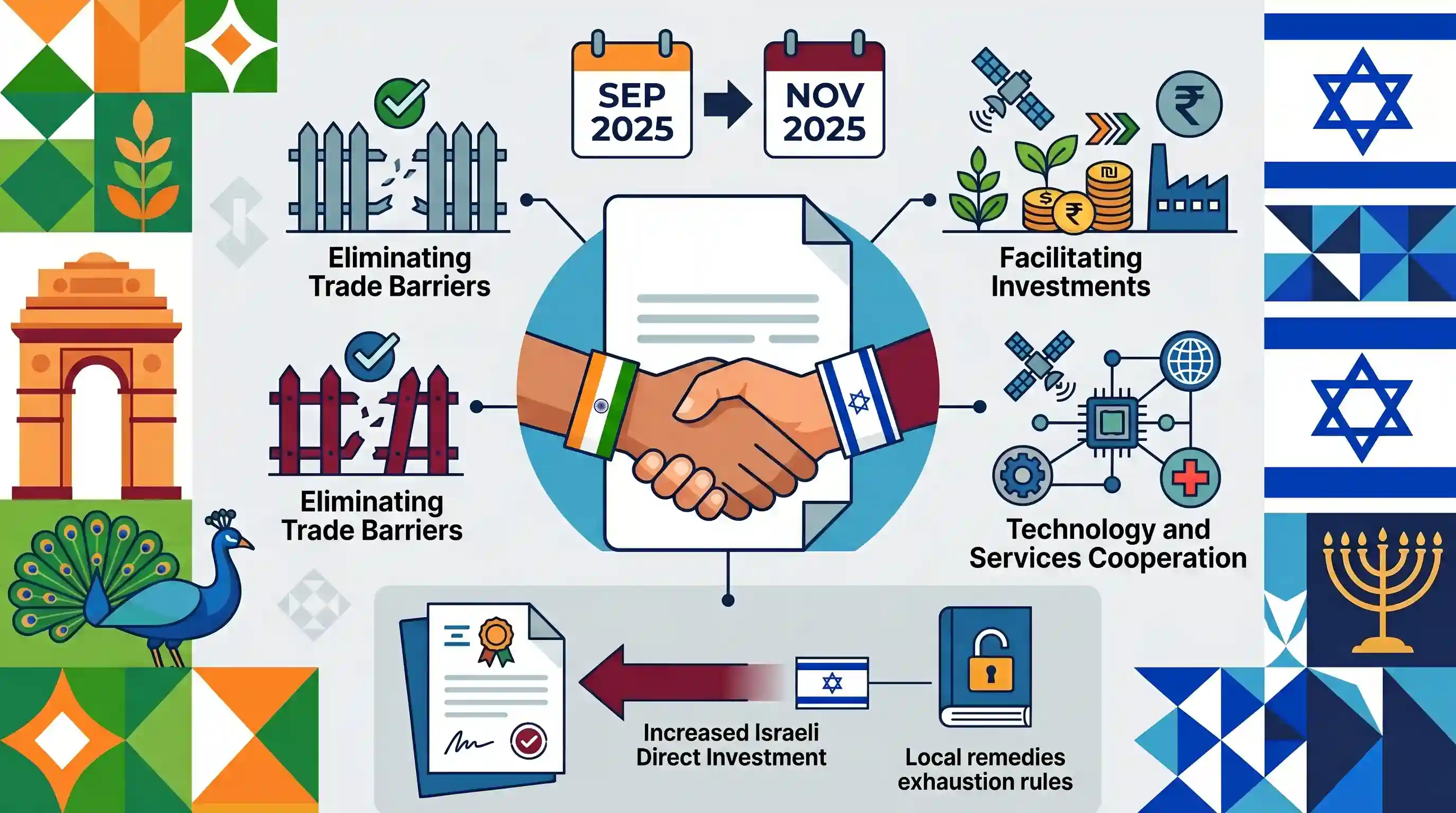
India and Israel have initiated formal negotiations for a Free Trade Agreement (FTA) to deepen economic ties, following the signing of Terms of Reference in November 2025. The talks, preceding PM Narendra Modi's visit to Israel, aim to eliminate trade barriers, facilitate investments, and enhance cooperation in technology and services. This development builds upon the September 2025 Bilateral Investment Agreement (BIA), which relaxed local remedies exhaustion rules to boost Israeli Foreign Direct Investment (FDI) into India.
Key Points
- India and Israel have commenced the first round of negotiations for a Free Trade Agreement (FTA) aimed at boosting commercial ties and reducing tariff and non-tariff barriers.
- The negotiations follow the Terms of Reference (ToR) signed in November 2025 and are timed ahead of Prime Minister Narendra Modi's visit to Israel.
- The FTA will cover market access for goods, investment facilitation, customs simplification, technology transfer, and the easing of norms for trade in services.
- Bilateral trade stood at $3.62 billion in 2024-25, witnessing a dip in both exports and imports compared to the previous fiscal year.
- A Bilateral Investment Agreement (BIA) signed in September 2025 reduced the local remedies exhaustion period for Israeli investors from five to three years to encourage Foreign Direct Investment (FDI).
Important Terms
Free Trade Agreement (FTA)

A pact between nations to reduce or eliminate barriers to trade, such as tariffs and quotas, on goods and services to increase cross-border economic exchange.
UPSC context
Relevant for GS Paper II (International Relations) and III (Economy); tests knowledge of trade diplomacy and regional economic integration.
Bilateral Investment Agreement (BIA)
A treaty between two countries to protect and promote mutual investments by establishing legal protections against expropriation and providing an independent dispute-resolution mechanism.
UPSC context
GS Paper III (Economy); concerns Foreign Direct Investment (FDI) policy, investor-state dispute settlement (ISDS), and India's Model BIT.
Local Remedies Exhaustion
A clause requiring foreign investors to seek redressal through the host country's domestic legal system for a specified period before initiating international arbitration.
UPSC context
GS Paper III (Economy/Law); a critical technical nuance in India's investment treaties affecting investor confidence and ease of doing business.
Foreign Direct Investment (FDI)
Investment made by a firm or individual in one country into business interests located in another country, typically by establishing business operations or acquiring assets.
UPSC context
GS Paper III (Economy); central to topics of capital flows, economic growth, and liberalization policies.
Terms of Reference (ToR)
A document defining the purpose, scope, and structure of a negotiation or project, serving as a roadmap for formal discussions.
UPSC context
Relevant for GS Paper II (IR); identifies the preliminary stage of diplomatic negotiations and trade treaty frameworks.
Prelims Trap
India strictly adheres to a 5-year local remedies exhaustion period in all recent Bilateral Investment Agreements under the 2015 Model BIT.
India recently deviated from the 2015 Model BIT's standard 5-year rule, lowering the Exhaustion of Local Remedies (ELR) to 3 years for Israel.
Static Concepts Connected
What is the Exhaustion of Local Remedies (ELR) in India's Bilateral Investment Treaties?
- The Principle: Requires foreign investors to pursue grievance mechanisms in host country domestic courts before resorting to international arbitration.
- 2015 Model BIT: Introduced a strict 5-year mandatory domestic litigation period in response to major international arbitration losses (e.g., Vodafone).
- Strategic Flexibility: India is now negotiating shorter ELR periods (like 3 years with Israel) to reassure investors and attract critical FDI.
How does 'De-hyphenation' define India's foreign policy in West Asia?
- Independent Partnerships: Evaluating and executing bilateral relations based on mutual merit, treating Israel and Palestine as separate, independent entities rather than a hyphenated construct.
- Strategic Autonomy: Enables India to pursue advanced defense and trade FTAs with Israel without compromising its traditional diplomatic support for the Palestinian cause.
Cross-Topic Patterns
BIT flexibility for high-tech FDI
India is relaxing strict 2015 Model BIT norms (like the 5-year ELR) for tech-rich partners to secure critical investments in AI, semiconductors, and cybersecurity.
De-hyphenation driving West Asia minilateralism
Bilateral economic institutionalization with Israel shields trade from regional geopolitical shocks and acts as a foundation for broader minilateral geo-economic initiatives like I2U2 and IMEC.

Expect a Prelims question contrasting India's rigid 2015 Model BIT provisions (like ELR) with flexible exceptions recently made for Israel.
Linked PYQs · 3
Linked PYQs · 3
- 2018MainsGS2
“India’s relations with Israel have, of late, acquired a depth and diversity, which cannot be rolled back.” Discuss.
- 2016MainsGS3
Justify the need for FDI for the development of the Indian economy. Why there is gap between MOUs signed and actual FDIs? Suggest remedial steps to be taken for increasing actual FDIs in India.
- 2011MainsGS2
Compared to the South Asian Free Trade Area (SAFTA), the Bay of Bengal Initiative for Multisectoral Technical and Economic Cooperation Free Trade Area (BIMSTEC FTA) seems to be more promising." Critically evaluate.
