India Nuclear Energy Expansion and Three Stage Program Progress
Source:Indian Express ↗
Why It Matters
Nuclear power is the cornerstone of India's long-term energy independence and decarbonization strategy. Understanding the nuances of India's three-stage nuclear program, the role of fast breeder reactors, and the geopolitical dimensions of civil nuclear cooperation is essential for GS3 S&T and GS2 IR.
Summary
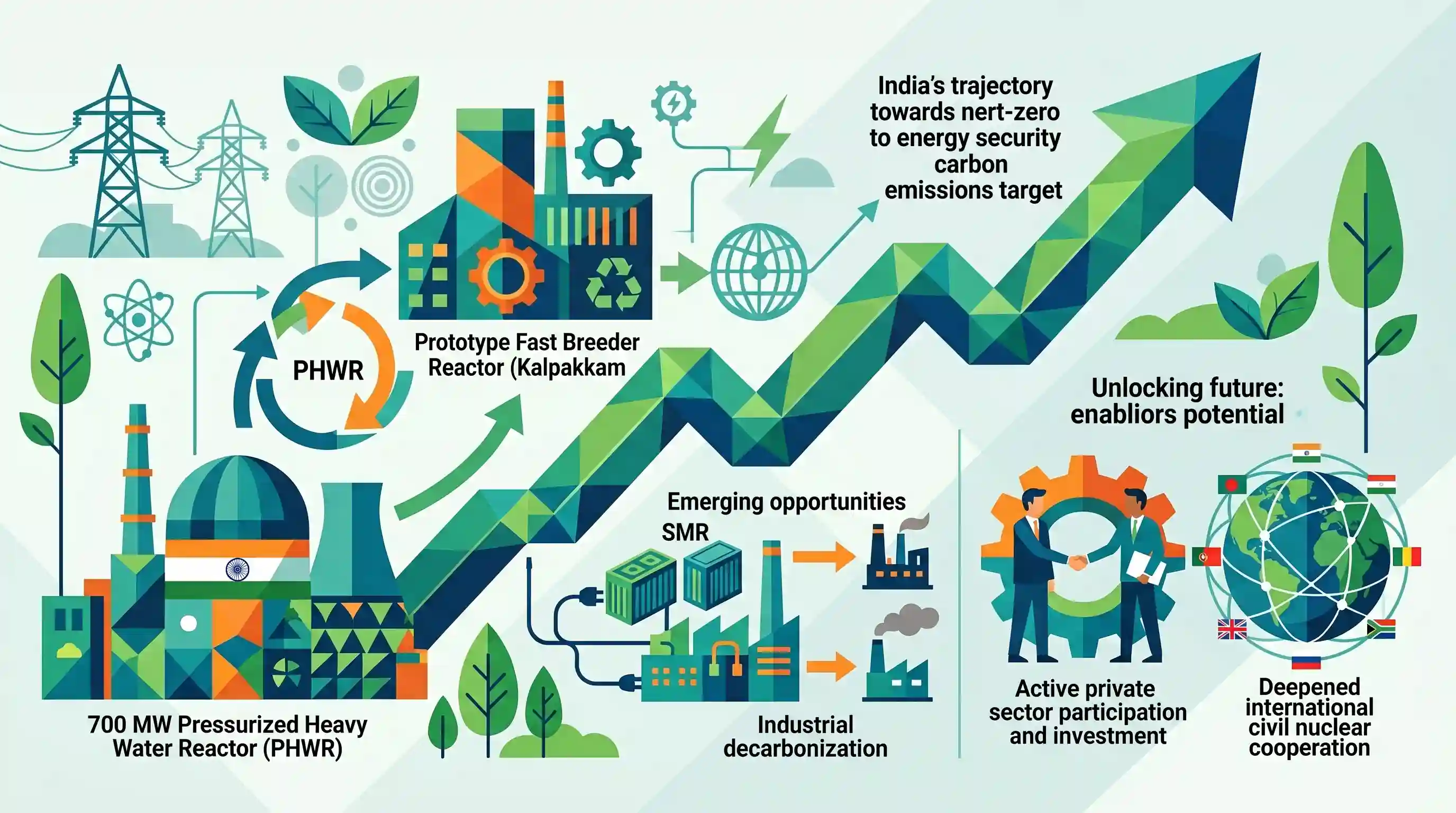
The article analyzes India's ambitious push to expand its nuclear energy sector, marking a crucial leap towards achieving energy security and net-zero carbon emissions by 2070. It explores the significance of India's indigenous technological advancements, such as the deployment of 700 MW Pressurized Heavy Water Reactors (PHWRs) and progress on the Prototype Fast Breeder Reactor (PFBR) at Kalpakkam, which transitions the nation into the second stage of its three-stage nuclear program. The piece highlights emerging opportunities like Small Modular Reactors (SMRs) for industrial decarbonization, while arguing that unlocking the sector's full potential requires active private sector participation and deepened international civil nuclear cooperation.
Key Points
- Nuclear energy provides a vital, stable baseload power source to complement intermittent renewables like solar and wind in India's clean energy transition.
- Recent milestones in the Prototype Fast Breeder Reactor (PFBR) project signify India's transition into the critical second stage of its three-stage nuclear program, paving the way for future thorium utilization.
- Scaling up nuclear capacity is highly capital-intensive, making recent policy discussions around integrating private sector investments into non-core nuclear infrastructure essential for growth.
- Small Modular Reactors (SMRs) present a scalable and cost-effective alternative to traditional large reactors, particularly suited for decarbonizing hard-to-abate industrial sectors.
- Strategic management of civil nuclear cooperation and adherence to IAEA safeguards remain critical for securing imported uranium and advanced technologies.
Important Terms
Three-Stage Nuclear Power Programme

A strategic roadmap designed by Dr. Homi Bhabha to achieve energy independence by utilizing India's vast thorium reserves through three phases: PHWRs, Fast Breeder Reactors, and Thorium-based reactors.
UPSC context
GS-3 Science & Tech; evaluates the strategy for long-term energy security through indigenous resource optimization and the thorium fuel cycle.
Small Modular Reactors (SMRs)
Advanced nuclear reactors with a capacity of up to 300 MWe per unit. They are factory-built, modular, and offer flexible deployment for industrial decarbonization and grid stability.
UPSC context
GS-3 Infrastructure and Environment; tests understanding of modern clean energy solutions and recent policy shifts toward private sector participation.
Prototype Fast Breeder Reactor (PFBR)
A 500 MWe sodium-cooled reactor at Kalpakkam that transitioned India into Stage 2 of its nuclear program. It 'breeds' more fuel than it consumes by converting fertile material.
UPSC context
GS-3 Science & Tech; evaluates knowledge of India’s technological progress in breeder reactor development and achieving first criticality in 2026.
IAEA Safeguards (Additional Protocol)
A legal agreement granting the IAEA expanded inspection authority. India ratified its version in 2014, facilitating international civil nuclear cooperation while maintaining the distinction between civilian and military facilities.
UPSC context
GS-2 International Relations; tests knowledge of India's nuclear diplomacy and compliance with international non-proliferation standards.
Bhabha Atomic Research Centre (BARC)
India’s premier nuclear research facility in Trombay. It spearheads indigenous R&D for reactor designs, fuel cycles, waste management, and nuclear applications in medicine and agriculture.
UPSC context
GS-3 Science & Tech; focuses on the role of premier institutions in achieving technological milestones for the national nuclear program.
Nuclear Power Corporation of India Limited (NPCIL)
A Public Sector Undertaking under the Department of Atomic Energy responsible for the design, construction, commissioning, and operation of India's commercial nuclear power plants.
UPSC context
GS-3 Infrastructure and Energy; relevant for institutional frameworks governing India's energy infrastructure and commercial power generation.
Pressurized Heavy Water Reactor (PHWR)
Nuclear reactors that use natural uranium as fuel and heavy water as both coolant and moderator. They form the backbone of India’s first-stage nuclear capacity expansion.
UPSC context
GS-3 Science & Tech; relevant for questions on India's indigenous technological achievements in commercial nuclear power generation.
Prelims Trap
Private sector entities are strictly prohibited from owning or operating nuclear power plants in India.
Historically true under the 1962 Atomic Energy Act, but the recent SHANTI Act (2025) explicitly allows private companies to own and operate nuclear plants.
Static Concepts Connected
How does India's three-stage nuclear programme function?
- Stage 1 (PHWR): Uses natural Uranium to produce electricity and a Plutonium-239 byproduct. Pressurized Heavy Water Reactors (PHWRs) use heavy water as both coolant and moderator.
- Stage 2 (FBR): Uses Plutonium-239 and Uranium-238 to breed more Plutonium, and introduces Thorium to breed Uranium-233. Operates without a moderator.
- Stage 3 (AHWR): Will use Uranium-233 and Thorium-232 in Advanced Heavy Water Reactors to generate power, fully utilizing India's vast domestic thorium reserves.
What distinguishes the Prototype Fast Breeder Reactor (PFBR) from traditional reactors?
- No Moderator: It relies on highly energetic 'fast' neutrons to sustain the chain reaction, making a neutron moderator (like heavy water or graphite) completely unnecessary.
- Liquid Sodium Coolant: Uses liquid sodium instead of water to efficiently transfer the intense heat generated within the highly compact reactor core.
- Fuel Breeding: Uses a Mixed Oxide (MOX) fuel core surrounded by a blanket of uranium, generating (breeding) more fissile material than it actually burns.
Cross-Topic Patterns
Strategic sector privatization
The SHANTI Act's push for private nuclear ownership directly parallels recent liberalization in India's space sector (IN-SPACe), signaling a macro-shift from government monopolies to public-private partnerships in critical technologies.
Baseload dynamics and Net-Zero 2070
As India rapidly scales intermittent renewables (solar/wind) for its 2070 Net-Zero targets, nuclear is increasingly prioritized in policy alongside large hydro to provide grid-stabilizing, round-the-clock baseload power.

Expect a 2026 Prelims question contrasting FBRs (no moderator, sodium coolant) with PHWRs, alongside new private ownership provisions.
Linked PYQs · 4
Linked PYQs · 4
- 2017MainsGS3
Give an account of the growth and development of nuclear science and technology in India. What is the advantage of fast breeder reactor programme in India?
- 2025MainsGS3
How can India achieve energy independence through clean technology by 2047? How can biotechnology can play a crucial role in this endeavour?
- 2018PrelimsGS1
In the Indian context, what is the implication of ratifying the 'Additional Protocol' with the 'International Atomic Energy Agency (IAEA)'?
- 2020PrelimsGS1
In India, why are some nuclear reactors kept under "IAEA Safeguards" while others are not?
