Clean Mobility Summit Spotlights India EV Transition and Circularity
Source:The Hindu ↗
Why It Matters
The article provides practical insights into India's EV transition and urban planning, directly aligning with GS3 topics such as reducing carbon emissions via clean mobility, sustainable infrastructure development, and establishing a circular economy for EV batteries (e-waste management).
Summary
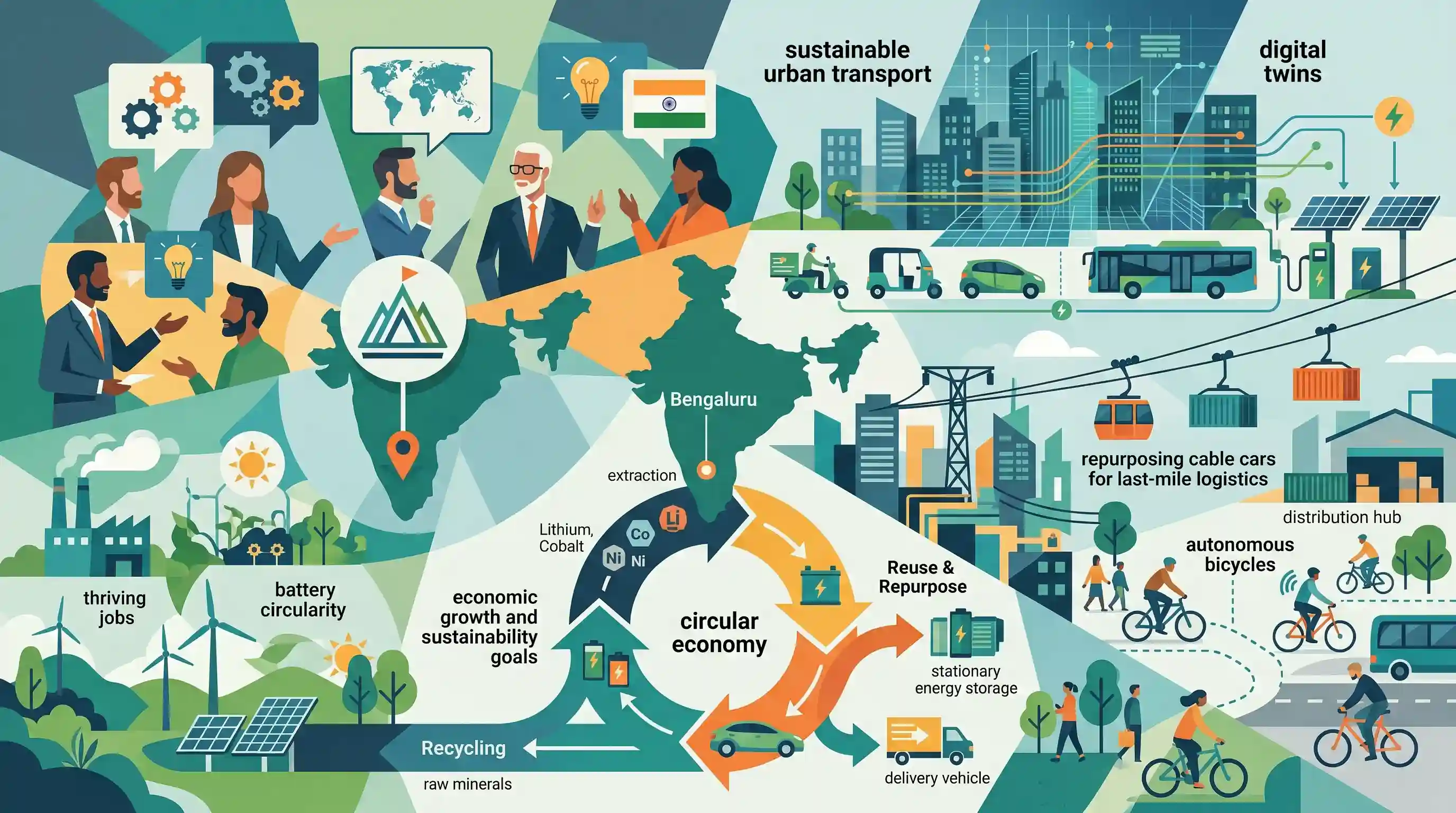
The Global Clean Mobility Summit in Bengaluru, organized by Micelio Mobility, highlighted India's potential to lead the global transition to sustainable transportation. International and domestic experts discussed innovative urban concepts like 'digital twins,' repurposing cable cars for last-mile logistics, and the development of autonomous bicycles. The event also saw the launch of a crucial report on battery circularity, aiming to create sustainable supply chains for electric vehicles and align the mobility sector with India's broader economic growth and sustainability goals.
Key Points
- The Global Clean Mobility Summit was organized in Bengaluru by Micelio Mobility to accelerate innovation in clean and sustainable transportation.
- Jan Kuenne (CEO, Grudig Akademie) highlighted India's leadership in clean mobility, emphasizing the need for 'digital twins' and alternative last-mile solutions like repurposed cable cars and autonomous bicycles.
- Raman C.V. of Maruti Suzuki India described clean, connected, and customer-centric mobility as a key catalyst for India's vision of becoming a developed economy by 2047.
- The summit featured the launch of the report 'Closing the Loop: Building a Roadmap for Battery Circularity in India,' which maps sustainable supply chains and investment pathways for an EV circular economy.
Important Terms
Battery Circularity

A closed-loop system where battery materials (lithium, cobalt, etc.) are reused, refurbished, and recycled to maximize lifespan, minimize waste, and ensure resource security.
UPSC context
GS Paper III: Environment & Economy. Tests strategies for sustainable supply chains and the Battery Waste Management Rules, 2022.
Digital Twin
A virtual, real-time 3D replica of a physical system like a city. It uses sensors and AI to simulate scenarios for better urban planning and governance.
UPSC context
GS Paper III: S&T and Infrastructure. Tests knowledge of Industry 4.0 tools in smart city governance and disaster management.
Circular Economy
An economic model replacing 'take-make-dispose' with a 'reduce-reuse-recycle' loop. It aims to eliminate waste, keep resources in use, and regenerate natural systems.
UPSC context
GS Paper III: Economy & Environment. Crucial for understanding sustainable development and India's commitment to SDG 12.
Micelio Mobility
An Indian clean mobility platform and seed fund dedicated to fostering the Electric Vehicle (EV) ecosystem through funding, testing, and industry collaboration.
UPSC context
GS Paper III: Economy/Infrastructure. Highlights the role of private venture capital and startups in India's clean energy transition.
Advanced Chemistry Cell (ACC)
Next-generation batteries that store energy chemically, offering higher efficiency. India supports their domestic production through a specific Production Linked Incentive (PLI) scheme.
UPSC context
GS Paper III: S&T and Economy. Relevant for domestic manufacturing and reducing critical mineral import dependence.
Last-Mile Logistics
The final stage of the supply chain delivering goods to the end consumer. It is a critical focus area for urban congestion and clean transport.
UPSC context
GS Paper III: Infrastructure. Tests knowledge of urban transport challenges and innovative solutions for logistics efficiency.
Prelims Trap
The Battery Waste Management Rules 2022 apply exclusively to Electric Vehicle (EV) batteries.
The 2022 Rules cover ALL battery types—Portable, Electric Vehicle, Automotive, and Industrial. They mandate Extended Producer Responsibility (EPR) across the board, not just for EVs.
Static Concepts Connected
What are the key provisions of the Battery Waste Management Rules, 2022?
- Broad Coverage: Applies comprehensively to all types of batteries, including Portable, Electric Vehicle (EV), Automotive, and Industrial batteries.
- EPR Mandate: Producers and importers are legally obligated to collect, recycle, or refurbish waste batteries, prohibiting disposal in landfills.
- Certificate Trading: Establishes a centralized online portal allowing the exchange and trading of EPR certificates between producers and registered recyclers.
What is a 'Digital Twin' in the context of urban governance?
- Virtual Replica: A highly detailed, dynamic virtual model of a physical asset, system, or city that updates continuously using real-time IoT data.
- Simulation & Optimization: Allows city planners to simulate traffic flows, test infrastructure changes, and predict environmental impacts before physical implementation.
- Sangam Initiative: The Department of Telecommunications launched the 'Sangam: Digital Twin' initiative to revolutionize infrastructure planning across India.
Cross-Topic Patterns
EV Circularity and Critical Minerals
Recycling EV batteries directly reduces India's import dependency on critical minerals like Lithium and Cobalt, aligning urban mobility goals with India's geopolitical critical minerals strategy.
Digital Twins in PM Gati Shakti
Mapping virtual urban replicas meshes with PM Gati Shakti's GIS-based platform, enabling integrated planning of clean mobility and logistics infrastructure without prior physical disruptions.

Expect a multi-statement question linking Digital Twin technology (Sangam initiative) with PM Gati Shakti and urban infrastructure planning.
Linked PYQs · 4
Linked PYQs · 4
- 2023MainsGS3
The adoption of electric vehicles is rapidly growing worldwide. How do electric vehicles contribute to reducing carbon emissions and what are the key benefits they offer compared to traditional combustion engine vehicles?
- 2019MainsGS1
How is efficient and affordable urban mass transport key to the rapid economic development of India?
- 2021MainsGS3
“Investment in infrastructure is essential for more rapid and inclusive economic growth.” Discuss in the light of India's experience.
- 2016MainsGS3
What are 'Smart Cities'? Examine their relevance for urban development in India. Will it increase rural-urban differences? Give arguments for 'Smart Villages' in the light of PURA and RURBAN Mission.
