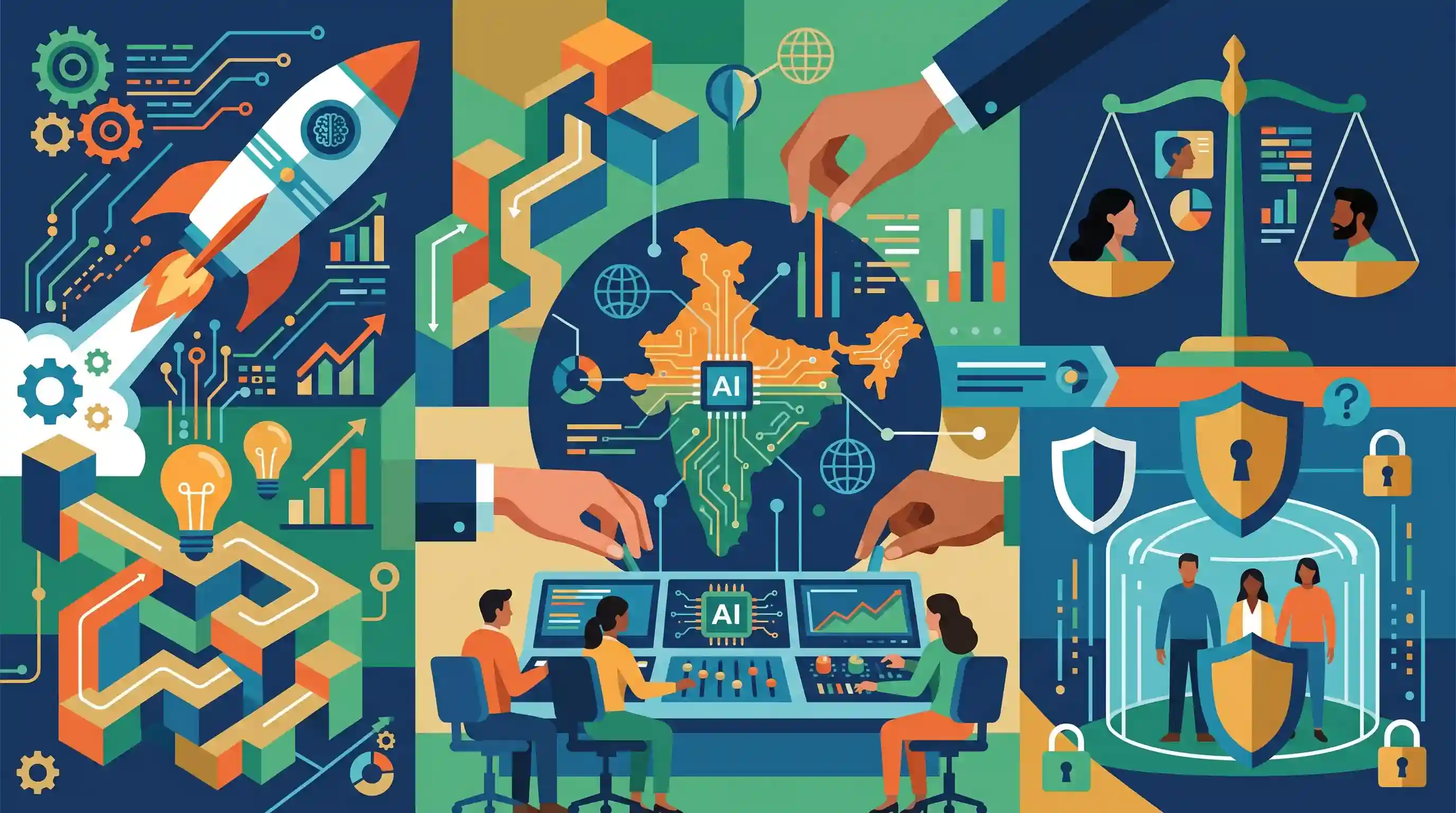
Innovation-first models and human oversight in artificial intelligence
Source:Indian Express ↗
Why It Matters
AI governance is a critical emerging topic for UPSC, overlapping across GS2 (Governance/Policy), GS3 (Science & Technology), and GS4 (Ethics in decision-making). Understanding India's 'innovation-first but safe' approach provides a direct framework for answering questions on technology regulation.
Summary
India is charting a unique path in Artificial Intelligence governance by fostering a pro-innovation ecosystem while mandating robust human oversight. Rather than imposing restrictive regulations, the government is adopting an agile framework that encourages AI development (such as through the India AI Mission) while ensuring systems remain ethical, unbiased, and under human command to protect citizens' digital rights.
Key Points
- India's AI governance model balances the need for rapid technological innovation ('open sky') with strict ethical oversight and accountability ('human command').
- Instead of adopting rigid regulatory frameworks like the EU AI Act, India prefers an agile, pro-innovation approach that fosters research and development while ensuring safety.
- The strategy mandates a 'human-in-the-loop' (HITL) mechanism to prevent AI systems from making autonomous critical decisions without human vetting.
- Ethical guardrails are emphasized to address algorithmic bias, ensure data privacy (aligned with the DPDP Act), and build 'safe and trusted AI' for citizen-centric services.
Important Terms
India AI Mission

A flagship national program (outlay ₹10,372 crore) building indigenous AI capacity through high-end compute infrastructure (10,000+ GPUs), a datasets platform (AI Kosh), and sectoral innovation centers.
UPSC context
GS Paper 3 (S&T); essential for understanding India’s technological sovereignty and AI-driven economic growth strategies.
Global Partnership on Artificial Intelligence (GPAI)
An international multi-stakeholder initiative (founded 2020) promoting human-centric AI development; India served as the 2024 Lead Chair and hosted the New Delhi Summit.
UPSC context
GS Paper 2 (International Relations); critical for India’s role in global tech diplomacy and norm-setting for responsible AI.
Digital Personal Data Protection (DPDP) Act
India’s first comprehensive data protection law (2023) balancing individual privacy rights with lawful data processing, following the Supreme Court’s Puttaswamy judgment declaring privacy a fundamental right.
UPSC context
GS Paper 2 (Governance) & Paper 3 (Internal Security); core for discussing digital rights and data sovereignty.
Ministry of Electronics and Information Technology (MeitY)
The nodal central ministry responsible for IT policy, electronics manufacturing, and digital infrastructure; it oversees the India AI Mission and AI governance guidelines.
UPSC context
GS Paper 2 (Governance); central authority for digital transformation and implementing tech-related legislative frameworks.
Ethical AI
An AI development approach prioritizing fairness, accountability, and transparency while minimizing bias to ensure algorithms respect human rights and social values.
UPSC context
GS Paper 4 (Ethics); vital for analyzing moral challenges in emerging technologies and algorithmic decision-making.
Digital India
An umbrella initiative to transform India into a digitally empowered society through improved infrastructure, e-governance, and digital inclusion (e.g., UPI, India Stack).
UPSC context
GS Paper 2 & 3; the foundational vision for all digital governance, infrastructure, and technology policies in India.
Prelims Trap
"India has enacted a statutory risk-based AI classification framework modeled after the European Union's AI Act."
India specifically avoids the EU's rigid structural model, opting instead for an agile, non-statutory strategy guided by the India AI Mission and existing digital laws.
Static Concepts Connected
What are the core pillars of the India AI Mission?
- Compute Capacity: Democratizing access to high-end AI compute infrastructure (GPUs) for domestic startups and academia.
- AIKosh Datasets: Establishing a unified national platform for high-quality, non-personal datasets to safely train AI models.
- Sovereign AI: Developing indigenous, culturally and linguistically relevant foundational Large Language Models (LLMs) to reduce foreign reliance.
What is 'Human-in-the-Loop' (HITL) in AI systems?
- Active Oversight: A governance model where human operators must review, verify, or approve an AI's proposed decision before final execution.
- Accountability Mechanism: Ensures legal and ethical responsibility remains with a human entity, preventing autonomous systemic failures in critical sectors.
- Bias Correction: Allows human intervention to override or adjust algorithmic outcomes if the machine learning model exhibits discriminatory or skewed results.
Cross-Topic Patterns
DPDP Act as AI's legal bedrock
India manages AI privacy risks not through a new AI-specific law, but by strictly applying the Digital Personal Data Protection (DPDP) Act's principles of data minimization and purpose limitation to AI training.
Tech Diplomacy at GPAI
India leverages its pro-innovation, Global South-centric AI stance to shape international tech-governance rules at multilateral forums like the Global Partnership on Artificial Intelligence (GPAI).

Expect a multi-statement question in 2026 contrasting India's 'pro-innovation' AI strategy and Sovereign AI with the EU's rigid AI Act.
Linked PYQs · 3
Linked PYQs · 3
- 2023MainsGS3
Introduce the concept of Artificial Intelligence (AI). How does Al help clinical diagnosis? Do you perceive any threat to privacy of the individual in the use of Al in healthcare?
- 2024MainsGS4
The application of Artificial Intelligence as a dependable source of input for administrative rational decision-making is a debatable issue. Critically examine the statement from the ethical point of view.
- 2020PrelimsGS1
With the present state of development, Artificial Intelligence can effectively do which of the following? 1. Bring down electricity consumption in industrial units 2. Create meaningful short stories and songs 3. Disease diagnosis 4. Text-to-Speech Conversion 5. Wireless transmission of electrical energy Select the correct answer using the code given below:
