Pharmaceutical R and D Challenges in India Drug Manufacturing
Source:Indian Express ↗
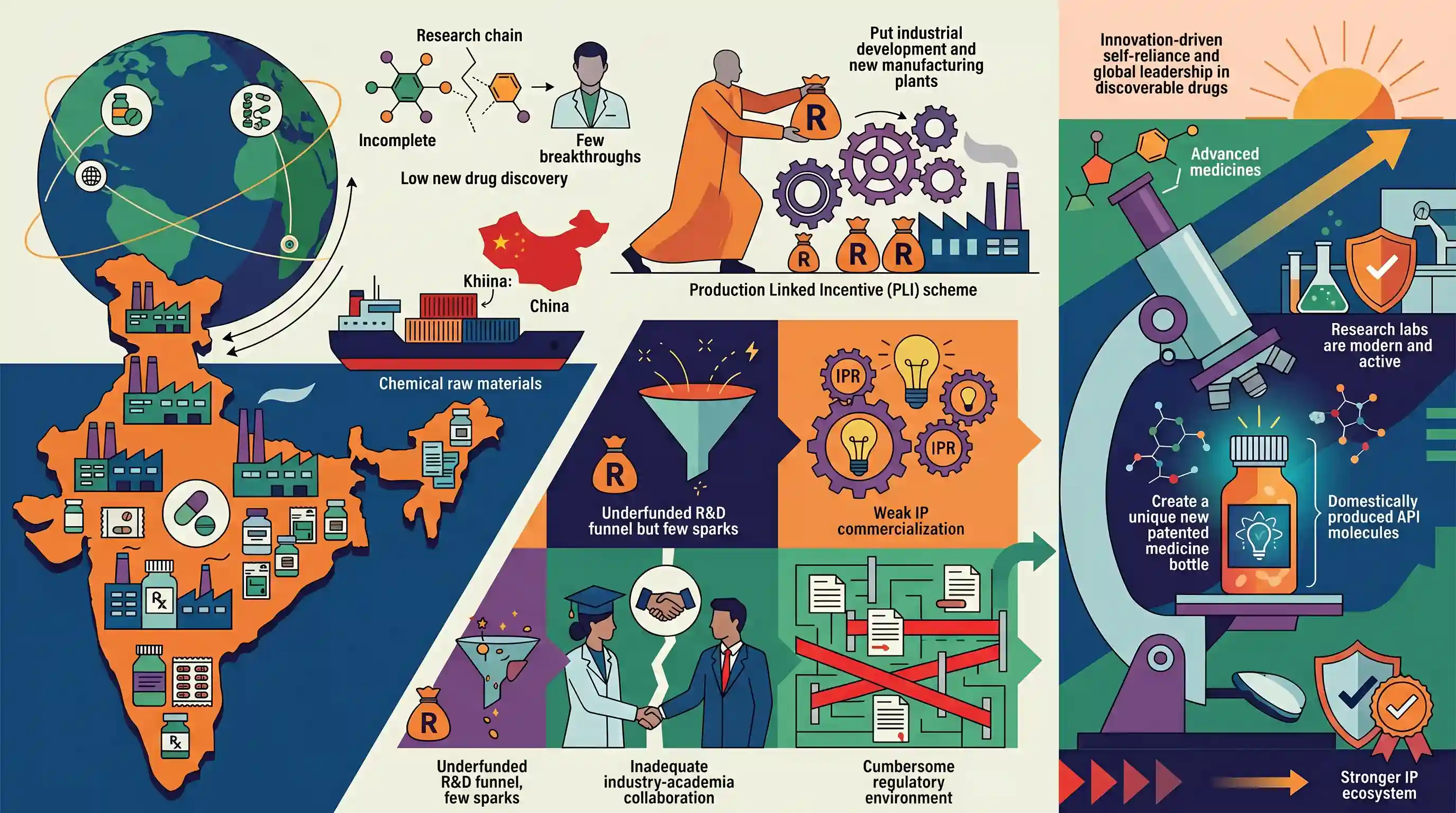
Why It Matters
This article is highly relevant for UPSC aspirants as it bridges the gap between GS2 (Health Policy) and GS3 (Science & Technology, Economy). It provides critical insights into India's pharmaceutical supply chain vulnerabilities, the limitations of current industrial policies like the PLI scheme, and the pressing need for R&D and IPR reforms to ensure long-term self-reliance.
Summary
The article emphasizes a critical paradox in the Indian pharmaceutical industry: despite being a global leader in generic medicine production (the 'pharmacy of the world'), India severely trails behind in discovering and developing new drugs. The sector's over-reliance on generic manufacturing and imports of Chinese Active Pharmaceutical Ingredients (APIs) exposes strategic supply chain vulnerabilities. Although the government has introduced the Production Linked Incentive (PLI) scheme to bolster manufacturing capabilities, structural challenges remain. These include low R&D expenditure by domestic companies, weak commercialization of intellectual property, inadequate industry-academia collaboration, and a cumbersome regulatory environment. To achieve true self-reliance and transition to an innovation-driven powerhouse, India must pivot its focus towards comprehensive R&D investment and streamline its intellectual property ecosystem.
Key Points
- While India is hailed as the 'pharmacy of the world' due to its massive generic drug and vaccine production by volume, it remains an insignificant player in the high-value global market for new drug discovery and development.
- The Indian pharmaceutical sector suffers from chronic underinvestment in Research & Development (R&D) compared to global standards, largely focusing on reverse-engineering off-patent molecules rather than innovating new chemical entities.
- A severe reliance on imported Active Pharmaceutical Ingredients (APIs) and Key Starting Materials (KSMs), primarily from China, creates a strategic vulnerability in India's healthcare supply chain.
- Government initiatives like the Production Linked Incentive (PLI) scheme aim to boost domestic manufacturing capacity but are insufficient on their own to foster a robust ecosystem for core pharmaceutical innovation.
- Structural roadblocks including weak industry-academia linkages, slow commercialization of patents, and a complex regulatory framework for clinical trials hinder India's transition from a volume-based manufacturer to an innovation-driven pharmaceutical powerhouse.
Important Terms
Production Linked Incentive (PLI) Scheme

A central sector scheme providing financial incentives on incremental sales to boost domestic manufacturing of pharmaceutical goods, APIs, and medical devices to enhance global competitiveness.
UPSC context
GS Paper 3 (Economy/Industry); tests strategies for 'Atmanirbhar Bharat' and reducing import dependence in strategic sectors.
Active Pharmaceutical Ingredients (API)
The primary, biologically active chemical component of a drug responsible for its therapeutic effect; India currently imports a significant portion of these from China.
UPSC context
GS Paper 3 (Science & Tech/Indigenization); vital for understanding supply chain vulnerabilities and domestic manufacturing challenges.
Central Drugs Standard Control Organisation (CDSCO)
India's national regulatory body under the Ministry of Health and Family Welfare, responsible for approving new drugs, clinical trials, and setting quality standards.
UPSC context
GS Paper 2 (Governance/Statutory Bodies); crucial for questions on drug safety, healthcare regulation, and institutional frameworks.
Indian Patent Act, 1970
The primary legislation governing intellectual property rights in India, containing safeguards like Section 3(d) to prevent 'evergreening' of patents and ensure affordable medicine.
UPSC context
GS Paper 3 (IPR); tests knowledge of patent regimes and India’s global trade obligations under TRIPS.
Indian Pharmaceutical Alliance (IPA)
An influential association of leading domestic pharmaceutical companies that advocates for the interests of the Indian generic drug industry and R&D-led growth.
UPSC context
GS Paper 2 (Pressure Groups/Health Governance); represents the industry-government interface in policy formulation.
Generic Medicines
Bioequivalent versions of brand-name drugs produced without patent protection, allowing for significantly lower costs and broader healthcare access.
UPSC context
GS Paper 2 (Health/Social Justice); central to India's identity as the 'Pharmacy of the World' and healthcare affordability.
Prelims Trap
India is the largest producer of pharmaceuticals globally by value.
Aspirants confuse volume with value. India ranks 3rd globally by volume (due to mass generics) but only 14th by value due to low new-drug innovation.
Static Concepts Connected
What are APIs and KSMs in pharmaceutical manufacturing?
- Active Pharmaceutical Ingredient: The biologically active component of a drug that produces the intended health effect.
- Key Starting Material: The basic chemical raw materials or intermediates required to manufacture an API.
- Excipients: Inactive substances (like lactose or mineral oil) used as physical carriers for the API.
How does Section 3(d) of the Indian Patent Act impact pharma?
- Prevents Evergreening: Restricts granting patents for incremental changes to existing drugs unless significant therapeutic efficacy is proven.
- Protects Generics: Allows India to mass-produce affordable generic versions of essential medicines, supporting its 'Pharmacy of the World' status despite international pressure.
Cross-Topic Patterns
API dependence + Geopolitics
Over-reliance on Chinese Key Starting Materials links directly to broader strategic discussions on de-risking supply chains, akin to vulnerabilities in semiconductors and critical minerals.
TRIPS + Domestic R&D gap
India champions global TRIPS waivers for equitable medicine access but faces a domestic paradox where its own R&D underinvestment limits the creation of patentable new chemical entities.

A Prelims question contrasting India's pharma production by volume vs value, paired with API import dependency facts, is highly likely.
Linked PYQs · 5
Linked PYQs · 5
- 2024MainsGS3
What is the present world scenario of intellectual property rights with respect to life materials? Although, India is second in the world to file patents, still only a few have been commercialized. Explain the reasons behind this less commercialization.
- 2025MainsGS3
Discuss the rationale of the Production Linked Incentive (PLI) scheme. What are its achievements? In what way can the functioning and outcomes of the scheme be improved?
- 2014MainsGS3
In a globalized world, Intellectual Property Rights assume significance and are a source of litigation. Broadly distinguish between the terms-Copyrights, Patents and Trade Secrets.
- 2024MainsGS2
In a crucial domain like the public healthcare system the Indian State should play a vital role to contain the adverse impact of marketisation of the system. Suggest some measures through which the State can enhance the reach of public healthcare at the grassroots level.
- 2015MainsGS2
Public health system has limitations in providing universal health coverage. Do you think that the private sector could help in bridging the gap? What other viable alternatives would you suggest?
