Eradication of Left Wing Extremism and Security Operations in Bastar
Source:The Hindu ↗
Why It Matters
The eradication of Left-Wing Extremism (LWE) represents a massive milestone in India's internal security management. For UPSC aspirants, this highlights the efficacy of the government's dual approach: kinetic security operations combined with aggressive socio-economic development (e.g., converting security camps to welfare centres). The rehabilitation of surrendered cadres also underscores crucial governance and reintegration policies.
Summary
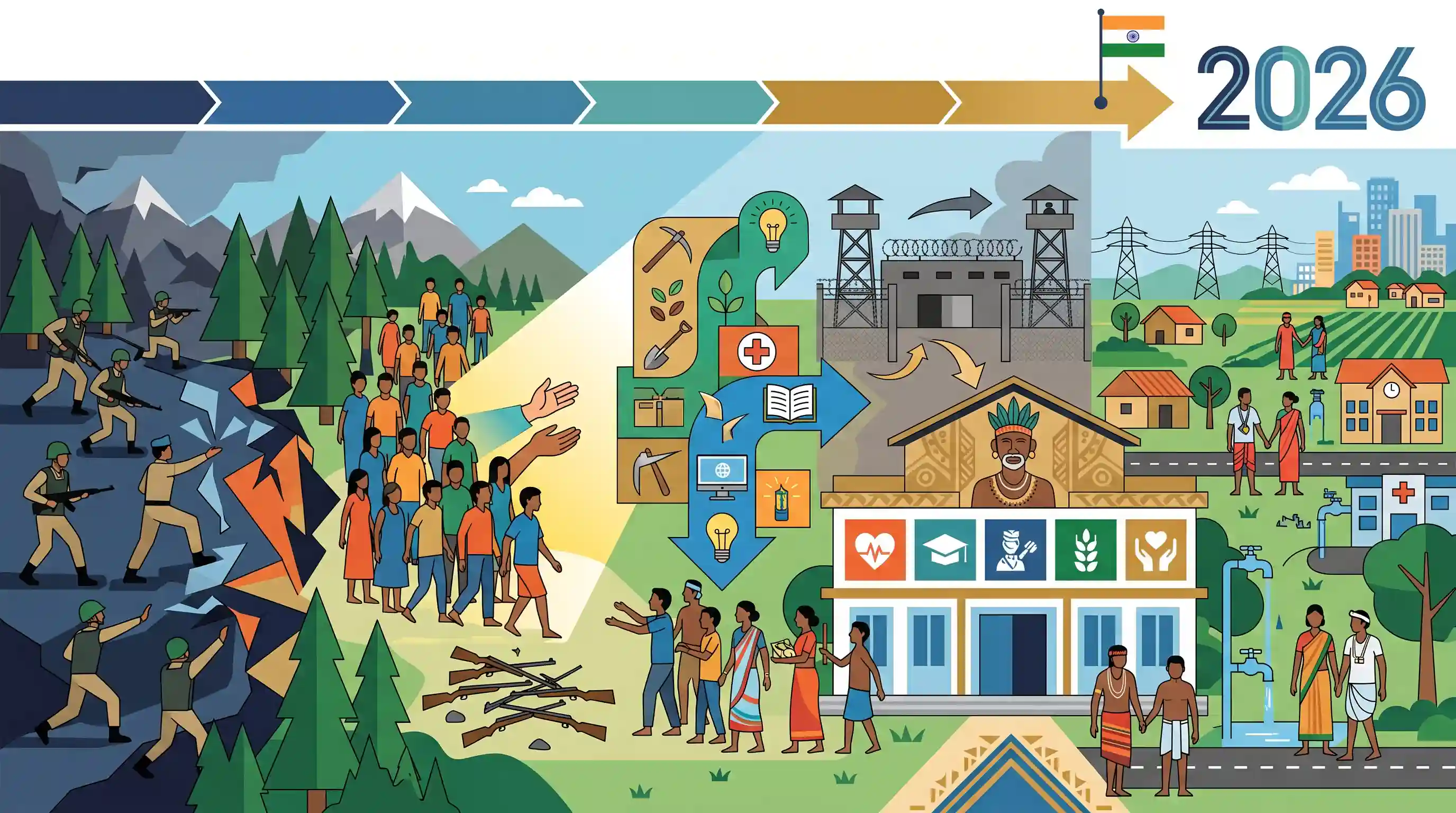
Union Home Minister Amit Shah declared India "Maoist-free," announcing that the remaining vestiges of Left-Wing Extremism (LWE) would be eradicated by March 31, 2026. Highlighting the success of security operations in Bastar, Chhattisgarh, Shah outlined plans to rehabilitate around 3,000 surrendered Naxals through a dedicated government package. The strategy involves converting former security camps into public service delivery centres—named after tribal leader Veer Gundadhur—to bridge the development deficit and ensure the long-term integration of affected regions into the mainstream.
Key Points
- The Union Home Minister declared that India is now free from the menace of Maoism, citing a March 31 deadline for the complete eradication of Left-Wing Extremism (LWE).
- Around 3,000 surrendered Naxals in Chhattisgarh will be rehabilitated and integrated into the mainstream society through a comprehensive package designed by the Modi government.
- Security camps in erstwhile Naxal strongholds like Bastar are being converted into public service centres named after tribal freedom fighter Veer Gundadhur.
- The government promised extensive development in the Bastar region over the next three to five years to address the socio-economic deficit that fueled extremism.
Important Terms
Left-Wing Extremism (LWE)

An umbrella term for radical armed insurgencies in India, primarily led by the CPI (Maoist), aiming to overthrow the state through protracted people's war.
UPSC context
GS Paper III: Internal Security. Tests understanding of non-state actors and challenges to internal security.
Naxalism
A specific Indian form of Maoism originating from the 1967 peasant uprising in Naxalbari, West Bengal, now concentrated in the 'Red Corridor.'
UPSC context
GS Paper III: Internal Security. Differentiates between ideological origins and domestic security impacts.
Niyad Nellanar Scheme
A Chhattisgarh government initiative focused on providing basic amenities—like schools, roads, and healthcare—to villages in core Naxal-affected areas through intensive development.
UPSC context
GS Paper III: Linkages between development and spread of extremism; GS Paper II: Welfare schemes.
Bhumkal Rebellion
A 1910 tribal uprising in the Bastar region against British colonial policies, led by Veer Gundadhur, symbolizing indigenous resistance against external exploitation.
UPSC context
GS Paper I: Modern History (Tribal revolts); GS Paper III: Tribal rights and internal security.
SAMADHAN Doctrine
The Ministry of Home Affairs' multi-pronged strategy to combat LWE: Smart leadership, Aggressive strategy, Motivation, Actionable intelligence, Dashboard-based KPIs, Harnessing technology, Action plan, and No-access-to-financing.
UPSC context
GS Paper III: Internal Security. The standard government framework for addressing the Maoist threat.
Surrender and Rehabilitation Policy
A government framework offering financial incentives, vocational training, and legal leniency to cadres who renounce violence to join the socio-economic mainstream.
UPSC context
GS Paper III: Internal Security. Focuses on conflict resolution and the 'hearts and minds' approach.
Prelims Trap
The Bhumkal Rebellion was a major tribal uprising spearheaded by Birsa Munda in the Chota Nagpur plateau.
The Bhumkal Rebellion (1910) took place in the Bastar region of Chhattisgarh and was led by Veer Gundadhur, not Birsa Munda.
Static Concepts Connected
What are the core pillars of India's anti-LWE strategy?
- Security interventions: Deployment of CAPFs, modernization of state police, and robust intelligence sharing mechanisms (e.g., Multi-Agency Centre).
- Development initiatives: Infrastructure building through schemes like the Road Connectivity Project for LWE Affected Areas and installation of mobile towers.
- Rights and entitlements: Ensuring tribal land rights and self-governance through effective implementation of the Forest Rights Act (FRA) and PESA.
What was the Bhumkal Rebellion of 1910?
- Location: It occurred in the Bastar region of present-day Chhattisgarh.
- Leadership: It was spearheaded by Veer Gundadhur, a prominent leader from the Dhurva tribal community.
- Key Causes: Protest against oppressive British forest conservation policies, land alienation, and exploitation by outside contractors.
Cross-Topic Patterns
Post-conflict transition & PESA
Converting security camps to service centres emphasizes that eradicating extremism requires filling the governance vacuum via decentralized frameworks like PESA and the Forest Rights Act.
Tribal icons in contemporary governance
Naming infrastructure after Veer Gundadhur reflects a continuing UPSC trend of examining tribal uprisings and integrating their lesser-known regional leaders into modern statecraft.

Expect a Prelims pair-matching question on tribal uprisings (Bhumkal/Gundadhur) or a Mains GS3 question on post-LWE development strategy.
Linked PYQs · 4
Linked PYQs · 4
- 2022MainsGS3
Naxalism is a social, economic and developmental issue manifesting as a violent internal security threat. In this context, discuss the emerging issues and suggest a multilayered strategy to tackle the menace of Naxalism.
- 2018MainsGS3
Left Wing Extremism (LWE) is showing a downward trend, but still affects many parts of the country. Briefly explain the Government of India's approach to counter the challenges posed by LWE.
- 2025MainsGS3
The Government of India recently stated that Left Wing Extremism (LWE) will be eliminated by 2026. What do you understand by LWE and how are the people affected by it? What measures have been taken by the government to eliminate LWE?
- 2020MainsGS3
What are the determinants of left-wing extremism in Eastern part of India? What strategy should Government of India, civil administration and security forces adopt to counter the threat in the affected areas?
