India Ascent to Fourth Largest Global Economy and Macroeconomic Growth
Source:The Hindu ↗
Why It Matters
Understanding the drivers of India's rapid GDP growth (such as domestic consumption and credit expansion) as well as stable macroeconomic indicators (low inflation and unemployment) is highly relevant for GS3 questions evaluating the overall health of the Indian economy, its global positioning, and its path toward high middle-income status by 2047.
Summary
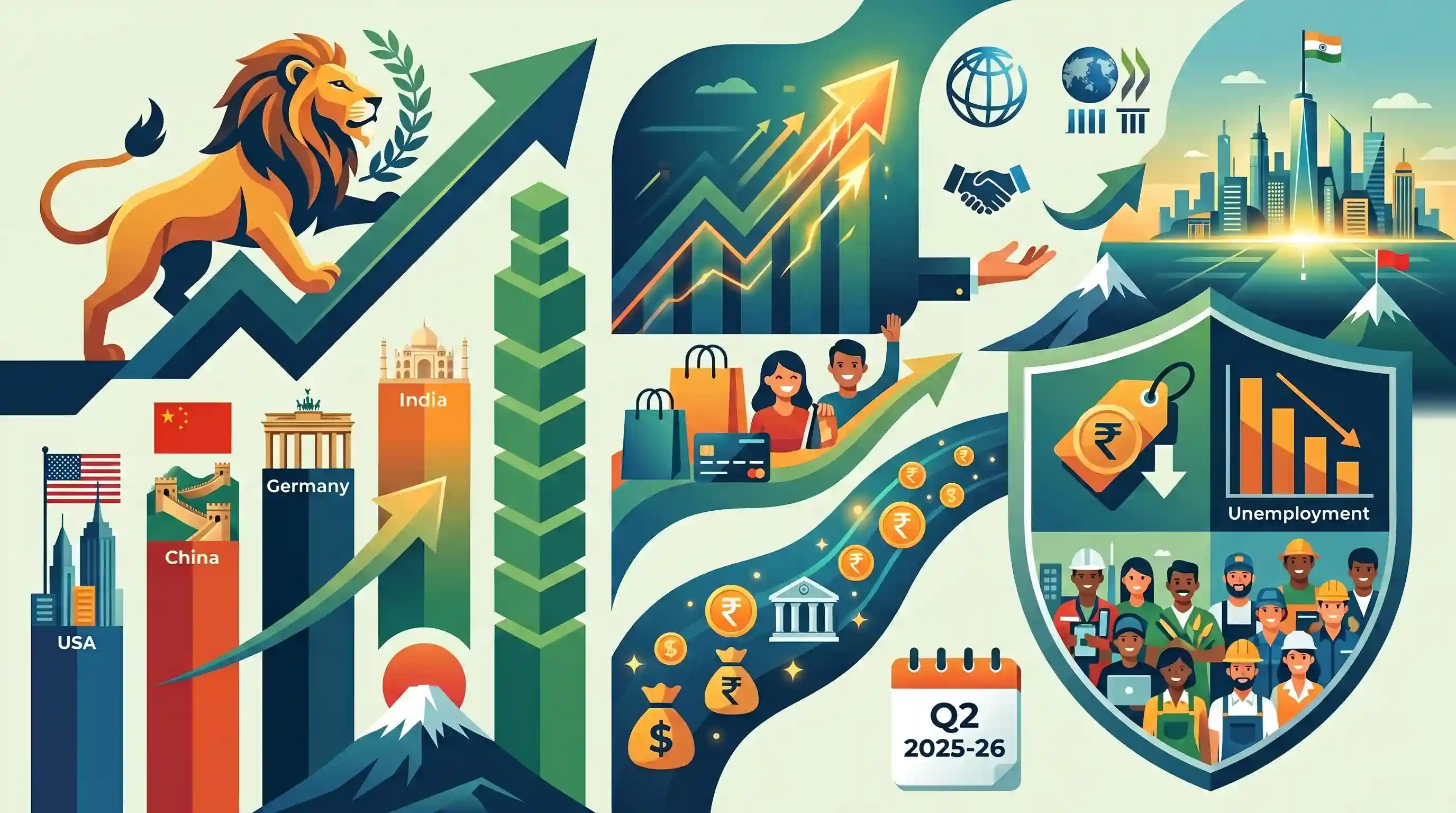
India has officially become the fourth-largest economy in the world, surpassing Japan with a GDP of $4.18 trillion, and is projected to overtake Germany to become the third-largest by 2030 with a $7.3 trillion economy. India’s real GDP grew at an impressive 8.2% in Q2 of 2025-26, supported by robust private consumption, benign financial conditions, and strong credit flows. Stable macroeconomic indicators, including below-threshold inflation and declining unemployment, continue to attract positive growth projections from international organizations like the World Bank, IMF, and OECD. The government has also stated its long-term ambition for India to attain high middle-income status by 2047.
Key Points
- India has surpassed Japan to become the world's fourth-largest economy with a GDP of $4.18 trillion.
- The government projects India's economy will reach $7.3 trillion by 2030, overtaking Germany to become the third-largest globally.
- India's real GDP grew by 8.2% in the second quarter of 2025-26, retaining its status as the fastest-growing major economy.
- Economic growth is primarily driven by robust private consumption, strong urban demand, strong credit flows to the commercial sector, and benign financial conditions.
- Macroeconomic stability has been reinforced by inflation dropping below the lower tolerance threshold, declining unemployment, and improving export performance.
- India aims to transition to high middle-income status by 2047, in line with its long-term development aspirations.
Important Terms
International Monetary Fund (IMF)

A UN-linked agency promoting global monetary cooperation and financial stability. It provides policy advice and short-term financial assistance to member nations facing balance-of-payments difficulties.
UPSC context
GS-III: Economic Growth and Planning. Its World Economic Outlook is a benchmark for India’s macroeconomic stability and global standing.
World Bank
An international financial institution providing loans and grants for long-term development. It focuses on poverty reduction, infrastructure, and human capital in developing nations.
UPSC context
GS-III: Mobilization of Resources. It is a critical partner for India’s infrastructure financing and "Viksit Bharat 2047" developmental goals.
Organisation for Economic Co-operation and Development (OECD)
An intergovernmental organization of 38 countries coordinating economic policies and setting global standards. India is a "Key Partner" engaged in its tax and trade frameworks.
UPSC context
GS-III: Macroeconomic Stability and Growth. Their projections and global tax standards (e.g., Global Minimum Tax) significantly impact India’s fiscal policy.
S&P Global Ratings
The world’s largest credit rating agency, providing essential risk assessments and financial information. It evaluates the creditworthiness of governments and corporations for global investors.
UPSC context
GS-III: Investment Models. Ratings influence India’s sovereign risk profile and the interest rates on its international market borrowings.
Moody's
A major global credit rating agency that assesses a nation’s creditworthiness. Its ratings guide investors on the safety and reliability of government-issued debt.
UPSC context
GS-III: Resource Mobilization. Higher ratings boost investor confidence, essential for attracting Foreign Direct Investment (FDI) into the Indian economy.
Asian Development Bank (ADB)
A Manila-based regional development bank that promotes social and economic growth in Asia. It offers loans, technical assistance, and grants for large-scale projects.
UPSC context
GS-III: Infrastructure and Growth. A key source of multilateral funding for India’s transport, energy, and urban transformation initiatives.
Prelims Trap
India is currently the fourth-largest economy in the world measured by Purchasing Power Parity (PPP).
India has become the fourth-largest by Nominal GDP, but remains the third-largest by PPP. UPSC routinely swaps these metrics to test precise understanding of GDP rankings.
Static Concepts Connected
How does the World Bank classify country income groups?
- Classification Criteria: It uses Gross National Income (GNI) per capita, converted to U.S. dollars using the World Bank Atlas method.
- Income Categories: Economies are divided into four tiers: low, lower-middle, upper-middle, and high-income.
- India's Status: India is currently a lower-middle-income economy, officially aiming for upper-middle-income status (often termed high middle-income) by 2047.
Real vs. Nominal GDP in National Income Accounting
- Nominal GDP: Measures a country's economic output using current market prices, without adjusting for inflation. The $4.18 trillion figure is nominal.
- Real GDP: Measures economic output at constant base-year prices. It filters out inflation to show actual volume growth (e.g., the 8.2% growth rate).
- GDP Deflator: The ratio of nominal GDP to real GDP. It acts as a comprehensive measure of inflation across the entire economy, broader than CPI.
Cross-Topic Patterns
High GDP ranking vs. Per Capita reality
Despite reaching the fourth spot in aggregate nominal GDP, India's HDI and per capita income rankings remain low, fueling the classic "economic growth vs. economic development" debate for GS Paper 3.
Demographic Dividend and Viksit Bharat 2047
Reaching a $7.3 trillion economy by 2030 and middle-income status by 2047 hinges heavily on skilling India's workforce to capitalize on the demographic window closing around 2041.

Expect a 2026 Prelims question mixing India's Nominal (4th) vs PPP (3rd) GDP rankings with World Bank GNI per capita classifications.
Linked PYQs · 3
Linked PYQs · 3
- 2019MainsGS3
Do you agree with the view that steady GDP growth and low inflation have left the Indian economy in good shape? Give reasons in support of your arguments.
- 2020MainsGS3
Define potential GDP and explain its determinants. What are the factors that have been inhibiting India from realizing its potential GDP?
- 2022MainsGS3
Economic growth in the recent past has been led by increase in labour productivity." Explain this statement. Suggest the growth pattern that will lead to creation of more jobs without compromising labour productivity.
