India Ranks as Fourth Largest Global Economy Amid Growth
Source:The Hindu ↗
Why It Matters
Understanding India's GDP growth trajectory, macroeconomic indicators, and the transition from a developing to a high middle-income nation is foundational for the GS3 Economy syllabus. It underscores the drivers of economic resilience (like private consumption) amidst global headwinds.
Summary
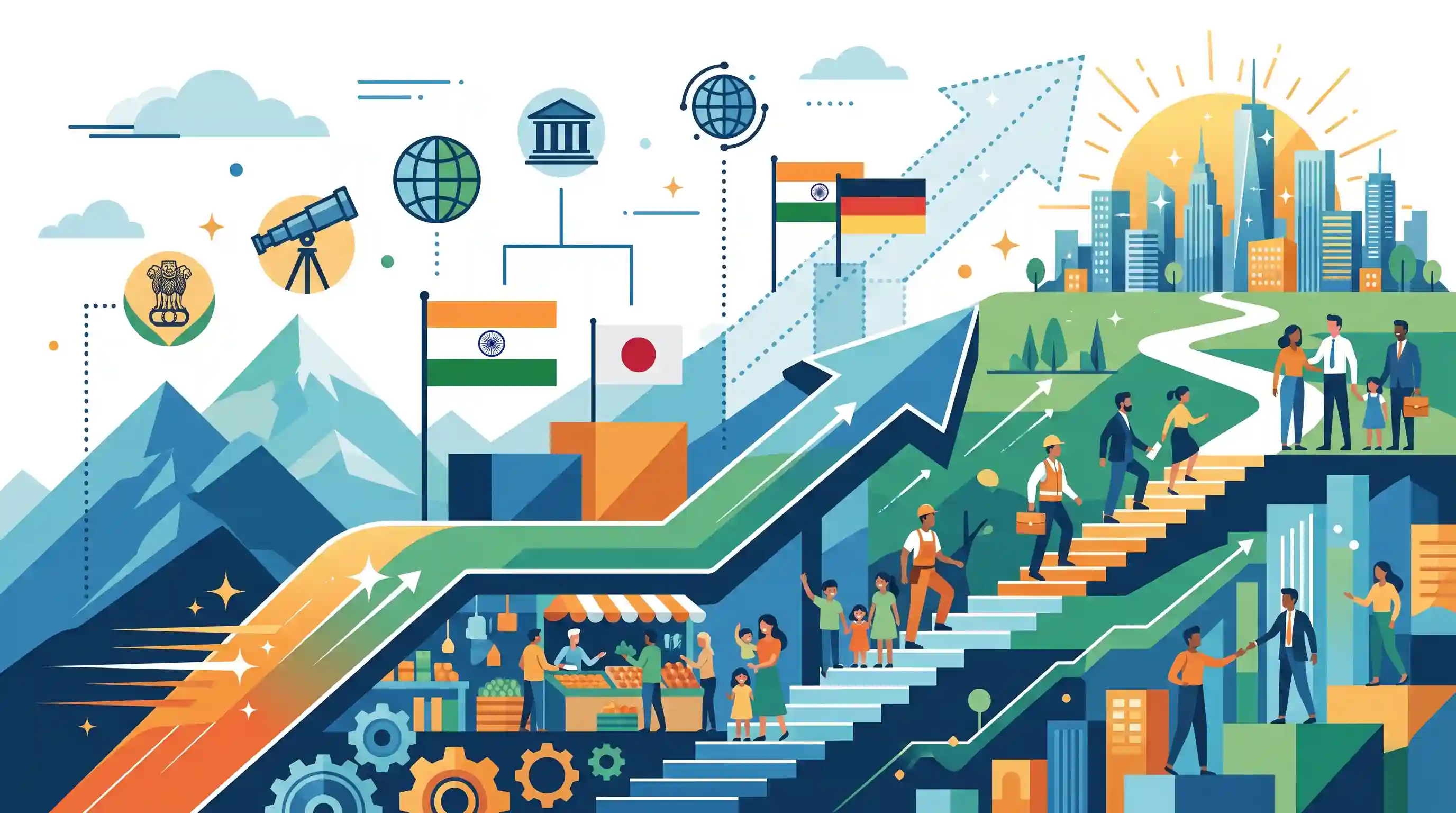
India's real GDP grew by 8.2% in the 2023-24 financial year, enabling the nation to surpass Japan and become the fourth-largest economy in the world with a GDP of $4.18 trillion. Driven by robust private consumption and strong macroeconomic fundamentals, India is currently the fastest-growing major economy. The government projects that India will overtake Germany to become the third-largest economy by 2030, with an estimated GDP of $7.3 trillion. Major global institutions, including the IMF and World Bank, forecast growth between 6.5% and 7% in the near term. These milestones align with India's broader vision of attaining high middle-income and developed country status by 2047.
Key Points
- India's real GDP expanded by 8.2% in FY24, pushing its economy to $4.18 trillion and surpassing Japan to become the world's fourth-largest economy.
- The government expects India to become the third-largest global economy by 2030, reaching a projected GDP of $7.3 trillion and overtaking Germany.
- India's long-term economic roadmap aims for the country to achieve high middle-income and developed nation status by 2047.
- Economic resilience is largely driven by robust private consumption, strong macroeconomic fundamentals, and benign financial conditions despite global geopolitical and trade uncertainties.
- International financial institutions, including the IMF, World Bank, and ADB, forecast India to maintain its position as the fastest-growing major economy with growth rates between 6.5% and 7% for FY25 and FY26.
Important Terms
IMF (International Monetary Fund)

A UN specialized agency (Bretton Woods institution) fostering global monetary cooperation, ensuring financial stability, and providing short-term financial assistance to countries facing balance-of-payment crises.
UPSC context
GS Paper II/III: Important for international institutions and India's external sector stability.
World Bank
A global development cooperative (comprising IBRD and IDA) providing long-term loans, grants, and technical expertise to developing nations to eradicate extreme poverty and promote shared prosperity.
UPSC context
GS Paper II/III: Key for development financing and multilateral institutional reforms.
Asian Development Bank (ADB)
A Manila-based regional bank promoting socio-economic progress in Asia-Pacific. It supports infrastructure, climate resilience, and poverty reduction through loans and grants. India is a founding member.
UPSC context
GS Paper II/III: Significant for regional cooperation and infrastructure projects in India.
OECD (Organisation for Economic Co-operation and Development)
An intergovernmental "policy lab" of 38 developed economies that sets global standards in taxation (BEPS), trade, and governance. India is a "Key Partner" but not a member.
UPSC context
GS Paper II/III: Relevant for global tax standards and international policy benchmarking.
Credit Rating Agencies (Moody’s/Fitch)
Private global firms that assess the creditworthiness of sovereign debt. Their ratings (e.g., Baa3/BBB-) significantly influence a country's borrowing costs and foreign investment inflows.
UPSC context
GS Paper III: Crucial for understanding capital markets and fiscal health indicators.
Prelims Trap
India has recently surpassed Japan to become the fourth-largest global economy in Purchasing Power Parity (PPP) terms.
India is the fourth-largest economy by *Nominal* GDP. In PPP terms, India is actually the *third-largest* economy in the world, behind only China and the USA.
Static Concepts Connected
What is the Middle-Income Trap?
- Definition: A situation where a developing nation reaches middle-income levels but experiences economic stagnation, failing to graduate to a high-income developed economy.
- Root Causes: Typically caused by a loss of cheap-labor competitive advantage in manufacturing, paired with a failure to transition toward high-skill, innovation-driven economic activities.
How is GDP calculated using the Expenditure Method?
- The Formula: GDP = C + I + G + (X-M). It measures total expenditure on final goods and services produced within a country's domestic territory.
- Dominance of PFCE: Private Final Consumption Expenditure (PFCE, or 'C') is the main driver of Indian economic resilience, accounting for approximately 55-60% of total GDP.
Cross-Topic Patterns
Demographic dynamics of GDP rankings
India overtaking Japan and soon Germany highlights divergent demographic trajectories: India's growth leverages its demographic dividend, while Japan and Germany face structural stagnation due to rapidly aging workforces.
Growth vs Development (Kuznets Curve)
Rising absolute GDP often masks widening income disparities. The Kuznets Curve is frequently tested by UPSC to contrast sheer macroeconomic growth with inclusive development and wealth distribution.

Expect a 2026 prelims multi-statement question contrasting India's Nominal vs PPP GDP rankings, paired with Middle-Income Trap concepts.
Linked PYQs · 4
Linked PYQs · 4
- 2021MainsGS3
Explain the difference between computing methodology of India's Gross Domestic Product (GDP) before the year 2015 and after the year 2015.
- 2020MainsGS3
Define potential GDP and explain its determinants. What are the factors that have been inhibiting India from realizing its potential GDP?
- 2018PrelimsGS1
Increase in absolute and per capita real GNP do not connote a higher level of economic development, if
- 2011PrelimsGS1
Economic growth is usually coupled with
