Geopolitical Shifts and India Strategic Engagement in West Asia
Source:The Hindu ↗
हे का महत्त्वाचे आहे
West Asia is fundamental to India's geopolitical and economic interests (energy security, diaspora, trade). Understanding the shifting dynamics—especially China's rise and the fallout of the Israel-Hamas war—is critical for GS2 International Relations and analyzing India's 'Think West' policy.
सारांश
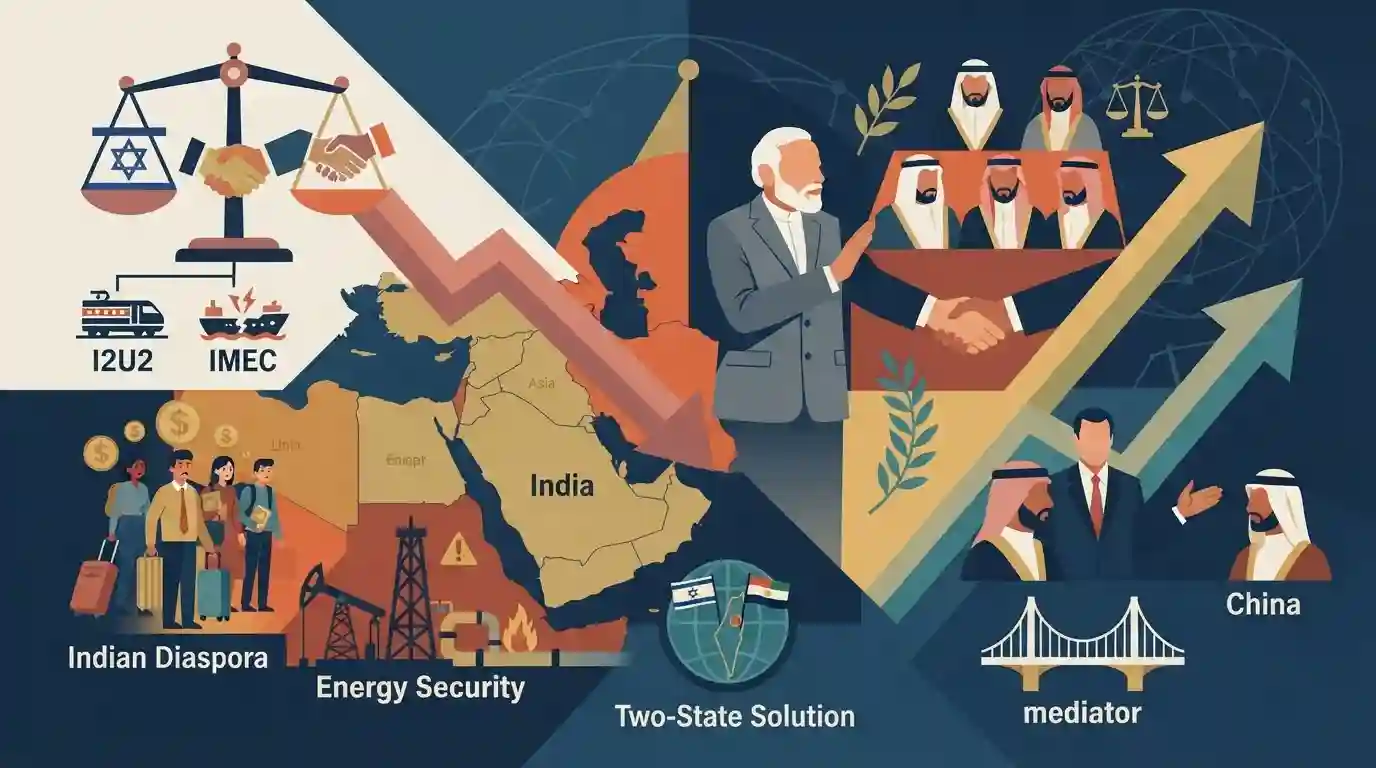
The article contends that India risks losing its strategic and diplomatic influence in West Asia due to a perceived tilt towards Israel during the Gaza conflict and the stalling of key regional projects like IMEC and I2U2. Concurrently, China has expanded its footprint by acting as a regional mediator, notably in the Saudi-Iran rapprochement. Given West Asia's critical importance for India's energy security, trade, and diaspora remittances, the author warns against diplomatic complacency. However, the piece emphasizes that New Delhi still has time to recalibrate its approach by reaffirming a balanced foreign policy, deepening engagement with Arab allies, and advocating for regional stability and the two-state solution.
मुख्य मुद्दे
- India's historically successful diplomatic balancing act between Israel and the Arab world is facing significant strain due to its perceived stance during the ongoing Israel-Gaza conflict.
- Strategic initiatives like the India-Middle East-Europe Economic Corridor (IMEC) and the I2U2 minilateral are stagnating, reducing India's geoeconomic momentum in the region.
- China is rapidly expanding its strategic footprint in the Middle East, acting as a regional peacemaker (such as brokering the Saudi-Iran deal) and filling the diplomatic vacuum.
- Declining influence in West Asia poses direct risks to India's energy security (oil/gas imports) and the welfare of the massive Indian diaspora, which contributes significantly through remittances.
- New Delhi can still course-correct by revitalizing its 'Think West' policy, proactively engaging with key Gulf allies, and reaffirming its commitment to a two-state solution to restore diplomatic balance.
महत्त्वाच्या संज्ञा
India-Middle East-Europe Economic Corridor (IMEC)

A planned infrastructure network of railways and sea routes enhancing trade connectivity between India, the Middle East, and Europe. It is widely viewed as a strategic economic alternative to China's Belt and Road Initiative.
UPSC context
GS Paper II (International Relations). Tests knowledge of India's geostrategic initiatives, connectivity projects, and strategic alternatives to China's BRI in West Asia.
Abraham Accords
A series of US-brokered agreements signed in 2020 that formally normalized diplomatic relations between Israel and several Arab nations, including the UAE and Bahrain, signaling a historic strategic shift in Middle Eastern geopolitics.
UPSC context
GS Paper II (International Relations). Important for analyzing West Asian geopolitics, regional stability, and their downstream impacts on India's diplomatic maneuvering and diaspora.
I2U2
A strategic partnership formed in 2021 by India, Israel, the UAE, and the US, often termed the "West Asian Quad." It focuses on joint investments in water, energy, transportation, space, health, and food security.
UPSC context
GS Paper II (Bilateral Groupings). Tests understanding of India's multi-alignment strategy, shifting alliances in West Asia, and geo-economic cooperation beyond traditional security frameworks.
पूर्वपरीक्षा सापळा
"India has officially abandoned the two-state solution in favor of Israel ties."
Despite growing strategic and defense ties with Israel, India has consistently maintained its official support for a negotiated two-state solution for Palestine.
संबंधित स्थिर संकल्पना
What is the I2U2 grouping and its primary focus?
- Members: India, Israel, United Arab Emirates (UAE), and the United States.
- Geoeconomic Focus: Focuses on joint investments in six mutually identified areas: water, energy, transportation, space, health, and food security.
- Nature: Often dubbed the "West Asian Quad," it is strictly non-military and fundamentally driven by economic cooperation and private sector capital.
What are the structural components of IMEC?
- Origin: Announced at the 2023 G20 New Delhi Summit under the Partnership for Global Infrastructure and Investment (PGII).
- Two Corridors: Comprises an Eastern corridor (connecting India to the Arabian Gulf) and a Northern corridor (connecting the Gulf to Europe).
- Infrastructure Scope: Designed to include a reliable cross-border ship-to-rail transit network, alongside electricity cables, hydrogen pipelines, and high-speed data cables.
आंतर-विषय नमुने
Think West + Energy Security vulnerabilities
The stagnation of West Asian diplomacy directly hits GS3 Energy Security. Regional instability threatens critical sea lanes, risking higher crude prices and a wider Current Account Deficit for India.
China's shift: from economics to strategic mediator
China is shifting from purely infrastructure diplomacy to active geopolitical mediation (e.g., Saudi-Iran pact), forcing a reassessment of India's traditional non-aligned balancing act in its extended neighborhood.

Expect a multi-statement question contrasting I2U2's economic mandate with IMEC's transit goals, alongside India's Palestine stance.
संबंधित PYQ · 2
संबंधित PYQ · 2
- 2025MainsGS2
"Energy security constitutes the dominant kingpin of India's foreign policy, and is linked with India's overarching influence in Middle Eastern countries.” How would you integrate energy security with India's foreign policy trajectories in the coming years?
- 2018MainsGS2
“India’s relations with Israel have, of late, acquired a depth and diversity, which cannot be rolled back.” Discuss.
