Strait of Hormuz Closure Risks on Indian Energy Security
Source:Indian Express ↗
Why It Matters
It provides a practical application of macroeconomic concepts (imported inflation, currency depreciation, RBI's trilemma) directly tied to geopolitical events, which is crucial for GS3 Economy and GS2 International Relations.
Summary
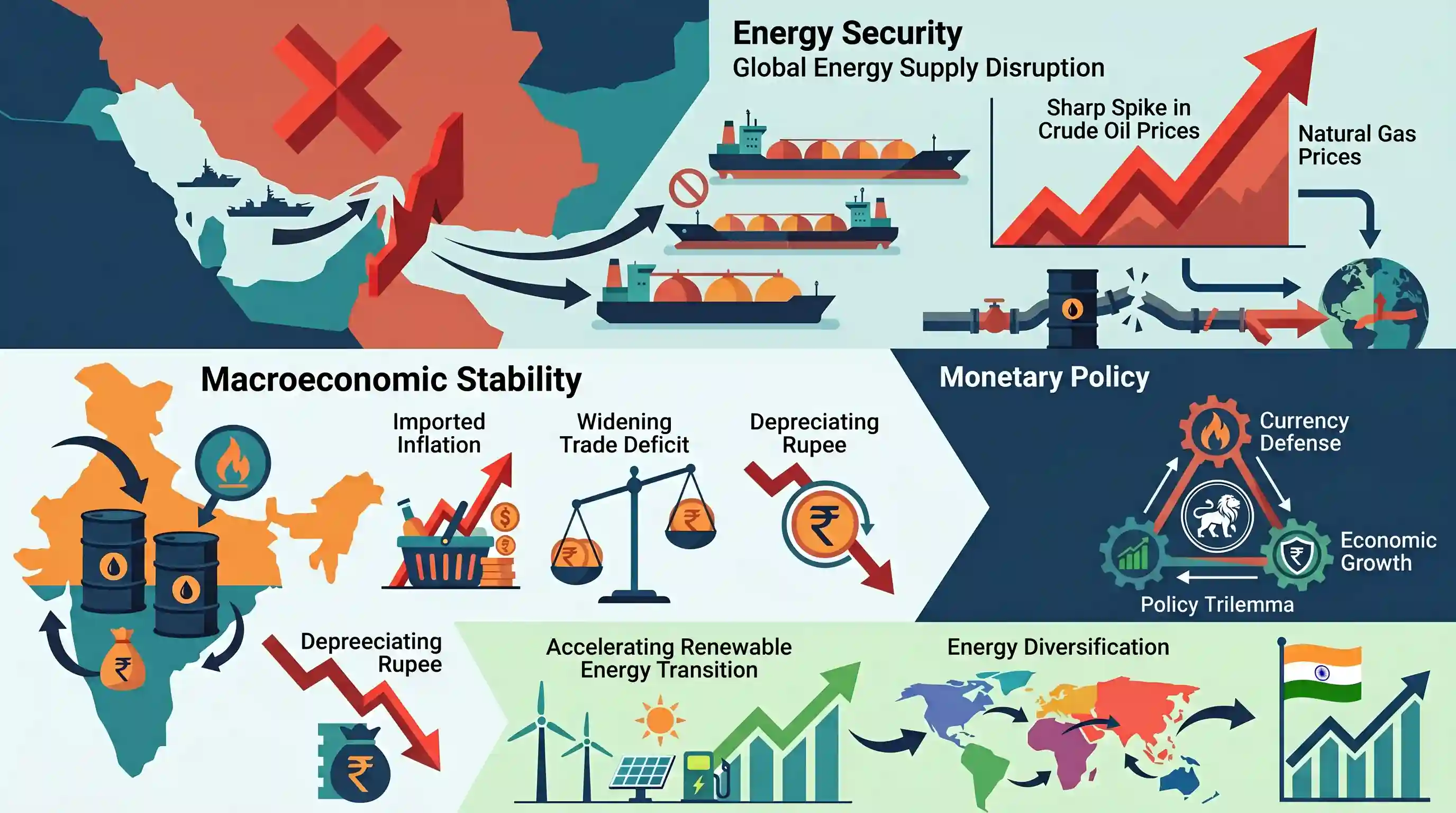
The article analyzes the potential economic and strategic fallout for India if a geopolitical conflict involving Iran leads to the closure of the Strait of Hormuz. Such a crisis would severely disrupt global energy supplies, causing a sharp spike in crude oil and natural gas prices. For India, which relies heavily on this maritime chokepoint for its hydrocarbon imports, this translates to severe imported inflation, a widening trade deficit, and a depreciating rupee. The situation would put the RBI in a complex policy trilemma—balancing inflation control, currency defense, and economic growth. Ultimately, the scenario highlights the urgent need for India to diversify its energy sources and accelerate its transition to renewable energy and alternative fuels to secure long-term macroeconomic stability.
Key Points
- A potential conflict involving Iran could lead to the blockade of the Strait of Hormuz, a critical maritime chokepoint for global oil and gas supplies.
- India is exceptionally vulnerable due to its high dependence on Middle Eastern crude oil and LNG imports routed through this strait.
- Supply disruptions would cause an immediate spike in international energy prices, leading to severe imported inflation and increased fuel costs domestically.
- The macroeconomic fallout would include a widening current account deficit, rapid depreciation of the rupee against the dollar, and the depletion of forex reserves.
- The Reserve Bank of India (RBI) would face a severe macroeconomic trilemma: whether to raise interest rates to curb inflation, intervene to defend the rupee, or maintain rates to prevent growth stagflation.
- The crisis underscores the strategic necessity for India to diversify its energy import sources geographically and accelerate its transition towards renewables, biofuels, and electric mobility.
Important Terms
Strait of Hormuz

A narrow waterway between Iran and Oman connecting the Persian Gulf to the Gulf of Oman; it is the world's most critical oil chokepoint.
UPSC context
GS Paper 1 (Geography) & GS Paper 2 (IR); tested for its strategic importance and location in West Asian geopolitics.
Energy Security
The uninterrupted availability of energy sources at an affordable price, crucial for sustaining economic growth and national sovereignty.
UPSC context
GS Paper 3 (Infrastructure: Energy); central to discussions on India's import dependence and transition to renewable energy.
Imported Inflation
A general rise in domestic prices caused by the increasing cost of imported goods or a depreciation of the domestic currency.
UPSC context
GS Paper 3 (Economy); tested under inflation types and the impact of global commodity price shocks on India.
Trade Deficit
An economic condition where the value of a country's imports of goods and services exceeds the value of its exports.
UPSC context
GS Paper 3 (Economy: External Sector); focuses on Balance of Payments (BoP) and currency stability.
Reserve Bank of India (RBI)
India's central bank and monetary authority, responsible for regulating the banking system, managing foreign exchange, and controlling inflation.
UPSC context
GS Paper 3 (Economy); core topic for monetary policy, banking regulation, and external sector management.
Policy Trilemma
An economic theory stating a country cannot simultaneously maintain a fixed exchange rate, free capital movement, and an independent monetary policy.
UPSC context
GS Paper 3 (Monetary Policy); tests the complexities of managing the rupee amidst global financial volatility.
Strategic Petroleum Reserves (SPR)
Emergency fuel stores maintained by a country to safeguard against potential supply disruptions or global price shocks.
UPSC context
GS Paper 3 (Energy/Security); relevant for India's tactical response to maritime chokepoint closures.
Prelims Trap
The Strait of Hormuz is a critical chokepoint connecting the Red Sea to the Arabian Sea.
Hormuz connects the Persian Gulf to the Gulf of Oman. Bab-el-Mandeb connects the Red Sea to the Gulf of Aden. UPSC frequently swaps these.
Static Concepts Connected
What is the Impossible Trinity in open-economy macroeconomics?
- Exchange Rate: Maintaining a fixed or actively managed currency to defend against severe depreciation.
- Monetary Policy: Operating an independent central bank capable of setting domestic interest rates for inflation targeting.
- Capital Flow: Allowing the free movement of capital in and out of the country.
- The Trilemma: An economy can only achieve two of these three objectives simultaneously, forcing a policy trade-off.
Where are India's Strategic Petroleum Reserves (SPRs) located?
- Phase I Locations: Underground rock caverns situated at Visakhapatnam (Andhra Pradesh), Mangaluru (Karnataka), and Padur (Karnataka).
- Capacity: Phase I provides roughly 9.5 days of emergency crude oil coverage to mitigate global supply shocks.
- Management: Managed by the Indian Strategic Petroleum Reserves Limited (ISPRL) under the Ministry of Petroleum.
Cross-Topic Patterns
Bypassing Hormuz via Chabahar
India's investments in Iran's Chabahar port and the INSTC act as strategic hedges to secure alternative energy and trade corridors bypassing volatile maritime chokepoints.
Oil shocks and the Twin Deficit
Spiking crude imports simultaneously inflate the Current Account Deficit and Fiscal Deficit (if government cuts fuel taxes to absorb price shocks), destabilizing macroeconomic fundamentals.
Renewable Energy as Forex Defense
EV adoption, the National Green Hydrogen Mission, and ethanol blending are increasingly framed in Economic Surveys not just as climate action, but as import-substitution strategies.

Mapping chokepoints (Hormuz/Bab-el-Mandeb) against macroeconomic indicators (CAD/imported inflation) is a high-probability 2026 question.
Linked PYQs · 5
Linked PYQs · 5
- 2025MainsGS2
"Energy security constitutes the dominant kingpin of India's foreign policy, and is linked with India's overarching influence in Middle Eastern countries.” How would you integrate energy security with India's foreign policy trajectories in the coming years?
- 2017MainsGS2
The question of India's Energy Security constitutes the most important part of India's economic progress. Analyze India's energy policy cooperation with West Asian countries.
- 2018MainsGS3
How would the recent phenomena of protectionism and currency manipulations in world trade affect macroeconomic stability of India?
- 2015MainsGS3
Craze for gold in Indians has led to a surge in import of gold in recent years and put pressure on balance of payments and external value of rupee. In view of this, examine the merits of the Gold Monetization Scheme.
- 2023MainsGS3
Discuss several ways in which microorganisms can help in meeting the current fuel shortage.
