Humanitarian medical assistance and regional conflict impact on Iran
Source:Indian Express ↗
Why It Matters
The article serves as a practical example for GS2 answers on how people-to-people ties and soft power diplomacy can strengthen bilateral relations, especially with nations facing geopolitical isolation or regional conflict. It also provides a case study of how the Israel-US-Iran conflict directly disrupts humanitarian aid and civilian infrastructure.
Summary
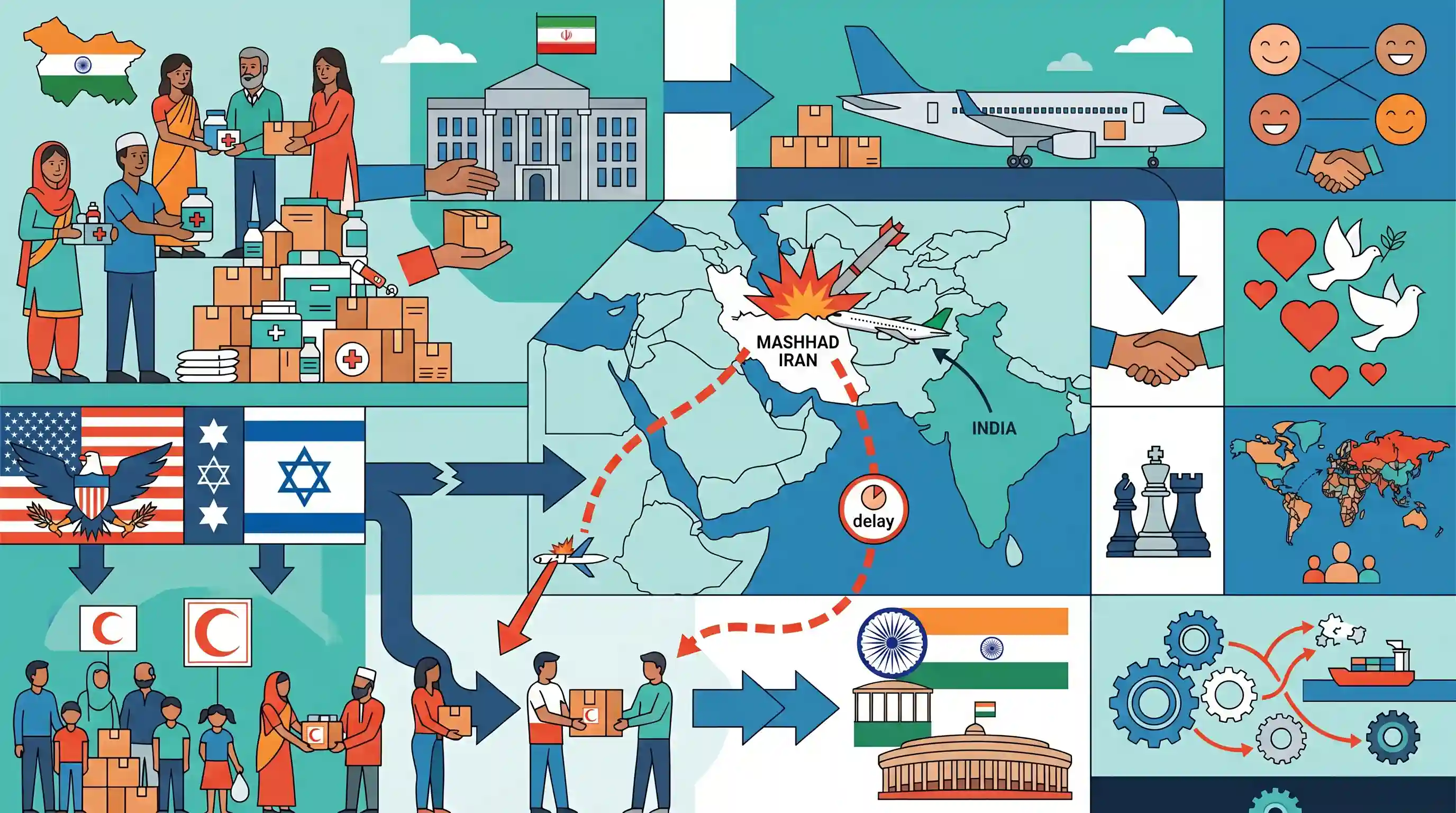
A 40-tonne consignment of medical supplies, funded by voluntary donations from the Indian public (notably from Kashmir), was dispatched to Iran by the Iranian embassy in New Delhi. The humanitarian shipment was received by the Iranian Red Crescent Society but faced delays due to an air strike at Mashhad airport that damaged the designated Mahan Air aircraft. These disruptions, occurring amidst broader US-Israeli strikes in Iran, underscore the volatile security environment in West Asia. Concurrently, the Indian government also delivered official medical assistance, highlighting robust people-to-people solidarity, soft power diplomacy, and India's continued engagement with Iran despite regional conflicts.
Key Points
- The Iranian embassy in New Delhi successfully dispatched 40 tonnes of medical supplies to Iran, purchased entirely using voluntary financial donations from the Indian public, particularly from Kashmir.
- The Government of India also recently delivered its own official consignment of medicines as a humanitarian gesture, showcasing strong bilateral and state-level ties.
- The citizen-led shipment was delayed by two weeks due to an air strike at Mashhad airport that damaged the Mahan Air aircraft scheduled to carry the cargo.
- Ongoing US-Israeli strikes in Iran (such as the recent targeting of Tehran's Sharif University of Technology) are negatively impacting civilian infrastructure and delaying international humanitarian supply chains.
- This development highlights the role of 'soft power' and deep-rooted people-to-people solidarity in anchoring India-Iran relations amidst turbulent West Asian geopolitics.
Important Terms
India-Iran Bilateral Relations

A strategic partnership based on energy security, connectivity (e.g., Chabahar Port), and civilizational ties, navigating global sanctions and regional stability.
UPSC context
GS Paper II (International Relations); tests strategic autonomy and regional connectivity (INSTC).
Soft Power Diplomacy
The ability of a country to influence others through attraction and persuasion—using culture, values, and humanitarian aid—rather than military or economic coercion.
UPSC context
GS Paper II (IR); focuses on India's global image and humanitarian outreach.
Red Crescent Society of the Islamic Republic of Iran
Iran's primary humanitarian organization, part of the International Red Cross Movement, responsible for disaster relief, search-and-rescue, and managing medical supplies during crises.
UPSC context
GS Paper II (International Institutions) and GS Paper III (Disaster Management).
Vienna Convention on Diplomatic Relations
A 1961 international treaty establishing the legal framework for diplomatic relations, including the rights, duties, and immunity of diplomatic missions and their staff.
UPSC context
GS Paper II (International Law); relevant for understanding embassy functions and jurisdictional immunity.
Humanitarian Diplomacy
The use of humanitarian action and aid to advance diplomatic objectives, maintain communication during conflict, and alleviate suffering across borders.
UPSC context
GS Paper II (IR); tests India's role as a net security and aid provider.
Mahan Air
A private Iranian airline frequently targeted by international sanctions; its operational disruptions highlight the impact of regional conflicts on civilian aviation and logistics.
UPSC context
GS Paper II (Geopolitics); illustrates the intersection of global sanctions and regional supply chains.
Prelims Trap
Financial and medical shipments to Iran directly violate US CAATSA and secondary sanctions.
Humanitarian aid (food, medicine, disaster relief) is explicitly exempt from US Treasury (OFAC) sanctions. Aspirants often confuse broad economic sanctions with total embargoes.
Static Concepts Connected
What is India's 'De-hyphenation' policy in West Asia?
- Independent engagement: Engaging with two adversarial nations independently based on mutual interests, rather than viewing their bilateral relationship through a single comparative lens.
- Classic example: India maintains robust defense and technology ties with Israel while concurrently delivering aid and developing connectivity infrastructure (Chabahar) with Iran.
What is the International North-South Transport Corridor (INSTC)?
- Multi-modal network: A 7,200-km multi-mode network of ship, rail, and road route connecting India, Iran, Azerbaijan, and Russia to reduce freight time to Europe.
- Geopolitical leverage: Bypasses the Suez Canal and provides India direct land access to Central Asia, circumventing the geographical barrier of Pakistan.
- Sanctions bottleneck: Its full potential remains constrained by Western sanctions on both Iran and Russia, which complicate insurance and financial transactions.
Cross-Topic Patterns
Soft Power and Strategic Autonomy
Citizen-led humanitarian aid provides India a non-political avenue to sustain Iranian civilizational relations even when formal economic ties are choked by Western sanctions.
Conflict Zones and Connectivity
Mashhad's location near the Afghan/Turkmen border links West Asian airstrikes directly to India's Central Asian connectivity ambitions and the security of INSTC routes.

Map questions in 2026 will likely pair West Asian conflict zones (Mashhad) with India's Central Asian connectivity routes (INSTC).
Linked PYQs · 3
Linked PYQs · 3
- 2018MainsGS2
In what ways would the ongoing US-Iran Nuclear Pact Controversy affect the national interest of India? How should India respond to this situation?
- 2018MainsGS2
“India’s relations with Israel have, of late, acquired a depth and diversity, which cannot be rolled back.” Discuss.
- 2025MainsGS2
"Energy security constitutes the dominant kingpin of India's foreign policy, and is linked with India's overarching influence in Middle Eastern countries.” How would you integrate energy security with India's foreign policy trajectories in the coming years?
