India Invited to Join US Led Board of Peace for Gaza
Source:The Hindu ↗
Why It Matters
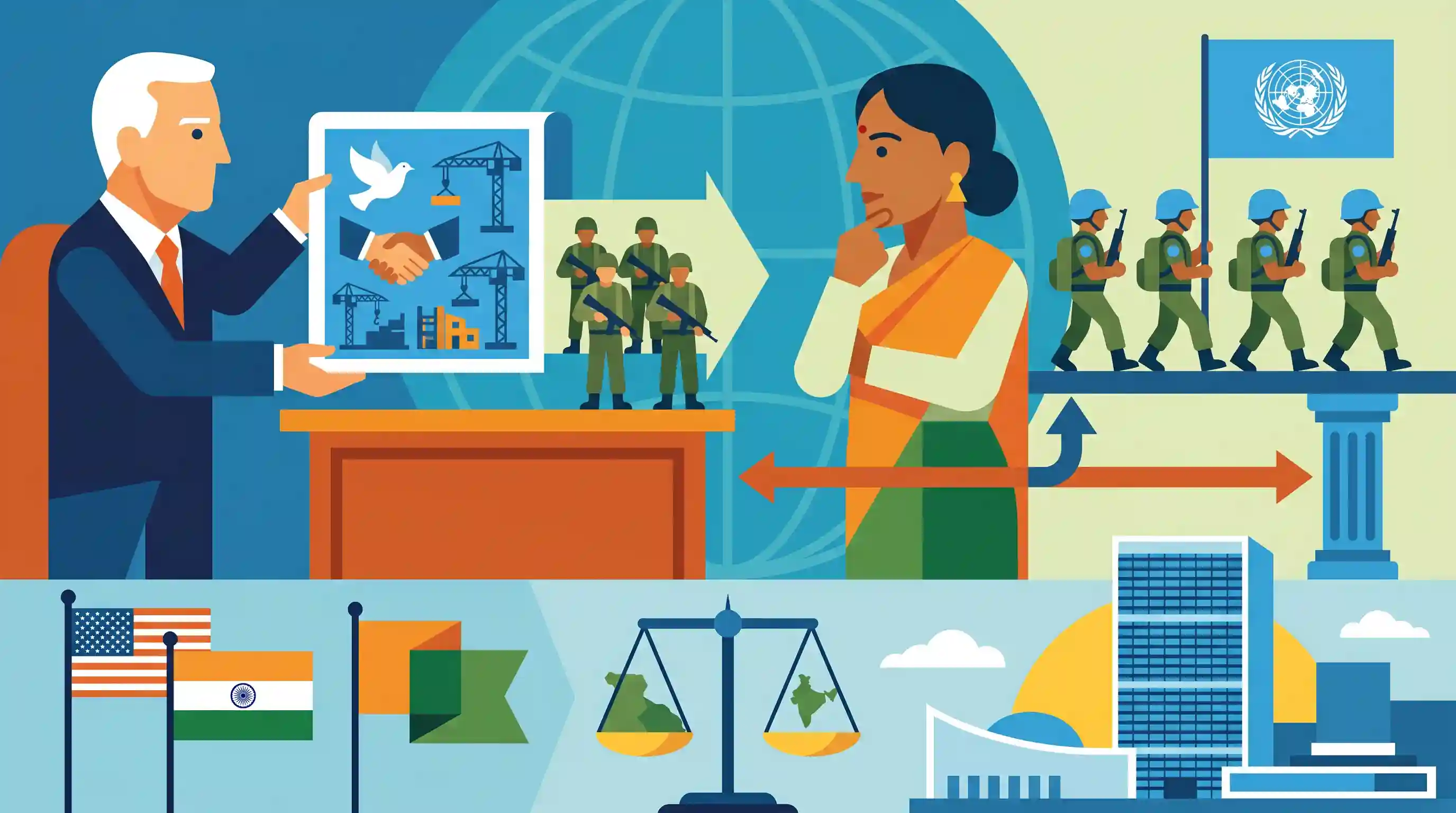
This development highlights the evolving role of India in global geopolitical flashpoints and tests its traditional foreign policy principles regarding multilateralism (UN vs US-led initiatives) and the Israel-Palestine issue. Evaluates India's stance on peacekeeping doctrines.
Summary
The United States has invited India to join President Donald Trump's proposed "Board of Peace" for Gaza, a mechanism intended to oversee a transitional governance structure and redevelopment efforts in a post-conflict, post-Hamas Gaza. The proposal also involves an International Stabilisation Force (ISF). India's potential involvement poses a diplomatic challenge, as New Delhi has historically supported a two-state solution and restricted its overseas military or stabilization deployments strictly to UN-mandated peacekeeping missions. Joining a US-led, non-UN force would mark a departure from its established foreign policy tenets.
Key Points
- The United States has formally invited India to sit on President Donald Trump's 'Board of Peace' for Gaza, a key component of his broader peace plan.
- The Board of Peace, to be headed by Trump, is designed to oversee funding and supervise an expert transitional governance committee, explicitly excluding Hamas.
- The plan envisions a non-UN 'International Stabilisation Force' (ISF) to secure Gaza. India's traditional foreign policy restricts military deployments to UN-mandated peacekeeping operations.
- Participation in the US-led initiative without a formal UN mandate would represent a significant shift in India's geopolitical posture and peacekeeping doctrine.
- India continues to officially back a two-state solution for resolving the Israel-Palestine conflict.
Important Terms
Board of Peace

A transitional governing body proposed by US President Donald Trump to oversee Gaza's post-war administration, reconstruction, and security until 2027, chaired by the US President.
UPSC context
GS Paper II: Bilateral Groupings and Agreements. Tests India's role in US-led Middle East peace initiatives.
International Stabilisation Force (ISF)
A proposed 15,000-20,000 strong multinational peacekeeping force authorized by UNSC Resolution 2803 to demilitarize Gaza, secure borders, and protect civilians post-conflict.
UPSC context
GS Paper II/III: International Relations and Security. Concerns India's overseas military deployment policy.
Two-State Solution
A diplomatic framework proposing two independent states—Israel and Palestine—living side-by-side. India has historically supported this as the only viable solution to the conflict.
UPSC context
GS Paper II: International Relations. Core tenet of India’s West Asia policy.
Hamas
A Sunni Islamist political and militant organization that governed the Gaza Strip since 2007; categorized as a terrorist group by several nations and the US.
UPSC context
GS Paper II: Important International Institutions and Actors. Tests understanding of regional non-state actors.
UN-mandated Peacekeeping
India's doctrinal preference to only deploy its military or stabilization forces abroad under a direct mandate from the United Nations Security Council.
UPSC context
GS Paper II: Foreign Policy. Tests India's commitment to multilateralism and strategic autonomy.
Dehyphenation of Policy
An Indian foreign policy approach of dealing with Israel and Palestine independently based on separate merits, rather than through the lens of their mutual conflict.
UPSC context
GS Paper II: Bilateral Relations. Explains India's shift toward balanced ties in the Middle East.
Prelims Trap
"The International Stabilisation Force (ISF) in Gaza operates under a UN Security Council mandate."
The proposed ISF and Board of Peace are US-led, non-UN initiatives. India's traditional foreign policy strictly restricts overseas deployments to UN-mandated missions.
Static Concepts Connected
What are the core tenets of India's overseas military deployment?
- UN Flag Requirement: India traditionally deploys its armed forces overseas exclusively under the mandate of the United Nations.
- Strategic Autonomy: India avoids joining US-led or NATO-led military alliances or unilateral intervention forces to maintain its strategic autonomy.
- Peacekeeping Focus: Operations typically emphasize peacekeeping, medical assistance, and post-conflict stabilization over offensive combat roles.
What is the framework of the Two-State Solution?
- Core Principle: It envisions an independent State of Palestine coexisting peacefully alongside the State of Israel.
- Pre-1967 Borders: It is generally based on the pre-1967 borders (before the Six-Day War), often with Jerusalem proposed as a shared capital.
- India's Stance: India officially supports a negotiated solution leading to a sovereign, independent, and viable Palestinian State.
Cross-Topic Patterns
Minilateralism vs. UN Multilateralism
The bypass of the UN for a US-led 'Board of Peace' reflects the ongoing paralysis of the UNSC and the global shift towards ad-hoc coalitions for conflict resolution.
India's West Asia De-hyphenation Policy
Balancing a US-led Gaza governance mechanism while continuing to back a sovereign Palestine severely tests India's established 'de-hyphenation' policy in West Asia.

Statements contrasting UN peacekeeping doctrines with non-UN ad-hoc deployments (like the Gaza ISF) are highly probable in 2026 Prelims.
Linked PYQs · 3
Linked PYQs · 3
- 2018PrelimsGS1
The term "two-state solution" is sometimes mentioned in the news in the context of the affairs of
- 2023PrelimsGS1
Consider the following statements: Statement-I: Israel has established diplomatic relations with some Arab States. Statement-II: The 'Arab Peace Initiative' mediated by Saudi Arabia was signed by Israel and Arab League. Which one of the following is correct in respect of the above statements?
- 2015MainsGS2
Discuss the impediments India is facing in its pursuit of a permanent seat in UN Security Council.
