Government investigates data breach at Tata Electronics supply chain
Source:The Hindu ↗
Why It Matters
This incident highlights the growing vulnerability of multinational supply chains and 'trade secrets' to corporate espionage and ransomware. As India positions itself as a global electronics manufacturing hub through schemes like the PLI, maintaining robust cybersecurity standards is critical for retaining investor confidence, securing foreign direct investment, and safeguarding commercial intellectual property.
Summary
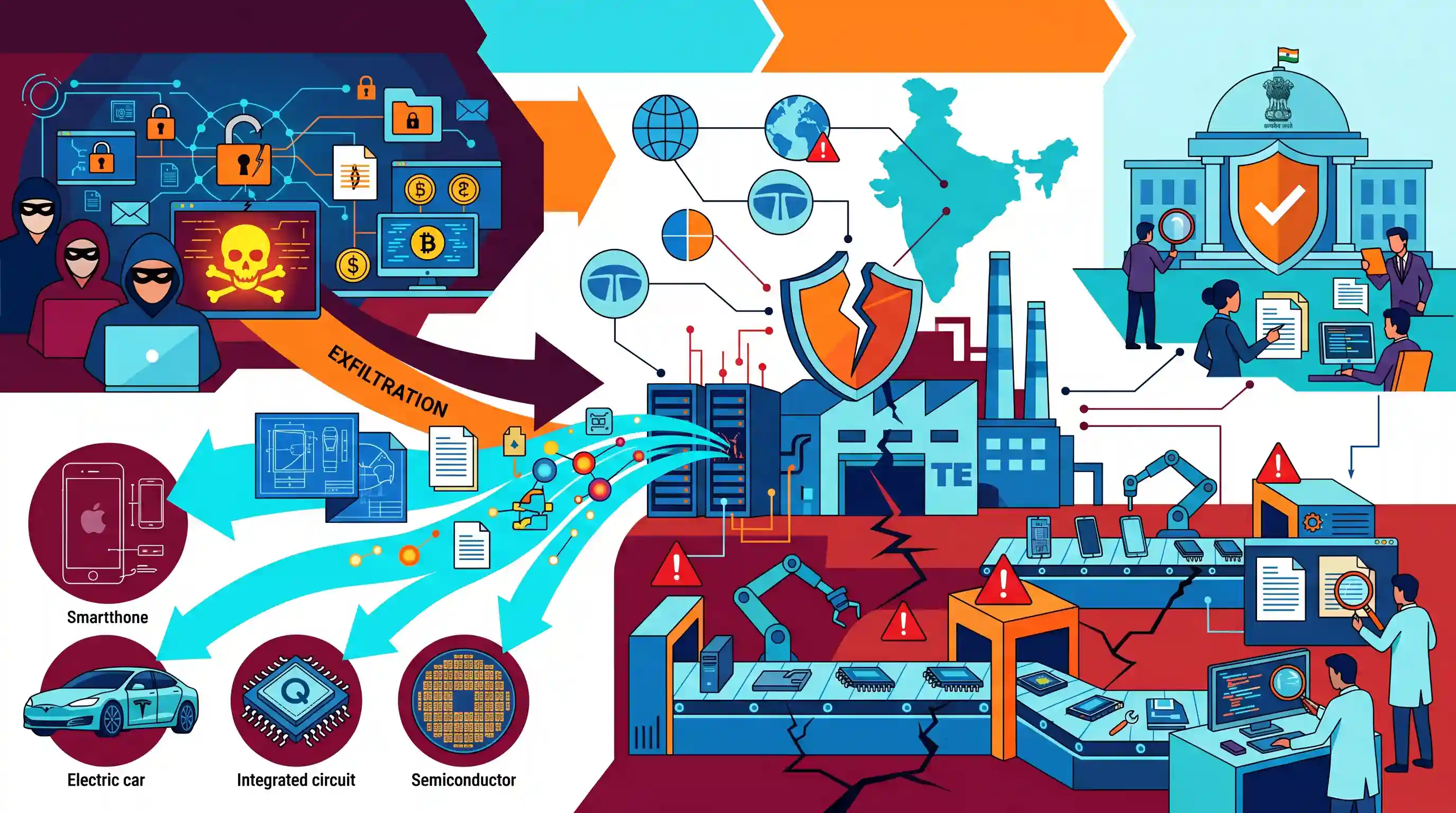
The Indian government is investigating a major cyber breach at Tata Electronics where a ransomware group leaked highly confidential supply chain documents and photos of Apple's unreleased iPhone 18 Pro on the dark web. The leak also compromised proprietary data from other global tech firms including Tesla, Qualcomm, and TSMC. The incident, reported to the Computer Emergency Response Team (CERT-In), has prompted a forensic audit by Tata Electronics, highlighting critical vulnerabilities in high-tech manufacturing supply chains and the security of trade secrets in India.
Key Points
- The Ministry of Electronics and Information Technology (MeitY) has launched an investigation into a major data breach at Tata Electronics, Apple's major manufacturing supplier in India.
- The data breach, conducted by a ransomware group, resulted in the exposure of highly confidential documents on the dark web, including component lists, supplier databases, and photos of Apple's unreleased iPhone 18 Pro models.
- The leak extended beyond Apple to expose sensitive documents of other global tech leaders, including Tesla, Qualcomm, and TSMC.
- The incident has been reported to CERT-In, India's national nodal agency for computer security incidents, to assist with containment and cybersecurity mitigation.
- In response to the leak, Tata Electronics has tightened internal security controls and engaged a global consultant to conduct a comprehensive forensic audit.
Important Terms
Computer Emergency Response Team (CERT-In)

India's national nodal agency for cyber incident response, operating under the Ministry of Electronics and Information Technology as mandated by the Information Technology Act, 2000.
UPSC context
GS Paper III (Cybersecurity). Tests understanding of institutional mechanisms protecting India's cyberspace and critical information infrastructure.
Ministry of Electronics and Information Technology (MeitY)
The executive ministry of the Government of India responsible for IT policy, strategy, electronics manufacturing, cyber laws, and digital governance.
UPSC context
GS Paper II & III (Governance/Technology). Tests awareness of key nodal agencies implementing Digital India and cyber regulatory frameworks.
TSMC (Taiwan Semiconductor Manufacturing Company)
The world's largest semiconductor foundry, headquartered in Taiwan, dominating over 90% of advanced microchip production and crucial to the global electronics supply chain.
UPSC context
GS Paper III (Science & Tech/Geopolitics). Highlights the strategic vulnerability and geopolitical concentration of high-tech manufacturing ecosystems.
Tata Electronics
A key electronics and semiconductor manufacturing arm of the Tata Group, leading India's domestic chip assembly, fabrication, and Apple product manufacturing.
UPSC context
GS Paper III (Economy/Infrastructure). Tests knowledge of private sector integration into global electronics supply chains and Atmanirbhar Bharat goals.
Apple
A global technology giant whose highly secretive hardware supply chain is increasingly diversifying into India, serving as an anchor for domestic high-tech manufacturing.
UPSC context
GS Paper III (Economy/Industrial Growth). Illustrates global value chain integration, foreign direct investment, and trade secret challenges in India.
Prelims Trap
India protects industrial trade secrets under a dedicated, codified Trade Secrets Act aligned with Article 39 of the TRIPS Agreement.
India currently does not have a codified, dedicated statute for trade secrets. It relies on a patchwork of common law, contracts (NDAs), and the BNS, though a bill was proposed in 2024.
Static Concepts Connected
What is the current legal and regulatory framework governing Trade Secrets in India?
- No Dedicated Legislation: India does not have a single, consolidated statute dedicated exclusively to protecting trade secrets or proprietary business data.
- Common Law & Contracts: Protection is primarily enforced through common law principles of equity, action for breach of confidence, and contractual remedies under the Indian Contract Act, 1872.
- Law Commission Proposal: The 22nd Law Commission's 289th Report (March 2024) recommended the draft 'Protection of Trade Secrets Bill, 2024' to formally align with TRIPS Article 39.
What is the statutory mandate and operational role of CERT-In?
- Statutory Basis: Established under Section 70B of the Information Technology (IT) Act, 2000 (amended in 2008), operating under the Ministry of Electronics and Information Technology.
- Mandatory Reporting Window: Mandates all service providers, body corporates, and intermediaries to report specified cybersecurity incidents within 6 hours of identification.
- Nodal Functions: Acts as the national nodal agency for cyber incident response, threat forecasting, issuing advisories, and coordinating systemic defense mitigation.
Cross-Topic Patterns
Electronics PLI vs Industrial Espionage
Securing global electronics supply chains under India's PLI scheme is no longer just an economic goal but a critical cyber-defense requirement to retain multinational investor confidence.
Trade Secrets and Bilateral FTAs
The historical absence of a codified trade secrets law in India remains a significant point of friction in intellectual property chapters during bilateral FTA negotiations with the EU and US.

CERT-In's 6-hour mandate paired with the Law Commission's proposed Trade Secrets Bill, 2024 is ripe for a multi-statement Prelims question.
Linked PYQs · 4
Linked PYQs · 4
- 2014MainsGS3
In a globalized world, Intellectual Property Rights assume significance and are a source of litigation. Broadly distinguish between the terms-Copyrights, Patents and Trade Secrets.
- 2020MainsGS3
Discuss different types of cyber crimes and measures required to be taken to fight the menace.
- 2021MainsGS3
Keeping in view India's internal security, analyse the impact of cross-border cyber attacks. Also discuss defensive measures against these sophisticated attacks.
- 2020PrelimsGS1
In India, under cyber insurance for individuals, which of the following benefits are generally covered, in addition to payment for the loss of funds and other benefits? 1. Cost of restoration of the computer system in case of malware disrupting access to one's computer 2. Cost of a new computer if some miscreant wilfully damages it, if proved so 3. Cost of hiring a specialized consultant to minimize the loss in case of cyber extortion 4. Cost of defence in the Court of Law if any third party files a suit Select the correct answer using the code given below:
