India Potential Role in Gaza International Stabilization Force
Source:Indian Express ↗
Why It Matters
Understanding India's potential role in post-conflict Gaza is crucial for UPSC aspirants as it highlights the evolution of Indian foreign policy, its strategic balancing in West Asia, and its historical and future engagements in UN peacekeeping missions.
Summary
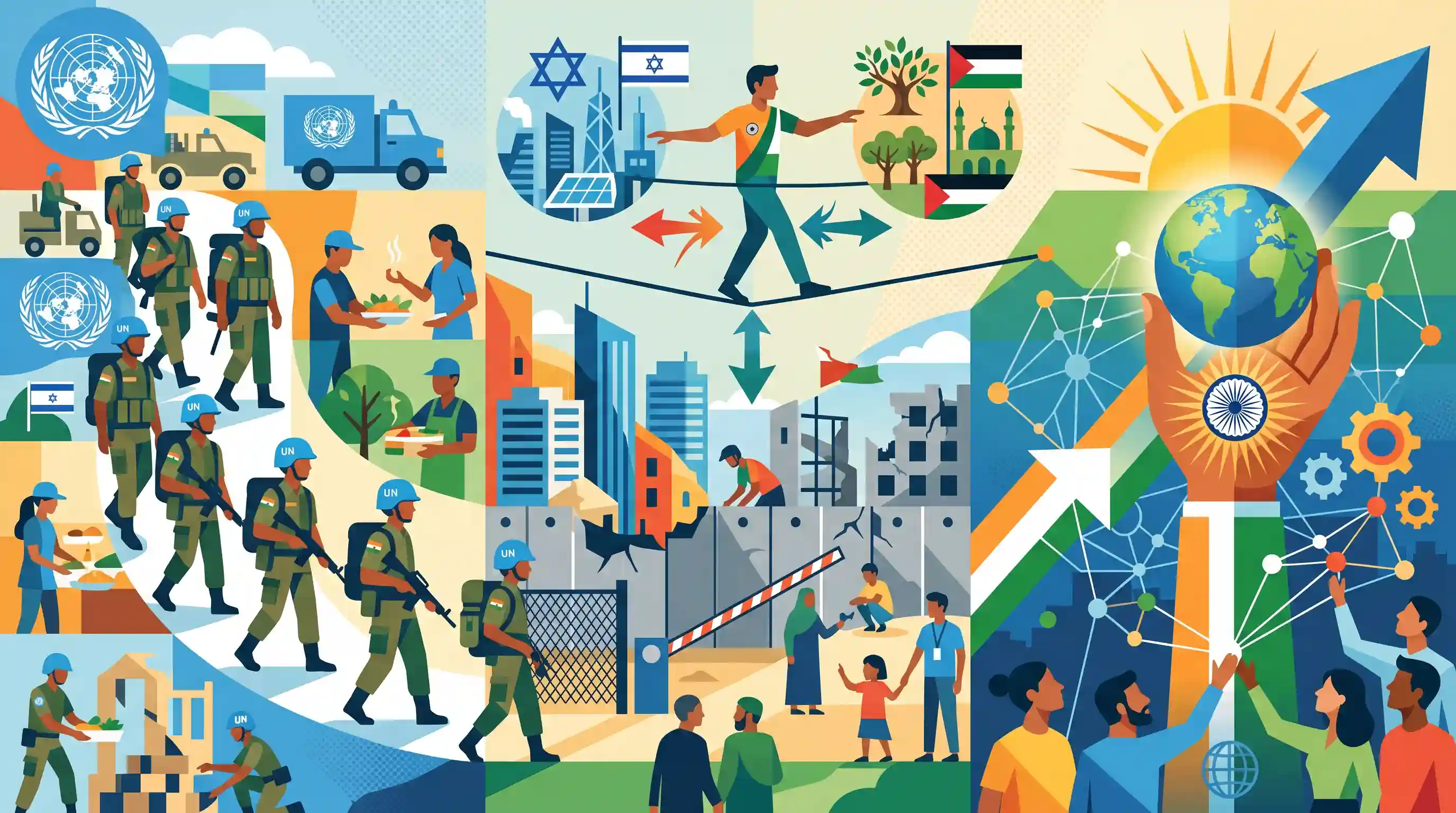
The article explores the prospect of India joining an international stabilisation force in Gaza following the Israel-Hamas conflict. Leveraging its extensive experience in United Nations Peacekeeping Operations, India's participation would underscore a transition from a traditionally risk-averse posture to a proactive global peacemaker role. While navigating the complex geopolitical dynamics of the Middle East and balancing its ties between Israel and Palestine presents significant challenges, such involvement could substantially boost India's strategic footprint and cement its status as a vital stakeholder in global security and regional stability.
Key Points
- A proposal for an international stabilisation force in post-conflict Gaza offers a new avenue for global peace efforts.
- India, with its rich history of contributing to UN Peacekeeping Operations, is seen as a potential key participant in such a force.
- Participating in a Gaza stabilization mission would signal a shift towards a more proactive and risk-taking Indian foreign policy.
- India's involvement would require careful diplomatic navigation given its strategic ties with Israel and historical support for the Palestinian cause.
- Such a move could elevate India's geopolitical profile and solidify its role as a responsible global stakeholder in Middle East stability.
Important Terms
United Nations Peacekeeping Forces (UNPKF)

Multinational military and civilian personnel deployed by the United Nations to maintain peace and security in conflict zones, operating under principles of consent, impartiality, and non-use of force except in self-defense.
UPSC context
GS Paper II: Important International Institutions. Tests knowledge of India's role as a top troop contributor and global security stakeholder.
Two-State Solution
The proposed framework for resolving the Israeli-Palestinian conflict by establishing an independent Palestinian state alongside the State of Israel, based on pre-1967 borders with mutually agreed swaps.
UPSC context
GS Paper II: Bilateral, Regional and Global Groupings. Tests understanding of long-standing diplomatic solutions to Middle Eastern instability.
De-hyphenation Policy
A diplomatic strategy where India maintains independent, high-level bilateral relationships with rival nations (e.g., Israel and Palestine) based on merit and national interest, rather than viewing them through a single lens.
UPSC context
GS Paper II: India’s Foreign Policy. Evaluates India's pragmatic transition from ideological neutrality to strategic interest-based engagement.
International Stabilisation Force (ISF)
A proposed multinational peacekeeping and reconstruction mission for post-conflict Gaza, aimed at facilitating humanitarian aid, training Palestinian security forces, and overseeing regional redevelopment under an international mandate.
UPSC context
GS Paper II: Effect of Policies and Politics of Developed and Developing Countries. Relevant for questions on emerging global security architectures.
Look West Policy
India's strategic framework focused on strengthening ties with West Asian countries (GCC, Iran, Israel) to secure energy interests, protect the Indian diaspora, and enhance maritime security.
UPSC context
GS Paper II: Regional Groupings and India's Interests. Essential for analyzing India's "extended neighborhood" strategy and energy security.
Prelims Trap
"The proposed Gaza stabilisation force is a formal UN Peacekeeping Mission deployed under Chapter VI."
An international stabilisation force is typically an ad-hoc multinational coalition, unlike formal UN Peacekeeping Missions which require a specific UN Security Council mandate.
Static Concepts Connected
What principles govern United Nations Peacekeeping Operations (UNPKO)?
- Charter basis: UNPKOs operate in the grey zone between Chapter VI (pacific settlement) and Chapter VII (enforcement) of the UN Charter.
- Guiding principles: Missions require the consent of the parties, strict impartiality, and non-use of force except in self-defense and defense of the mandate.
- India's contribution: India is historically the largest cumulative troop-contributing country (TCC) to UN missions, deploying over 290,000 personnel since the 1950s.
What characterizes India's "de-hyphenation" policy in West Asia?
- Independent engagement: India manages relations with mutually antagonistic actors (like Israel and Palestine) on their own individual merits rather than linking them in a zero-sum game.
- Strategic flexibility: It allows India to deepen defense and tech partnerships with Israel while simultaneously maintaining historical diplomatic support for a Palestinian two-state solution.
Cross-Topic Patterns
IMEEC trade corridor + Regional stability
India's willingness to engage in Gaza stabilisation is tied to protecting its emerging geoeconomic investments, particularly the India-Middle East-Europe Economic Corridor (IMEEC), from regional volatility.
Net Security Provider + West Asia
Expanding beyond its traditional Indian Ocean Region (IOR) footprint, India's readiness to join Middle Eastern security architectures highlights its evolving "Vishwa Mitra" doctrine.

A 2026 Mains question will likely test India's West Asia policy shift from 'de-hyphenation' to active security provision in conflicts.
Linked PYQs · 4
Linked PYQs · 4
- 2018MainsGS2
“India’s relations with Israel have, of late, acquired a depth and diversity, which cannot be rolled back.” Discuss.
- 2022MainsGS2
How will I2U2 (India, Israel, UAE and USA) grouping transform India's position in global politics?
- 2025MainsGS2
"The reform process in the United Nations remains unresolved, because of the delicate imbalance of East and West and entanglement of the USA vs. Russo-Chinese alliance.” Examine and critically evaluate the East-West policy confrontations in this regard.
- 2023PrelimsGS1
Consider the following pairs: Area of conflict mentioned in news Country where it is located 1. Donbas : Syria 2. Kachin : Ethiopia 3. Tigray : North Yemen How many of the above pairs are correctly matched?
