Monsoon Deficit and Oil Spikes Threaten India Inflation Outlook
Source:Indian Express ↗
Why It Matters
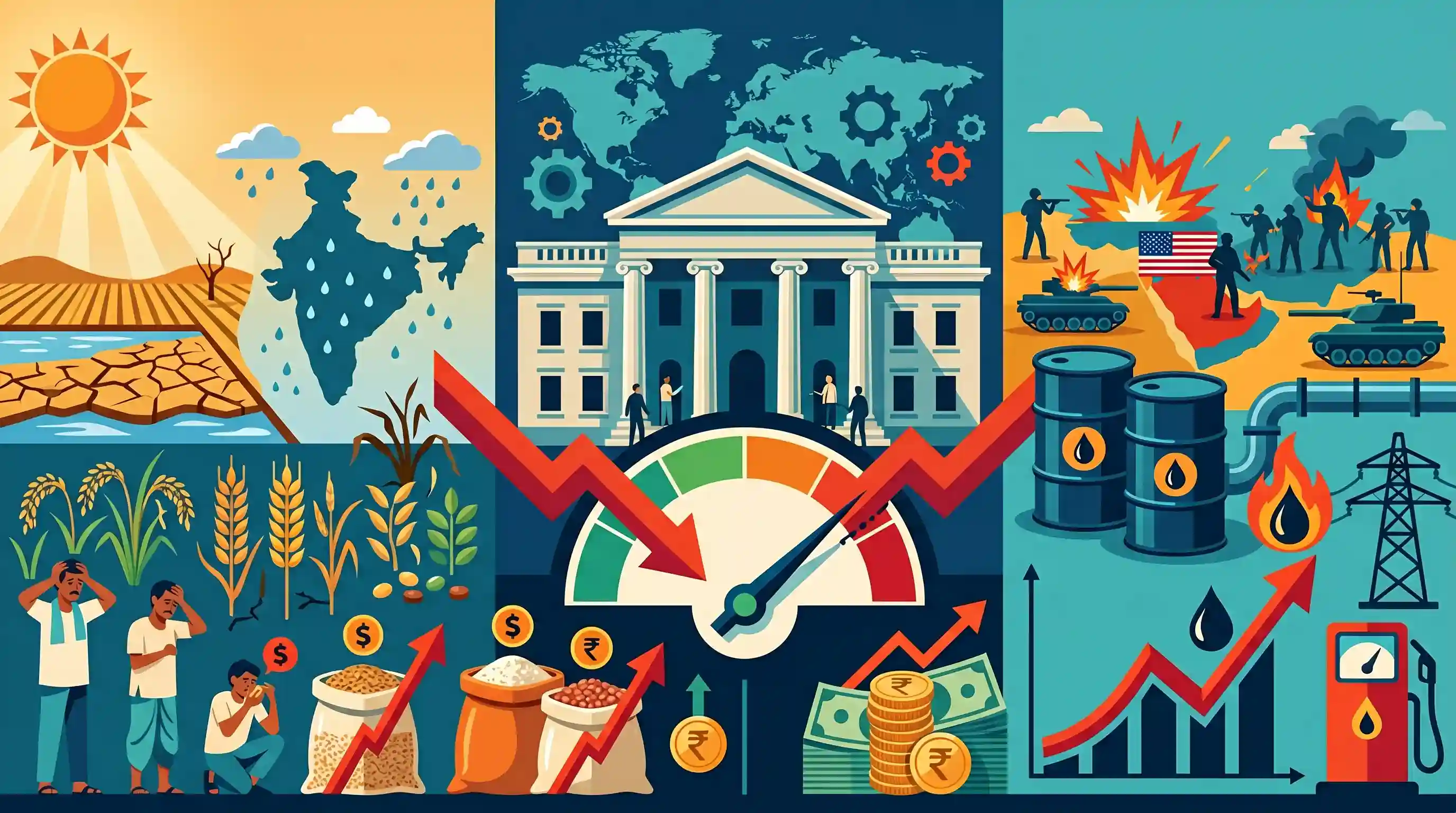
Highlights the vulnerability of the Indian economy to external supply-side shocks, specifically climate anomalies (El Nino) and geopolitical conflicts (West Asia). It demonstrates the practical limitations of RBI's monetary policy and inflation targeting framework when faced with imported inflation and food supply disruptions.
Summary
The article analyzes the twin risks to India's inflation outlook: a below-average monsoon forecast due to potential El Nino conditions, and rising global energy prices driven by the US-Israel war against Iran. While the RBI initially projected CPI inflation at 4.6% assuming a normal monsoon, lower agricultural output from poor spatial rainfall and high Brent crude prices could push retail inflation beyond the central bank's 6% upper tolerance limit.
Key Points
- The RBI projected CPI inflation at 4.6% for 2026-27 under the assumption of a normal monsoon, a target now threatened by climate and geopolitical risks.
- The IMD has forecast a below-average monsoon at 92% of the Long Period Average (LPA), raising concerns about El Nino impacts on spatial and temporal rainfall distribution.
- Weak monsoons and consequent lower reservoir levels could negatively impact both Kharif and Rabi agricultural outputs, exacerbating food inflation.
- Geopolitical tensions from the US-Israel war against Iran are pushing up energy prices, with Brent crude reaching $100 per barrel and increasing costs for LPG and airfares.
- The dual supply-side shocks of an extreme El Nino and sustained high oil prices could push retail inflation above the RBI's 6% upper tolerance limit.
Important Terms
Reserve Bank of India (RBI)

India's central bank, established in 1935, responsible for monetary policy, banking regulation, and maintaining price stability through its flexible inflation targeting framework (4% ± 2%).
UPSC context
GS Paper III: Essential for understanding monetary policy, inflation control, and the institutional framework of the Indian economy.
India Meteorological Department (IMD)
The premier government agency under the Ministry of Earth Sciences responsible for meteorological observations and forecasting, including the vital Southwest Monsoon predictions.
UPSC context
GS Papers I & III: Crucial for topics on Geography (Monsoon) and Agriculture (sowing cycles/food security).
Consumer Price Index (CPI)
An economic indicator that measures the average change in retail prices of a basket of consumer goods and services, used by the RBI to target inflation.
UPSC context
GS Paper III: The primary metric for assessing inflation's impact on households and guiding monetary policy.
El Niño
A climate phenomenon involving the periodic warming of sea surface temperatures in the equatorial Pacific, which often disrupts the Indian monsoon, leading to lower rainfall.
UPSC context
GS Papers I & III: Essential for Geography (Atmospheric Circulation) and Economy (Impact on agricultural output and food inflation).
Central Water Commission (CWC)
A premier technical organization under the Ministry of Jal Shakti that coordinates schemes for the conservation, utilization, and management of water resources, including reservoir monitoring.
UPSC context
GS Papers I & III: Relevant for water resource management, irrigation infrastructure, and drought preparedness.
Brent Crude
A major global price benchmark for sweet light crude oil from the North Sea; its price fluctuations significantly impact India's import bill and inflation.
UPSC context
GS Paper III: Tests understanding of energy security, Current Account Deficit (CAD), and imported inflation.
ICRA
A leading Indian credit rating agency that provides independent research and risk assessments; frequently cited for economic growth and inflation forecasts.
UPSC context
GS Paper III: Represents the role of external analytical agencies in economic forecasting and market sentiment.
State Bank of India (SBI)
India's largest public sector bank, which provides influential economic research reports (e.g., Ecowrap) analyzing inflation, monsoon impacts, and GDP growth.
UPSC context
GS Paper III: Relevant for its role in the financial system and as a key observer of domestic macroeconomic trends.
Prelims Trap
"The RBI's statutory mandate is to keep Core Inflation within the 2-6% tolerance band."
RBI's FIT framework officially targets Headline CPI (which includes volatile food and fuel), not Core CPI, because food constitutes ~46% of India's consumption basket.
Static Concepts Connected
What is the Flexible Inflation Targeting (FIT) framework?
- Mandate: The RBI is mandated to maintain Headline Consumer Price Index (CPI-C) inflation at 4%, with a tolerance band of +/- 2%.
- Statutory Basis: Under the amended RBI Act, 1934, the inflation target is set by the Government of India in consultation with the RBI every five years.
- Failure Threshold: If average inflation breaches the 2-6% band for three consecutive quarters, the RBI must submit a report to the Central Government explaining the failure and proposed remedies.
How does El Niño impact the Indian Monsoon?
- Mechanism: It involves the periodic, abnormal warming of sea surface temperatures in the central and eastern equatorial Pacific Ocean, which alters global atmospheric circulation.
- Trade Winds: This warming shifts the Walker Circulation, weakening the south-east trade winds and disrupting the flow of moisture toward the Indian subcontinent.
- Indian Impact: It typically results in a delayed or deficient South-West monsoon, negatively impacting agricultural output and reservoir levels (though not every El Niño guarantees a drought).
Cross-Topic Patterns
Imported Inflation and Current Account Deficit
Rising Brent crude prices don't just spike domestic inflation; they widen India's Current Account Deficit (CAD) and exert downward pressure on the Rupee, linking monetary policy directly to Balance of Payments.
Climate Risks to MSP and Food Security
Sub-par monsoons limit reservoir storage for Rabi crops, triggering supply shocks. This often forces the government to use export bans and hike MSPs, further embedding sticky food inflation.

Expect a multi-statement prelims question in 2026 linking El Niño ocean temperatures, Headline CPI components, and imported inflation.
Linked PYQs · 3
Linked PYQs · 3
- 2024MainsGS3
What are the causes of persistent high food inflation in India? Comment on the effectiveness of the monetary policy of the RBI to control this type of inflation.
- 2014MainsGS1
Most of the unusual climatic happenings are explained as an outcome of the El-Nino effect. Do you agree?
- 2015MainsGS1
How far do you agree that the behaviour of the Indian monsoon has been changing due to humanizing landscapes? Discuss.
