Consumer Price Inflation Dynamics and Monetary Policy Transmission
Source:Indian Express ↗
આ શા માટે મહત્વનું છે
Understanding inflation trends, the Consumer Price Index, and monetary policy transmission is essential for analyzing macroeconomic stability, purchasing power, and RBI policy responses in India.
સારાંશ
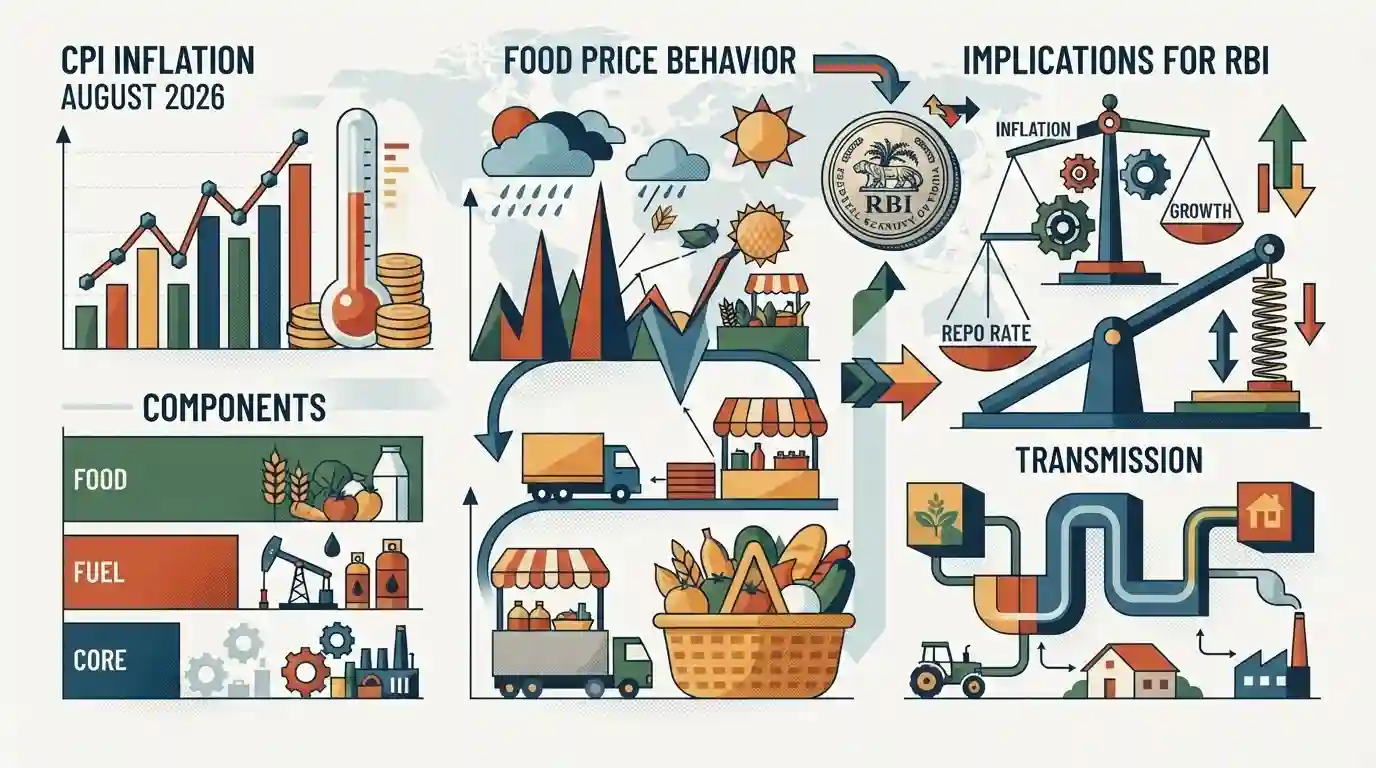
The article explains the trends in India's Consumer Price Index (CPI) inflation for August 2026, analyzing its components, food price behavior, and the implications for the Reserve Bank of India's (RBI) monetary policy decisions and repo rate trajectory.
મુખ્ય મુદ્દા
- India's Consumer Price Index (CPI) inflation trends for August 2026 reflect ongoing adjustments in retail prices and food inflation dynamics.
- The Reserve Bank of India (RBI) relies on CPI-combined inflation to gauge retail price movements and formulate its monetary policy stance, including repo rate decisions.
- Persistent food price pressures and supply-side constraints remain major drivers of headline inflation volatility in India.
મહત્વપૂર્ણ શબ્દો
Flexible Inflation Targeting Framework

A monetary policy strategy where the central bank targets a specific inflation rate (4% with a +/- 2% tolerance band) while keeping growth objectives in mind.
UPSC context
UPSC Paper III (Indian Economy): Core framework for managing price stability, monetary policy design, and macroeconomic stability in India.
Reserve Bank of India
India's central banking institution that controls monetary policy, issues currency, regulates the banking system, and manages foreign exchange reserves.
UPSC context
UPSC Paper III (Indian Economy): Tests understanding of central banking, financial regulation, inflation management, and monetary transmission.
Monetary Policy Committee
A statutory committee headed by the RBI Governor responsible for fixing the benchmark policy repo rate to achieve the inflation target.
UPSC context
UPSC Paper III (Indian Economy): Evaluates institutional mechanisms of monetary policy formulation and interest rate decisions.
National Statistical Office
An office under the Ministry of Statistics and Programme Implementation responsible for collecting, compiling, and publishing key macroeconomic data like CPI and GDP.
UPSC context
UPSC Paper III (Indian Economy): Tests knowledge of official statistics, data collection methodologies, and economic indicators.
પ્રિલિમ્સ ટ્રેપ
RBI uses Wholesale Price Index (WPI) inflation as the primary anchor for its monetary policy framework and repo rate decisions.
Aspirants often confuse Wholesale Price Index (WPI) with Consumer Price Index (CPI); the RBI targets CPI-Combined inflation, not WPI, for its monetary policy stance.
સંલગ્ન સ્થિર ખ્યાલો
What is the composition and mandate of India's Flexible Inflation Targeting (FIT) framework?
- Statutory Basis: Statutory basis: Amended RBI Act of 1934 mandates the central bank to maintain price stability while keeping in mind growth.
- Inflation Target: Target band: Central government notifies the CPI inflation target at 4% with a tolerance band of +/- 2% (2% to 6%).
- Accountability Mechanism: Accountability: If the RBI fails to meet the target for three consecutive quarters, it must submit a formal report to the government explaining the failure.
આંતર-વિષય પેટર્ન
Inflation targeting versus inclusive growth objectives
Monetary policy decisions to curb inflation must balance growth objectives, directly linking RBI's rate hikes or pauses to rural demand, industrial credit off-take, and employment generation trends.
Monetary policy limitations in managing food shocks
Persistent food inflation shocks complicate monetary management, requiring supply-side interventions like buffer stock releases and agricultural supply chain reforms rather than interest rate tools alone.

RBI's flexible inflation targeting framework, CPI components, and MPC voting dynamics are prime candidates for a conceptual statement question.
સંલગ્ન PYQ · 3
સંલગ્ન PYQ · 3
- 2024MainsGS3
What are the causes of persistent high food inflation in India? Comment on the effectiveness of the monetary policy of the RBI to control this type of inflation.
- 2022PrelimsGS1
In India, which one of the following is responsible for maintaining price stability by controlling inflation?
- 2020PrelimsGS1
Consider the following statements: 1. The weightage of food in Consumer Price Index (CPI) is higher than that in Wholesale Price Index (WPI). 2. The WPI does not capture changes in the prices of services, which CPI does. 3. Reserve Bank of India has now adopted WPI as its key measure of inflation and to decide on changing the key policy rates. Which of the statements given above is/are correct?
