India Industrial Output Growth and IIP Base Year Revision
Source:Indian Express ↗
Why It Matters
This provides concrete, current data on the IIP and the real-time macroeconomic impacts of global supply chain disruptions (West Asia war) on key Indian sectors like fertilisers and manufacturing. It also highlights an important upcoming statistical change (base year revision to 2022-23), making it essential for GS3 economy answers and Prelims MCQ topics.
Summary
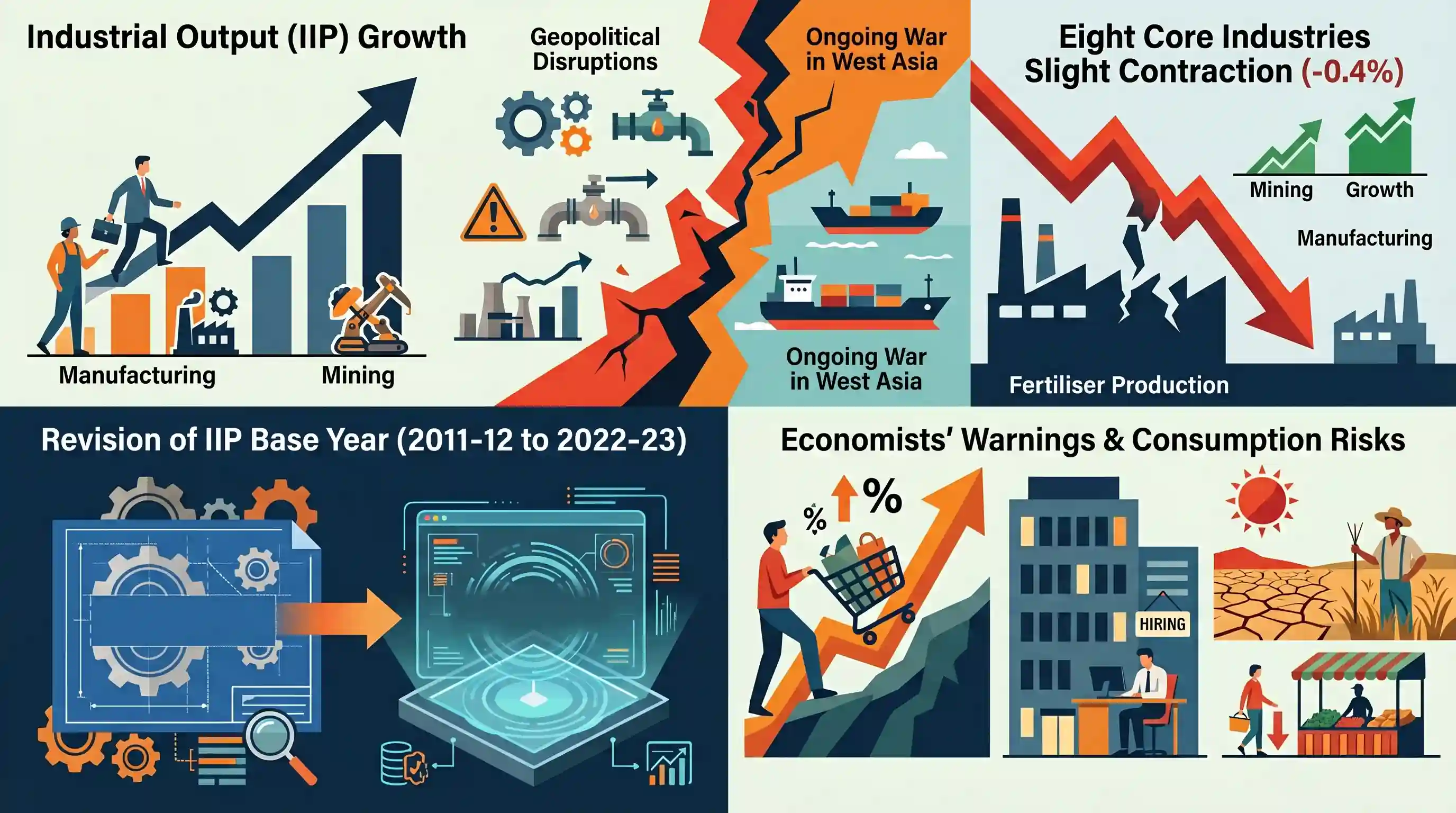
India's industrial output (IIP) grew by 4.1% in March 2026, showing resilience despite disruptions caused by the ongoing war in West Asia. Although the eight core industries saw a slight contraction (0.4%)—exacerbated by a historic 24.6% drop in fertiliser production—mining and manufacturing posted steady growth. The Ministry of Statistics and Programme Implementation (MoSPI) announced an upcoming revision of the IIP base year from 2011-12 to 2022-23 to better reflect current economic realities. Despite this positive macroeconomic indicator, economists warn of delayed impacts from the geopolitical crisis, along with domestic consumption risks stemming from inflation, subdued IT hiring in urban areas, and El Nino's potential effect on rural demand.
Key Points
- India's industrial growth (IIP) for March 2026 stood at 4.1%, cooling slightly from 5.1% in February but defying expectations amid the West Asia war.
- The eight core industries output contracted by 0.4% in March, largely driven by a record 24.6% plunge in fertiliser production due to the geopolitical conflict.
- Mining and manufacturing grew by 5.5% and 4.3% respectively, while electricity generation growth slowed to 0.8%.
- MoSPI is updating the base year for the IIP from 2011-12 to 2022-23 starting June 1, aligning it with recent revisions to the CPI and GDP series.
- Urban consumption is threatened by inflation and sluggish IT hiring, while rural demand faces risks from potential below-normal rainfall due to El Nino.
Important Terms
Index of Industrial Production (IIP)

A monthly indicator tracking the volume of production in Indian industries like mining, manufacturing, and electricity. It serves as a short-term barometer of industrial performance.
UPSC context
GS Paper III: Indian Economy and industrial growth; critical for understanding macroeconomic indicators and manufacturing sector health.
Index of Eight Core Industries
A collection of eight high-impact sectors—Coal, Crude Oil, Natural Gas, Refinery Products, Fertilizers, Steel, Cement, and Electricity—constituting roughly 40.27% of the total IIP weight.
UPSC context
GS Paper III: Infrastructure and Industrial growth. Tests knowledge of key sectors driving the Indian economy and their relative weightage.
Ministry of Statistics and Programme Implementation (MoSPI)
The nodal ministry responsible for the Indian statistical system, including the collection, analysis, and dissemination of official data like GDP, IIP, and CPI through the National Statistical Office (NSO).
UPSC context
GS Paper II & III: Governance and Economic Planning. Tests knowledge of the institutional framework managing national data and infrastructure monitoring.
Consumer Price Index (CPI)
A measure of retail inflation that tracks changes in the price of a fixed basket of goods and services consumed by households, used by the RBI for inflation targeting.
UPSC context
GS Paper III: Indian Economy and Monetary Policy. Fundamental for understanding inflation, purchasing power, and central bank interest rate decisions.
Base Year Revision
A reference point (assigned a value of 100) used for economic comparisons. Revisions ensure that indices like IIP or CPI accurately reflect contemporary consumption and production patterns.
UPSC context
GS Paper III: Economic Measurement. Tests understanding of how structural changes in the economy are captured via statistical updates (e.g., shifting to 2022-23).
Prelims Trap
"Fertilisers hold the highest weight in the Index of Eight Core Industries due to their importance for food security."
Aspirants often assume strategic importance equals statistical weight. Fertilisers actually carry the lowest weight (2.6%) in the core index, while Refinery Products hold the highest (28%).
Static Concepts Connected
How are IIP and the Eight Core Industries compiled and weighted?
- Publishing Authorities: IIP is published monthly by the NSO (MoSPI). The Eight Core Industries index is released by the OEA under DPIIT (Ministry of Commerce and Industry).
- Sectoral Weights: Manufacturing dominates the IIP (~77.6%), followed by Mining (~14.4%) and Electricity (~8%).
- Core Sectors: The 8 core sectors comprise 40.27% of the total IIP. Refinery products hold the highest weight, while fertilisers are last.
What is the economic significance of updating a base year?
- Capturing Structural Shifts: Revising the base year (e.g., to 2022-23) updates the item basket and weights to reflect current structural realities, production technologies, and consumption patterns.
- Data Synchronization: Revisions are typically synchronized across GDP, IIP, and CPI to ensure statistical consistency and reliable cross-comparability among macroeconomic indicators.
Cross-Topic Patterns
Geopolitics + Agri-Subsidies
The West Asia conflict disrupts imports for fertilisers (like rock phosphate and natural gas), directly inflating India's agricultural subsidy burden and linking foreign policy to rural food security.
Climate + Macroeconomic Demand
El Nino's threat to monsoon rainfall impacts rural income, demonstrating how climate anomalies directly filter into manufacturing output data and broad macroeconomic demand.

Expect a 2026 Prelims question mapping the 8 core industries' weights, tied to the newly updated IIP base year of 2022-23.
Linked PYQs · 5
Linked PYQs · 5
- 2015PrelimsGS1
In the 'Index of Eight Core Industries', which one of the following is given the highest weight?
- 2020PrelimsGS1
With reference to chemical fertilizers in India, consider the following statements : 1. At present, the retail price of chemical fertilizers is market-driven and not administered by the Government. 2. Ammonia, which is an input of urea, is produced from natural gas. 3. Sulphur, which is a raw material for phosphoric acid fertilizer, is a by-product of oil refineries. Which of the statements given above is/are correct?
- 2020PrelimsGS1
The term 'West Texas Intermediate', sometimes found in news, refers to a grade of
- 2020PrelimsGS1
Consider the following statements: 1. The weightage of food in Consumer Price Index (CPI) is higher than that in Wholesale Price Index (WPI). 2. The WPI does not capture changes in the prices of services, which CPI does. 3. Reserve Bank of India has now adopted WPI as its key measure of inflation and to decide on changing the key policy rates. Which of the statements given above is/are correct?
- 2021PrelimsGS1
With reference to Indian economy, demand-pull inflation can be caused/ increased by which of the following? 1. Expansionary policies 2. Fiscal stimulus 3. Inflation-indexing wages 4. Higher purchasing power 5. Rising interest rates Select the correct answer using the code given below.
