India Indonesia Expand Defense Ties with Missile Supply
Source:The Hindu ↗
Why It Matters
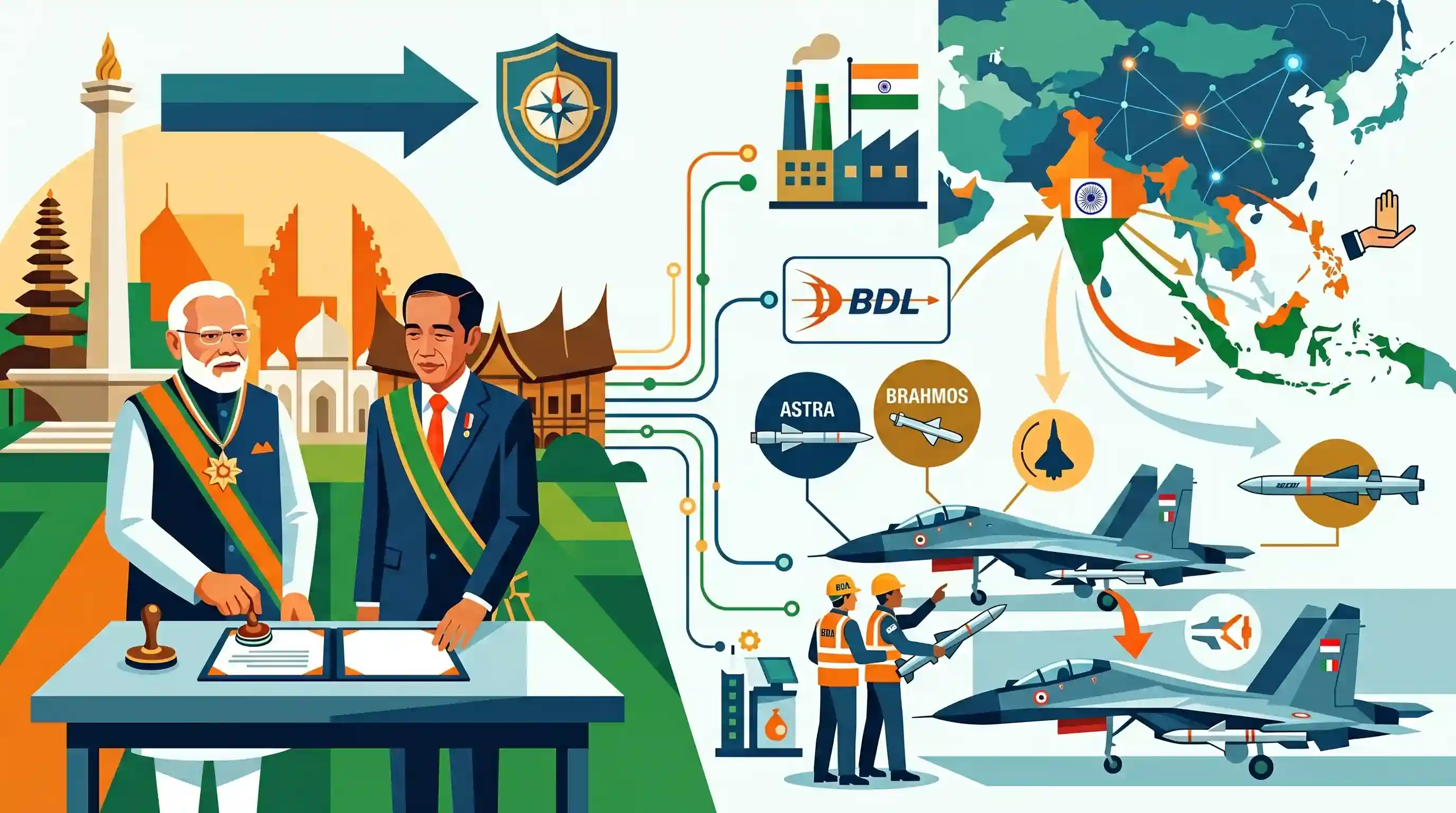
This development marks a key milestone in India's transition from a major arms importer to a critical defence exporter, reinforcing its strategic footprint in Southeast Asia. It underscores the security dimensions of the Act East Policy, maritime security in the Indo-Pacific, and the technological maturity of India's indigenous defence manufacturing (such as the Astra and BrahMos systems).
Summary
During Prime Minister Narendra Modi's state visit to Jakarta in July 2026, India and Indonesia signed landmark in-principle agreements to deepen defence ties. Indonesia will procure an additional battery of the BrahMos supersonic cruise missile system and Astra Mk-1 beyond-visual-range (BVR) air-to-air missiles, which Bharat Dynamics Limited (BDL) will integrate into Indonesia's Su-30 fighter jets. This development reinforces India's growing status as a defence exporter in the Indo-Pacific, supplementing existing export agreements with the Philippines and discussions with Vietnam, Malaysia, and the UAE. During the visit, PM Modi was also conferred with 'Bintang Adipurna', Indonesia's highest civilian honour.
Key Points
- India and Indonesia have agreed in-principle to expand their defence cooperation, focusing on the procurement of an additional battery of the BrahMos supersonic cruise missile system and Astra Mk-1 beyond-visual-range (BVR) air-to-air missiles.
- Indonesia had previously agreed to procure one BrahMos battery and has now committed to a second, expanding the deal's scope. Exact commercial terms and quantities are to be finalized in subsequent negotiations.
- Bharat Dynamics Limited (BDL) will integrate the indigenous Astra Mk-1 missile with the Indonesian Air Force's Su-30 fighter aircraft. The Astra Mk-1 has an operational range of 80–110 km and is powered by a solid rocket motor.
- The advanced longer-range Astra Mk-2 variant is in its final phase of development and flight trials, having already received clearance from the Defence Acquisition Council (DAC).
- The BrahMos missile—a joint venture between India's DRDO and Russia's NPO Mashinostroyenia—cruises at speeds up to Mach 2.8 with a range exceeding 290 km. Its combat credibility was highlighted by its use in Operation Sindoor.
- Prime Minister Narendra Modi was conferred with 'Bintang Adipurna', Indonesia's highest honour, during his diplomatic visit to Jakarta in July 2026.
- The deal aligns with India's broader push to boost defence exports; India is delivering its third BrahMos consignment to the Philippines ($375M contract) and is in active talks with Vietnam, Malaysia, and the UAE (for BrahMos and Akashteer systems).
Important Terms
Act East Policy

India's foreign policy initiative launched in 2014 to promote economic, cultural, and strategic cooperation with East and Southeast Asian nations.
UPSC context
GS Paper II (International Relations - Bilateral and regional groupings involving India and/or affecting India's interests).
Bintang Adipurna
Indonesia's highest civilian honour, awarded to PM Narendra Modi in July 2026 for strengthening the India-Indonesia Comprehensive Strategic Partnership.
UPSC context
GS Paper II (Bilateral relations; international awards/diplomatic recognitions).
Operation Sindoor
India's May 2025 joint military strike on terror camps in Pakistan and PoJK, launched in response to the Pahalgam terrorist attacks.
UPSC context
GS Paper III (Internal Security; security challenges and management in border areas).
Bharat Dynamics Limited (BDL)
A Ministry of Defence public sector enterprise established in 1970 that manufactures guided missile systems and other military hardware for the Indian Armed Forces.
UPSC context
GS Paper III (Indigenisation of technology, defense manufacturing, and public sector undertakings).
Defence Acquisition Council (DAC)
The highest decision-making body in India’s Ministry of Defence, chaired by the Defence Minister, that approves capital acquisitions and policies for the armed forces.
UPSC context
GS Paper III (Security forces and agencies; defence procurement, modernization, and Atmanirbhar Bharat).
Defence Research and Development Organisation (DRDO)
India's premier military research and development agency under the Ministry of Defence, tasked with designing and developing indigenous defense technologies and weapon systems.
UPSC context
GS Paper III (Science and Technology; development and indigenisation of critical defense technologies).
Prelims Trap
Astra Mk-1 is India's first indigenously developed short-range Surface-to-Air Missile (SAM) designed for naval air defence.
Astra Mk-1 is a Beyond-Visual-Range Air-to-Air Missile (BVRAAM), not a surface-to-air system. It is designed to be integrated into fighter aircraft like the Su-30 to target aerial threats.
Static Concepts Connected
What is the Missile Technology Control Regime (MTCR) and its significance for India?
- Core Purpose: Established in 1987 to limit the proliferation of missiles and UAVs capable of carrying a 500 kg payload for at least 300 km.
- India's Membership: India became the 35th member in 2016, which eased the export of dual-use technologies and allowed extended-range development of BrahMos.
- Legal Status: Consensus-based, non-treaty association; it does not impose legally binding obligations but relies on national export control laws.
How do Cruise Missiles differ from Ballistic Missiles in propulsion and trajectory?
- Trajectory: Cruise missiles fly at low altitudes within the atmosphere parallel to Earth; ballistic missiles follow a high-altitude, sub-orbital parabolic flight path.
- Propulsion: Cruise missiles are powered by jet engines (like turbofans/ramjets) throughout; ballistic missiles are rocket-powered only during initial launch phases.
- Targeting and Speed: Cruise missiles offer high maneuverability and pinpoint precision; ballistic missiles rely on extreme terminal speed and gravity-driven descent.
Cross-Topic Patterns
Chokepoint diplomacy and maritime security
Sabang Port development near the Strait of Malacca links India's Act East Policy with net security provider ambitions in the eastern Indian Ocean.
Defence exports and economic diplomacy
Transitioning from a top arms importer to exporting systems like Astra and BrahMos shifts India's bilateral leverage from economic partner to security-guarantor.

Indo-Pacific maritime choke points (Sabang) paired with BrahMos/Astra defense exports will dominate 2026 security architecture questions.
Linked PYQs · 2
Linked PYQs · 2
- 2023PrelimsGS1
Consider the following statements: 1. Ballistic missiles are jet-propelled at subsonic speeds throughout their flights, while cruise missiles are rocket-powered only in the initial phase of flight. 2. Agni-V is a medium-range supersonic cruise missile, while BrahMos is a solid-fuelled intercontinental ballistic missile. Which of the statements given above is/are correct?
- 2016MainsGS2
Evaluate the economic and strategic dimensions of India's Look East Policy in the context of the post Cold War international scenario.
