India Indo Pacific Strategy And Regional Trade Integration Deficit
Source:Indian Express ↗
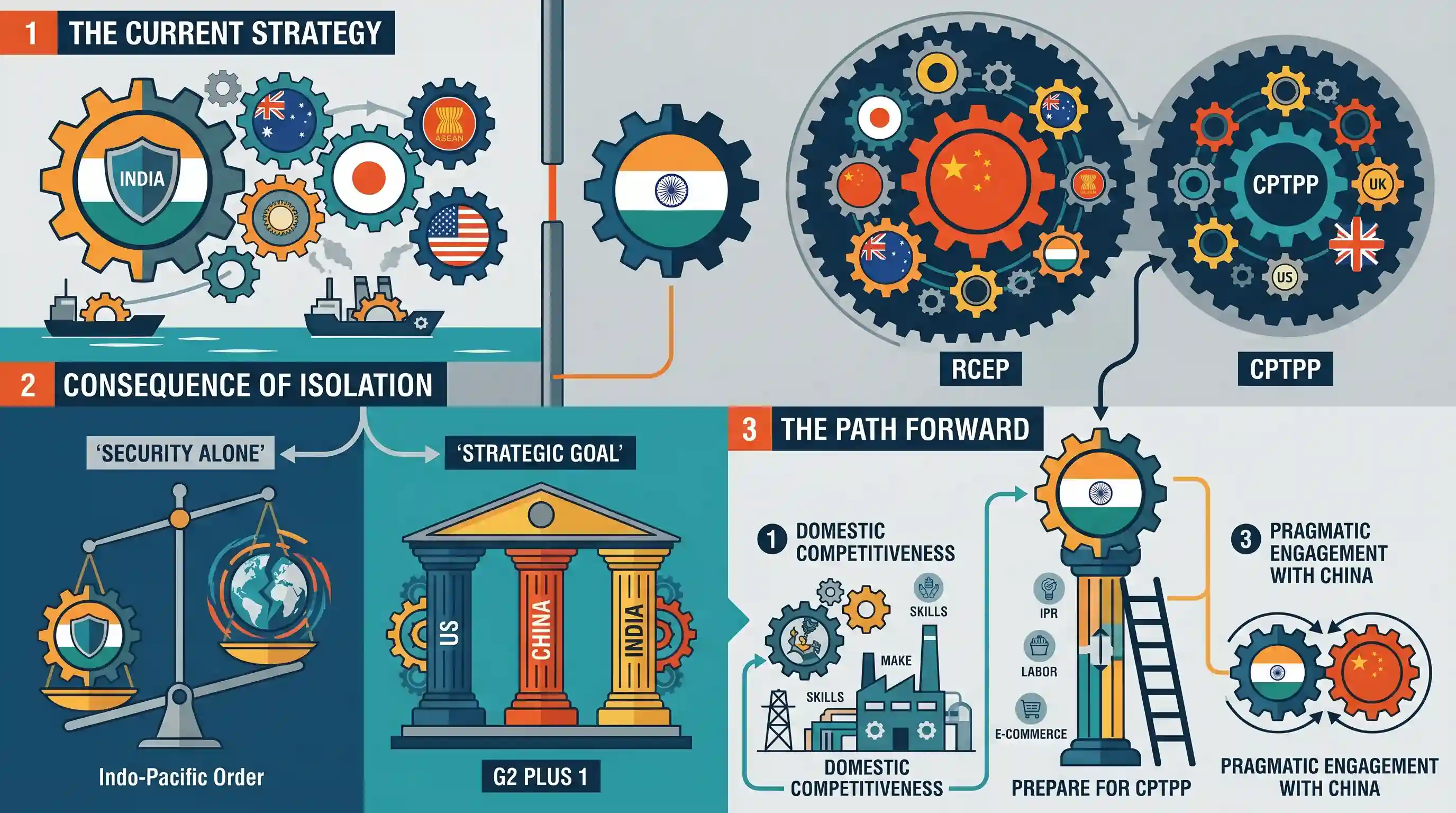
Why It Matters
The article provides a critical critique of India's 'security-first' Indo-Pacific strategy. It highlights the gap between India's defense posturing and its lack of economic integration, which is highly relevant for both GS2 (International Relations, regional groupings, and policies affecting India's interests) and GS3 (Indian Economy, global value chains, and bilateral/multilateral trade agreements).
Summary
The article argues that India cannot secure its long-term Indo-Pacific strategic objectives through maritime and defense cooperation alone. Despite strengthening security relations through the Act East policy and bilateral defense deals, India remains economically isolated from the region's primary trade architectures, such as the Regional Comprehensive Economic Partnership (RCEP) and the Comprehensive and Progressive Agreement for Trans-Pacific Partnership (CPTPP). While regional allies like Australia, Japan, and ASEAN remain deeply integrated with China's economy and active in these mega-FTAs, India's exclusion leaves it outside vital global value chains. To influence the regional economic order and emerge as a powerful 'G2 plus 1' pillar alongside the US and China, India must pragmatically engage with China, prepare to join CPTPP, and build the domestic competitiveness needed for deep economic integration.
Key Points
- Prime Minister Modi's diplomatic tour of Indonesia, Australia, and New Zealand underscored India's intent to deepen defense, strategic, and technological partnerships in the Indo-Pacific amid strategic uncertainty.
- While defense and security partnerships (e.g., a $630 million missile deal with Indonesia and expanded security ties with Australia) are robust, India remains economically disconnected from the region's primary trade architecture.
- Unlike major regional players (ASEAN, Japan, South Korea, Australia, New Zealand) that are heavily integrated with the Chinese economy and are members of mega-regional trade agreements like RCEP and CPTPP, India remains an outlier.
- The US-led Indo-Pacific Economic Framework (IPEF) has struggled to gain traction, and India opted out of its critical trade pillar from the very beginning. Meanwhile, the UK has joined CPTPP, and Indonesia is expected to join next year.
- The author argues that maritime and defense cooperation alone cannot shape the Indo-Pacific order; India must build domestic competitiveness, pragmatically engage with China, seriously consider joining CPTPP, and re-evaluate RCEP.
- Integrating with existing trade architectures would give India the opportunity to emerge as a third economic pillar—a 'G2 plus 1'—rather than leaving the regional order to be dictated by a G2 (US-China) or G-2 (G minus 2) dynamic.
Important Terms
Act East policy

India's diplomatic initiative launched in 2014 to promote economic, strategic, and cultural relations with the Asia-Pacific region at bilateral, regional, and multilateral levels, upgrading the earlier Look East Policy.
UPSC context
GS Paper II (IR); tests India's strategic, connectivity, and economic integration with Southeast Asia and the wider Indo-Pacific.
SAGAR (Security and Growth for All in the Region)
India's strategic maritime vision launched in 2015 for the Indian Ocean Region, focusing on collaborative security, disaster management, sustainable development of the blue economy, and capacity building.
UPSC context
GS Paper II (IR & Security); tests India's maritime diplomacy, ocean governance, and counter-strategies in the Indian Ocean Region.
MAHASAGAR
The Indian Navy's high-level outreach initiative (Mutual and Holistic Advancement for Security Across the Regions) launched in 2023, expanding the SAGAR doctrine towards active, collective maritime security in the Indian Ocean.
UPSC context
GS Paper II (IR & Security); tests evolving maritime security doctrines and India's partnerships with the Global South.
RCEP
The world's largest free trade agreement, signed in 2020 by 15 Asia-Pacific countries, including China and Japan. India was an original negotiating partner but withdrew in 2019.
UPSC context
GS Paper III (Economy) & GS II (IR); tests trade integration, economic diplomacy, and implications of India's opt-out.
CPTPP
A high-standard free trade agreement signed in 2018 among 11 Pacific Rim nations (later joined by the UK), aimed at deep tariff elimination and regulatory harmonization.
UPSC context
GS Paper III (Economy) & GS II (IR); tests global trade architectures, supply chain rules, and Indian economic policy options.
IPEF (Indo-Pacific Economic Framework)
A US-led economic initiative launched in 2022 with 14 partners (including India) focused on supply chains, clean energy, and tax/anti-corruption, rather than traditional tariff reduction.
UPSC context
GS Paper II (IR); tests multilateral economic frameworks, supply chain resilience, and India's participation in non-FTA economic alliances.
Prelims Trap
India is a full signatory to all four policy pillars of the US-led Indo-Pacific Economic Framework (IPEF).
India actively participates in Pillars II (Supply Chains), III (Clean Economy), and IV (Fair Economy), but has stayed out of the binding Pillar I (Trade) since inception.
Static Concepts Connected
What are the four functional pillars of the Indo-Pacific Economic Framework (IPEF)?
- Pillar I (Trade): Focuses on high-standard commitments in digital trade, labor, and environmental rules. India has opted out of this pillar.
- Pillar II (Supply Chains): Seeks to secure critical supply chains, establish emergency communication networks, and reduce mineral vulnerabilities.
- Pillar III (Clean Economy): Aims to accelerate clean energy transitions, decarbonization, and climate-resilient technologies.
- Pillar IV (Fair Economy): Focuses on anti-corruption measures, tax transparency, and curbing illicit financial flows.
How do CPTPP and RCEP differ in terms of trade standards and scope?
- CPTPP High Standards: CPTPP enforces strict, binding rules on labor standards, environmental protection, intellectual property, and State-Owned Enterprises (SOEs).
- RCEP Traditional Focus: RCEP is a more traditional tariff-reduction framework led by ASEAN, with less demanding domestic regulatory harmonization requirements.
- India's Absence: India walked out of RCEP in 2019 due to fears of cheap Chinese dumping and is not a CPTPP member due to strict IP and labor standards.
Cross-Topic Patterns
Strategic Autonomy vs. Mega-FTAs
India's refusal to join mega-FTAs (RCEP, CPTPP) due to domestic protection concerns directly limits its capacity to offer a viable economic counterweight to China's regional dominance.
Defense Exports as Strategic Leverage
Exporting indigenous hardware like Astra and BrahMos to ASEAN partners shifts India from a net security consumer to a defense provider, upgrading Act East dynamics.

2026 Prelims may test IPEF's specific pillars and CPTPP's expanding membership alongside India's strategic defense export initiatives.
Linked PYQs · 2
Linked PYQs · 2
- 2020MainsGS2
Quadrilateral Security Dialogue (Quad)' is transforming itself into a trade bloc from a military alliance, in present times - Discuss.
- 2016PrelimsGS1
The term 'Regional Comprehensive Economic Partnership' often appears in the news in the context of the affairs of a group of countries known as
