Corporate profit growth deceleration in fourth quarter
Source:Indian Express ↗
Why It Matters
Corporate earnings are a leading indicator of economic health. Slower profit growth impacts private capital expenditure (CapEx) and tax collections, directly affecting India's growth trajectory and employment generation.
Summary
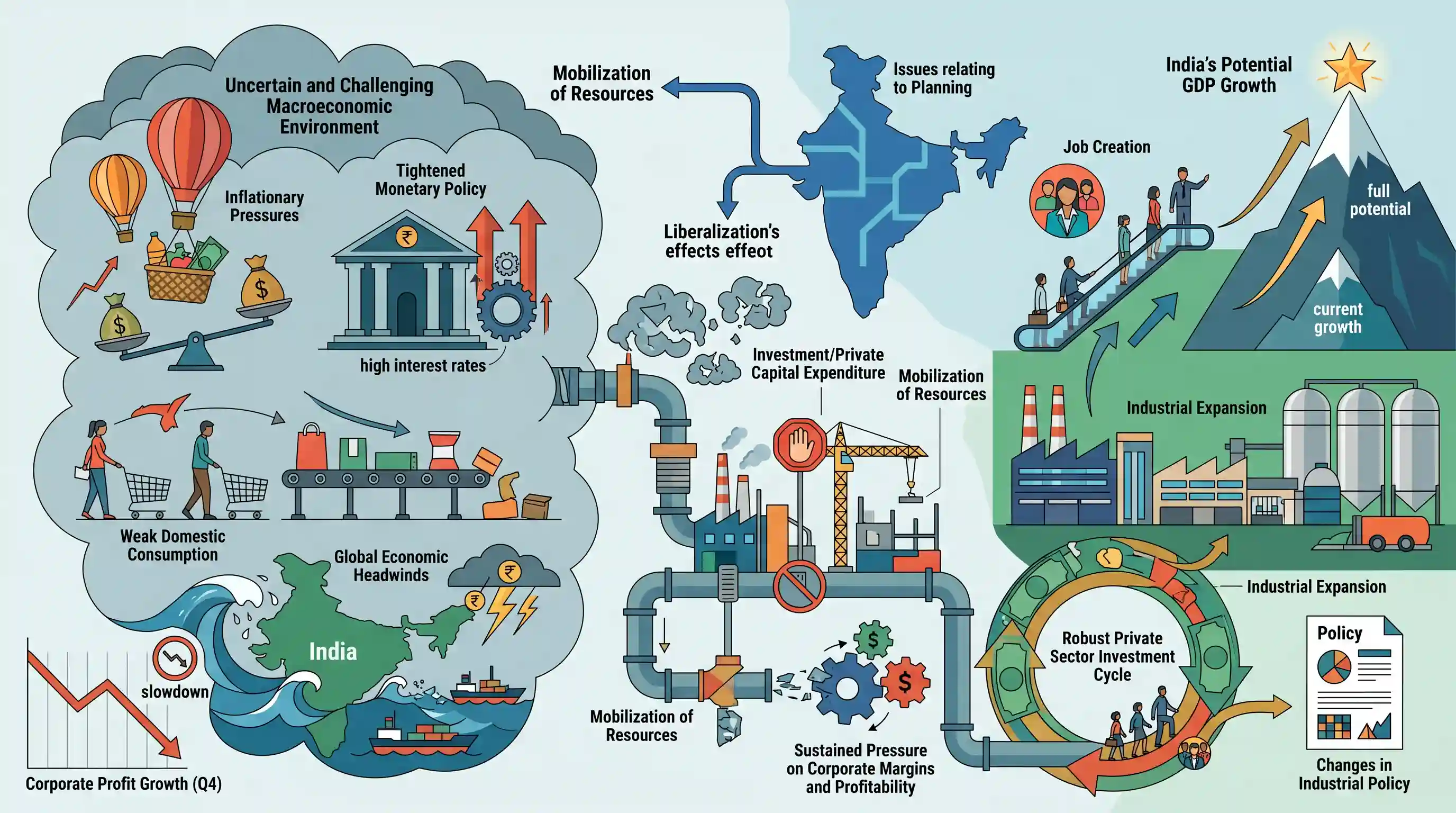
Corporate profit growth for India Inc slowed down in the fourth quarter, reflecting the impact of an uncertain and challenging macroeconomic environment. Factors contributing to this uncertainty often include inflationary pressures, tightened monetary policy (higher interest rates), weak domestic consumption, and global economic headwinds. From a macroeconomic perspective, sustained pressure on corporate margins and profitability is concerning as it risks delaying the much-needed revival in private capital expenditure. A robust private sector investment cycle is essential for job creation, industrial expansion, and achieving India's potential GDP growth.
Key Points
- India Inc experienced a deceleration in profit growth during the fourth quarter, indicating stress in corporate earnings.
- The slowdown is attributed to an 'uncertain economic environment,' typically encompassing factors like inflation, high interest rates, subdued consumer demand, and global geopolitical headwinds.
- Sluggish corporate profitability can negatively impact the anticipated revival in private sector capital expenditure (CapEx), which is critical for sustaining long-term GDP growth.
- The trend highlights the vulnerability of the industrial and manufacturing sectors to broader macroeconomic instability, requiring policy support or easing of monetary conditions to spur consumption.
Important Terms
India Inc

Refers to the formal, organized corporate sector of the Indian economy, comprising both public and private listed companies.
UPSC context
GS-III (Industrial Growth); relevant for analyzing the health of the organized sector and its role in national development.
Private Capital Expenditure (Capex)
The money spent by private companies to acquire, upgrade, or maintain physical assets like machinery and factories to expand long-term production capacity.
UPSC context
GS-III (Investment Models); tests understanding of the private sector's role in the 'virtuous cycle' of growth and job creation.
Monetary Policy
The policy through which the Reserve Bank of India (RBI) manages the money supply and interest rates to maintain price stability and support growth.
UPSC context
GS-III (Indian Economy); fundamental for understanding inflation targeting (4% +/- 2%) and the RBI's tools like Repo Rate.
Potential GDP
The maximum sustainable output an economy can achieve when it is using all its resources (labor and capital) at normal capacity without triggering inflation.
UPSC context
GS-III (Growth and Development); acts as a benchmark for measuring 'output gaps' and the effectiveness of supply-side reforms.
Inflationary Pressures
Factors such as high input costs or strong demand that lead to a sustained rise in the general price level, eroding purchasing power.
UPSC context
GS-III (Macroeconomics); crucial for analyzing impacts on corporate margins, consumer demand, and central bank policy decisions.
Reserve Bank of India (RBI)
India's central bank and supreme monetary authority, responsible for regulating the banking system, managing foreign exchange, and implementing monetary policy.
UPSC context
GS-III (Economy); key institution for questions on financial stability, banking regulations, and inflation control.
Prelims Trap
Higher benchmark interest rates naturally expand corporate profit margins by cooling down raw material inflation.
High rates directly increase debt-servicing and borrowing costs for companies. This tight monetary condition compresses profit margins and stalls private CapEx.
Static Concepts Connected
What is Gross Fixed Capital Formation (GFCF) and its significance?
- Definition: It measures the net increase in physical assets (like machinery, factories, and infrastructure) within an economy over a specific period.
- Components: It comprises gross investments by the private corporate sector, the government, and the household sector.
- Significance: GFCF is a direct indicator of the investment rate. A higher rate is essential for job creation and expanding the economy's productive capacity.
How does Potential GDP differ from actual economic growth?
- Potential GDP: The highest level of real GDP an economy can sustain over the medium to long term without triggering accelerating inflation.
- Output Gap: The difference between actual and potential GDP. A negative gap indicates spare capacity and weak consumer demand.
- Role of CapEx: Sluggish private CapEx restricts the addition of physical capacity, which limits the long-term upward trajectory of India's potential GDP.
Cross-Topic Patterns
Monetary Policy vs Industrial Growth
The RBI's inflation targeting via higher repo rates increases corporate borrowing costs, naturally suppressing profit margins and delaying the private investment cycle.
Government Crowding-In Effect
The Centre's heavy infrastructure CapEx aims to "crowd in" private investment, but subdued corporate profitability prevents the private sector from capitalizing on this multiplier effect.

Expect a 2026 Prelims question testing the inverse relationship between monetary tightening, corporate profitability, and private CapEx.
Linked PYQs · 5
Linked PYQs · 5
- 2023MainsGS3
Faster economic growth requires increased share of the manufacturing sector in GDP, particularly of MSMEs. Comment on the present policies of the Government in this regard.
- 2020MainsGS3
Define potential GDP and explain its determinants. What are the factors that have been inhibiting India from realizing its potential GDP?
- 2017MainsGS3
Industrial growth rate has lagged-behind in the overall growth of Gross-Domestic-Product (GDP) in the post-reform period." Give reasons. How far the recent changes in Industrial-Policy are capable of increasing the industrial growth rate?
- 2020MainsGS3
Explain the meaning of investment in an economy in terms of capital formation. Discuss the factors to be considered while designing a concession agreement between a public entity and a private entity.
- 2021MainsGS3
“Investment in infrastructure is essential for more rapid and inclusive economic growth.” Discuss in the light of India's experience.
