Overseas Lithium Block Acquisitions and India Resource Security
Source:The Hindu ↗
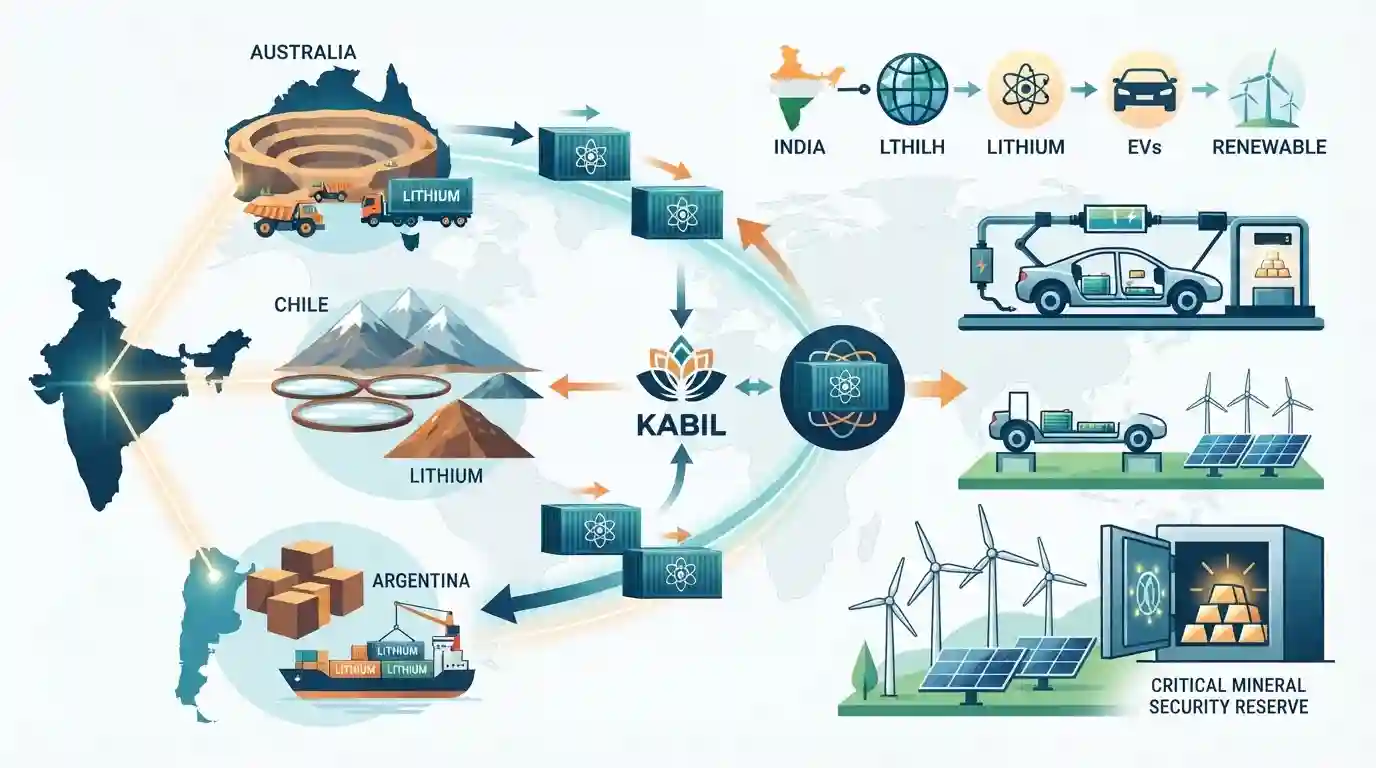
Why It Matters
Securing critical minerals like lithium through overseas asset acquisition is vital for India's green energy goals, manufacturing ambitions (like PLI schemes for EVs and batteries), and reducing geopolitical vulnerabilities in supply chains dominated by a few nations.
Summary
India is in talks to acquire lithium blocks in Australia and Chile, while also looking at five additional lithium blocks in Argentina. Driven by state-owned ventures like KABIL, these efforts aim to secure raw material supplies for India's clean energy transition, electric vehicle manufacturing, and broader critical mineral security.
Key Points
- India is actively engaged in negotiations to acquire lithium blocks in Australia and Chile.
- India is also eying five additional lithium blocks in Argentina through state-owned enterprise efforts (KABIL).
- These strategic acquisitions are aimed at securing supply chains for electric vehicles (EVs) and clean energy transition.
- Critical minerals diplomacy is a key pillar of India's long-term resource security and net-zero commitments.
Important Terms
KABIL (Khanij Bidesh India Ltd)

A joint venture of three public sector companies under the Ministry of Mines, established to identify, acquire, develop, and process strategic and critical minerals overseas for India's domestic security.
UPSC context
UPSC GS Paper III (Economy / Infrastructure & Minerals): Tests India's energy transition strategy, supply chain security, and public sector enterprise roles.
Static Concepts Connected
What is the mandate of Khanij Bidesh India Limited (KABIL) and its parent ministries?
- Parent PSUs: Joint venture of three PSUs (NALCO, HCL, MECL) under the Ministry of Mines.
- Core Mandate: Tasked with identifying, acquiring, developing, and operating mineral assets overseas.
- Strategic Focus: Focuses on critical and strategic minerals like lithium, cobalt, and nickel for domestic security.
Cross-Topic Patterns
Critical Minerals & Economic Diplomacy
KABIL overseas asset acquisition and bilateral MoUs with lithium-rich Latin American states reflect the intersection of economic diplomacy and energy transition goals.
Energy Transition & Net-Zero Targets
The quest for lithium and cobalt across the Lithium Triangle directly supports India's net-zero roadmap and domestic EV manufacturing targets under FAME and PLI schemes.

Expect a match-the-following or statement-based question linking KABIL, MSP, and the Lithium Triangle geography.
Linked PYQs · 3
Linked PYQs · 3
- 2025PrelimsGS1
Consider the following pairs : Country Resource-rich in I. Botswana : Diamond II. Chile : Lithium III. Indonesia : Nickel In how many of the above rows is the given information correctly matched?
- 2026PrelimsGS1
Which of the following statements about Rare Earth Elements (REEs) and Critical Minerals is/are correct ? 1. Modern technological innovations including Artificial Intelligence, robotics and space exploration extensively utilise Rare Earth Elements (REEs). 2. China has the highest share in mining of REEs followed by India. 3. The Government of India launched the National Critical Mineral Mission (NCMM) in 2025 to establish a robust framework for self-reliance in the critical mineral sector. 4. Rare Earth Elements are a set of 13 metallic elements. Select the answer using the code given below :
- 2025MainsGS3
Mineral resources are fundamental to the country's economy and these are exploited by mining. Why is mining considered an environmental hazard? Explain the remedial measures required to reduce the environmental hazard due to mining.
