Prime Minister Highlights India Economic Growth Outlook
Source:The Hindu ↗
Why It Matters
The article touches upon multiple core themes of the GS Paper 3 syllabus, including mobilization of resources, growth, development, employment, effects of liberalization on the economy, changes in industrial policy, and indigenization of technology. Understanding India's macroeconomic indicators and policy directions is essential for Mains answers on economic trajectory and technological self-reliance.
Summary
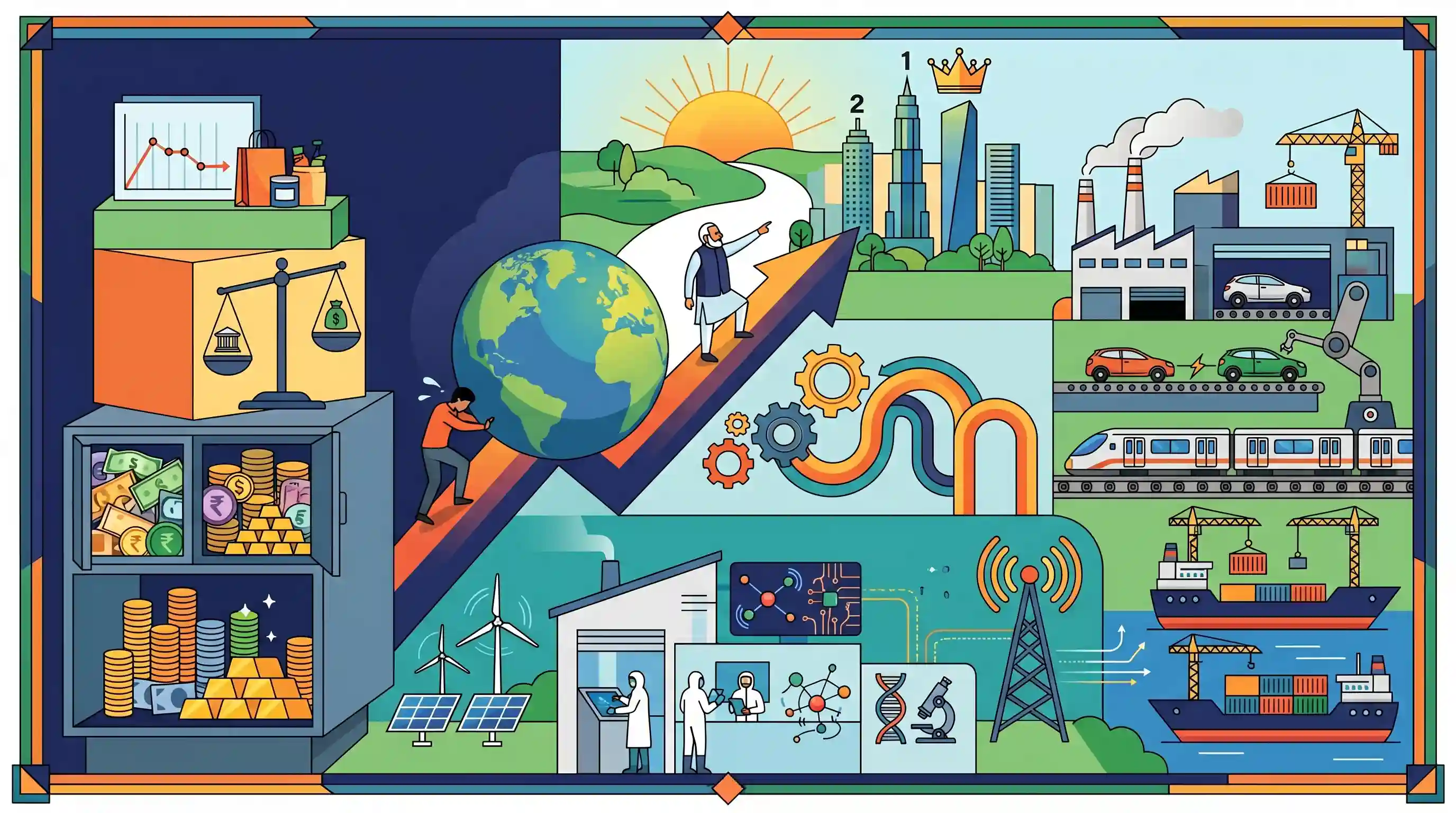
Prime Minister Narendra Modi highlighted India's robust economic trajectory, asserting that the country is positioned to lift the global economy out of its current slow growth. Driven by the mantra of "reform, perform, and transform," India aims to become the world's third-largest economy and reach developed nation status by 2047. Key reforms are underway, including next-generation GST changes to simplify taxation and lower prices. Stressing self-reliance, Modi urged the private sector to ramp up research and development in clean energy, quantum technology, and biotechnology. India’s strong macroeconomic fundamentals—marked by a declining fiscal deficit (targeted at 4.4%), low inflation, and robust forex reserves—underpin this growth, alongside significant progress in indigenizing technology like the 5G stack and scaling manufacturing exports in EVs and rail coaches.
Key Points
- Prime Minister Narendra Modi stated that India's strong macroeconomic fundamentals position it to help lift global economic growth and aim for developed nation status by 2047.
- Next-generation GST reforms, designed to simplify the indirect tax law and reduce prices, are expected to be completed before Diwali.
- The private sector has been urged to boost R&D investments in future-forward sectors like clean energy, quantum technology, battery storage, and biotechnology.
- India is focusing on speed, scale, and scope for a self-reliant economy, highlighted by achievements such as developing a domestic 5G stack and significantly increasing automobile, EV, and rail coach exports.
- Macroeconomic stability is demonstrated by lowering the fiscal deficit to an expected 4.4%, robust foreign exchange reserves, low inflation, a controlled current account deficit, and strong capital market inflows.
Important Terms
Goods and Services Tax (GST)

A comprehensive indirect tax on goods and services, intended to simplify the tax regime. Recent "GST 2.0" reforms aim for a two-slab structure (5% and 18%) to boost affordability.
UPSC context
GS Paper III (Taxation); tests understanding of indirect tax structures, fiscal federalism, and reforms to enhance ease of doing business.
Fiscal Deficit
The shortfall in a government's income compared with its spending. The government has targeted a consolidated path to reach a 4.4% deficit-to-GDP ratio for FY 2025-26.
UPSC context
GS Paper III (Budgeting); essential for understanding fiscal consolidation, debt sustainability, and macroeconomic stability.
Viksit Bharat @ 2047
The national vision to transform India into a developed nation by 2047, targeting a $30-40 trillion economy with high per capita income and inclusive growth.
UPSC context
GS Paper II & III (Growth/Governance); tests long-term planning, inclusive development goals, and strategic national objectives.
National Quantum Mission (NQM)
A flagship mission (2023–2031) to develop an indigenous ecosystem in quantum computing, communication, sensing, and materials, positioning India among global leaders in frontier tech.
UPSC context
GS Paper III (Science & Tech); tests knowledge of emerging technologies, R&D policy, and technological sovereignty.
5G Technology Stack
An end-to-end indigenous solution comprising software and hardware for 5G networks, reducing reliance on foreign telecom equipment and enhancing national security.
UPSC context
GS Paper III (Indigenization of Technology); covers critical infrastructure, telecommunications policy, and the 'Atmanirbhar Bharat' initiative.
Reform, Perform, and Transform
The Prime Minister's governance mantra focusing on structural policy changes (Reform), efficient bureaucratic execution (Perform), and resulting socio-economic shifts (Transform).
UPSC context
GS Paper II (Governance); used to analyze public policy frameworks and the impact of administrative reforms on national development.
Prelims Trap
"The private sector accounts for the majority of India's Gross Expenditure on R&D (GERD)."
In India, the government still drives the majority (~64%) of R&D spending. This contrasts with developed nations like the US and China, where private sectors contribute over 70%.
Static Concepts Connected
What is the FRBM Act's post-pandemic fiscal consolidation glide path?
- Original target: Originally, the Act aimed to limit the fiscal deficit to 3% of GDP, but this was breached during the COVID-19 pandemic.
- Revised glide path: The revised glide path aims to bring the fiscal deficit below 4.5% of GDP by FY 2025-26.
- Debt-to-GDP ratio: The Act also targets limiting general government debt to 60% of GDP (40% for the Centre, 20% for States).
What is an 'Inverted Duty Structure' in taxation?
- Definition: A situation where the tax rate on raw materials or inputs is higher than the tax rate on the finished product.
- Working capital blockage: It leads to accumulation of Input Tax Credit (ITC), blocking working capital for domestic manufacturers.
- Anti-manufacturing impact: It perversely discourages domestic value addition and makes directly imported finished goods cheaper.
Cross-Topic Patterns
Low Private R&D + Deep Tech Policy
The push for private R&D in quantum and clean tech aligns directly with the National Deep Tech Startup Policy, aiming to reverse India's low private sector contribution to GERD.
GST rationalization + Manufacturing PLIs
Correcting the inverted duty structure via GST reform acts as a crucial non-fiscal catalyst alongside PLI schemes, improving profit margins for domestic EV and telecom equipment manufacturers.

Expect a Prelims statement contrasting India's GERD-to-GDP stagnation (<0.7%) and public-heavy funding share against global norms.
Linked PYQs · 5
Linked PYQs · 5
- 2022MainsGS3
Economic growth in the recent past has been led by increase in labour productivity." Explain this statement. Suggest the growth pattern that will lead to creation of more jobs without compromising labour productivity.
- 2023MainsGS3
Faster economic growth requires increased share of the manufacturing sector in GDP, particularly of MSMEs. Comment on the present policies of the Government in this regard.
- 2017MainsGS3
Industrial growth rate has lagged-behind in the overall growth of Gross-Domestic-Product (GDP) in the post-reform period." Give reasons. How far the recent changes in Industrial-Policy are capable of increasing the industrial growth rate?
- 2019MainsGS3
Enumerate the indirect taxes which have been subsumed in the Goods and Services Tax (GST) in India. Also, comment on the revenue implications of the GST introduced in India since July 2017.
- 2013MainsGS3
Discuss the rationale for introducing Goods and Services Tax (GST) in India. Bring out critically the reasons for the delay in roll out for its regime.
