India Pursues Comprehensive Free Trade Agreements with US and EU
Source:The Hindu ↗
Why It Matters
The topic is highly relevant for GS-2 (Bilateral, regional and global groupings and agreements involving India and/or affecting India's interests) and GS-3 (Indian Economy). Understanding India's shift toward negotiating multiple FTAs simultaneously and the geopolitical complexities of US protectionist policies (tariffs, visas) is crucial for both Mains answers and Prelims MCQs on international agreements.
Summary
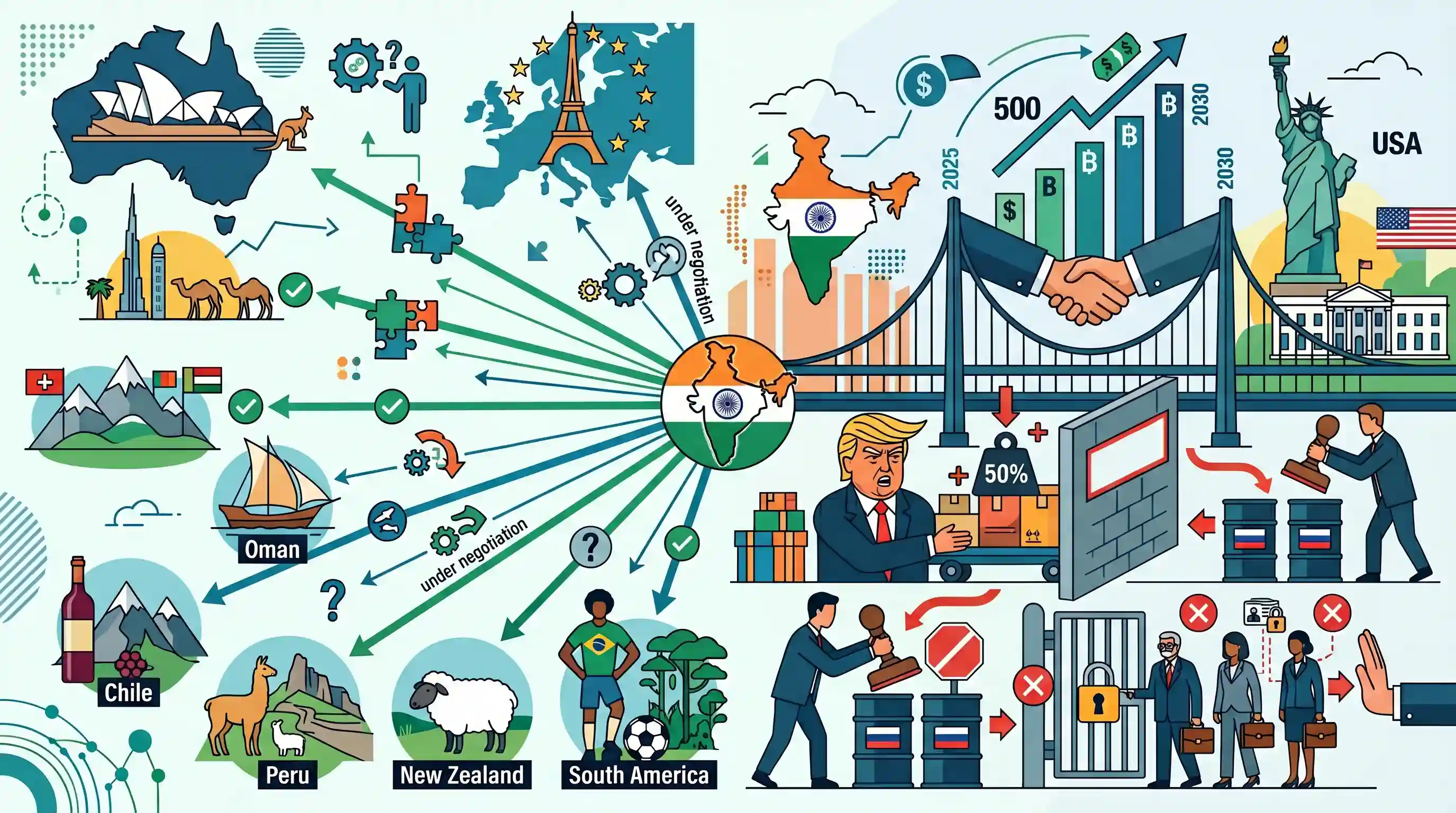
India is actively expanding its global trade footprint by pursuing new Free Trade Agreements (FTAs) and Bilateral Trade Agreements (BTAs) with strategic partners, including the US, EU, Oman, Chile, Peru, and New Zealand. Commerce Minister Piyush Goyal highlighted India's success with recent pacts with Australia, the UAE, and EFTA while addressing the India-Brazil Business Dialogue, signaling intent to expand trade ties in South America. High-level talks with the US are currently underway, aiming for a first-tranche agreement by late 2025 to help double bilateral trade to $500 billion by 2030. However, the negotiations face potential hurdles from the Trump administration's proposed 50% tariff on Indian goods, additional duties on Russian crude, and restrictive H-1B visa policies.
Key Points
- India is actively negotiating Free Trade Agreements (FTAs) with the US, EU, Oman, Chile, Peru, and New Zealand to boost global trade integration.
- Trade agreements have already been implemented with Australia, the UAE, and the EFTA bloc, with a new pact signed with the UK.
- India aims to expand its Preferential Trade Agreement with Brazil to deepen market access across South America.
- An Indian delegation in Washington is negotiating a Bilateral Trade Agreement (BTA) with the US, targeting the first tranche by fall 2025.
- The India-US goal is to double bilateral trade to $500 billion by 2030, but negotiations face headwinds from the Trump administration's proposed 50% tariffs on Indian goods and changes to H-1B visas.
Important Terms
Free Trade Agreements (FTAs)

A formal agreement between two or more countries to reduce or eliminate tariffs, quotas, and other trade barriers on most goods and services to facilitate cross-border trade.
UPSC context
GS Paper II (International Relations) and GS Paper III (Economy); tests knowledge of trade diplomacy and economic integration.
Bilateral Trade Agreement (BTA)
An agreement between two nations to set trade terms, often serving as a broader framework for cooperation that may include FTAs or specific sector-based concessions.
UPSC context
GS Paper II; focuses on bilateral relations and the shift from multilateralism to strategic two-party pacts.
Preferential Trade Agreement (PTA)
A trade pact where partners provide preferential access to specific products by reducing duties on an agreed 'positive list' of items, rather than broad tariff elimination.
UPSC context
GS Paper III; tests understanding of the hierarchy of trade agreements and WTO-compliant preferential treatments.
H-1B Visa Program
A non-immigrant U.S. visa allowing domestic companies to employ foreign workers in specialty occupations requiring technical expertise; Indians are its largest beneficiaries globally.
UPSC context
GS Paper II; essential for analyzing India-US relations, the Indian diaspora, and the impact of foreign protectionist policies.
European Free Trade Association (EFTA)
An intergovernmental organization consisting of Iceland, Liechtenstein, Norway, and Switzerland. India recently signed a landmark TEPA with EFTA involving a $100 billion investment commitment.
UPSC context
GS Paper II & III; significant for current affairs regarding new-generation FTAs and investment-linked trade deals.
India-Brazil Business Dialogue
A high-level diplomatic and commercial forum aimed at expanding trade, investment, and strategic cooperation between India and Brazil, particularly focusing on the Global South.
UPSC context
GS Paper II; relevant for South-South cooperation, BRICS, and India's expanding economic footprint in Latin America.
Prelims Trap
India recently signed the Trade and Economic Partnership Agreement (TEPA) with the European Union.
TEPA was signed with the European Free Trade Association (EFTA)—comprising Iceland, Liechtenstein, Norway, and Switzerland—not the EU. The India-EU BTIA is still under negotiation.
Static Concepts Connected
What is the difference between a PTA, an FTA, and a CEPA?
- PTA: Reduces tariffs on a specific "positive list" of agreed products (e.g., India-Mercosur PTA).
- FTA: Eliminates tariffs on mostly all goods, maintaining only a limited "negative list" of protected domestic items.
- CEPA / CECA: Comprehensive pact encompassing trade in goods, services, investments, intellectual property, and regulatory cooperation (e.g., India-UAE CEPA).
How do H-1B visas relate to the WTO GATS framework?
- GATS Mode 4: Classified under WTO GATS Mode 4, which covers the temporary movement of natural persons across borders to supply services (e.g., Indian IT professionals in the US).
- Non-Tariff Barrier: Restrictive visa policies and fee hikes function as non-tariff barriers, directly hindering India's IT and services exports.
Cross-Topic Patterns
Geopolitics vs US Protectionism
Despite deeper strategic alignment via Quad and iCET, India-US economic diplomacy is complicated by protectionist 'America First' tariffs and H-1B visa hurdles.
South American PTAs & Critical Minerals
India's push for trade pacts with Chile and Peru strategically aligns with securing critical minerals (like lithium and copper) necessary for its green energy transition.

Expect a comparative Prelims question on TEPA (EFTA), CEPA (UAE), and ECTA (Australia) matching their scope, partners, or list types.
Linked PYQs · 5
Linked PYQs · 5
- 2020MainsGS3
Explain the meaning of investment in an economy in terms of capital formation. Discuss the factors to be considered while designing a concession agreement between a public entity and a private entity.
- 2023MainsGS3
What are the direct and indirect subsidies provided to farm sector in India? Discuss the issues raised by the World Trade Organization (WTO) in relation to agricultural subsidies.
- 2017MainsGS3
Account for the failure of manufacturing sector in achieving the goal of labour-intensive exports. Suggest measures for more labour-intensive rather than capital-intensive exports.
- 2024MainsGS2
Discuss the geopolitical and geostrategic importance of Maldives for India with a focus on global trade and energy flows. Further also discuss how this relationship affects India's maritime security and regional stability amidst international competition ?
- 2019MainsGS2
‘What introduces friction into the ties between India and the United States is that Washington is still unable to find for India a position in its global strategy, which would satisfy India's national self-esteem and ambitions.’ Explain with suitable examples.
