India Cuts Import Duties on Key Smartphone and Electronics Components
Source:Indian Express ↗
Why It Matters
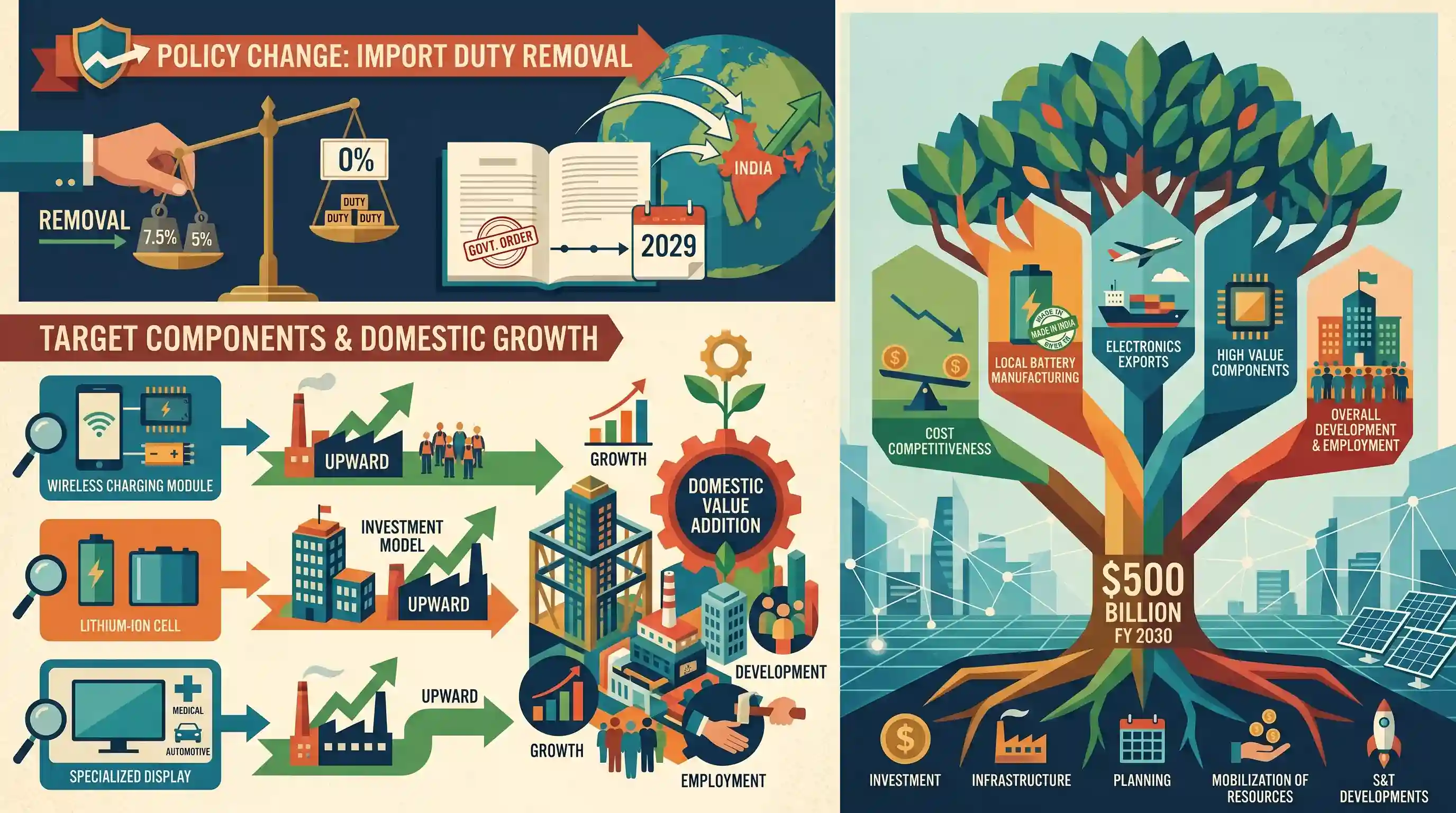
Reducing component-level import tariffs helps resolve inverted duty structures and lowers input costs for manufacturers. By exempting critical parts like lithium-ion cells and display panels, the government is lowering barriers to local assembly, facilitating integration into Global Value Chains (GVCs), and accelerating the transition from low-value assembly to high-value domestic design and manufacturing. This directly complements flagship industrial initiatives like the Production Linked Incentive (PLI) scheme.
Summary
The Indian government has removed import duties of 5% and 7.5% on select electronics and smartphone components—including wireless charging modules, lithium-ion cells, and specialized displays—until March 31, 2029. This policy shift aims to enhance cost competitiveness, promote domestic value addition, and attract investments in local battery and electronics manufacturing, supporting India's goal of achieving a $500 billion electronics manufacturing ecosystem by FY 2030.
Key Points
- The Indian government has scrapped import duties of 5% and 7.5% on several key electronics and smartphone components until March 31, 2029.
- The tariff exemptions apply to crucial components such as key parts for mobile wireless charging modules, displays for medical devices and automobiles, and lithium-ion cells.
- The move is designed to boost India's cost competitiveness in manufacturing, encourage domestic value addition, and drive the localization of high-value electronics assembly.
- Exempting lithium-ion cells is expected to catalyze fresh capital investments in domestic battery manufacturing, benefiting both the consumer electronics and electric vehicle (EV) sectors.
- This reform aligns with India's long-term target of scaling its electronics manufacturing sector to a $500 billion industry by FY 2029-30.
- Over the last decade, smartphone production in India has grown 28-fold, reaching Rs 5.45 trillion (approximately $57 billion) in FY 2024-25. Global giants like Apple and Xiaomi stand to benefit significantly from this duty relief.
Important Terms
Production Linked Incentive (PLI) Scheme

A flagship Indian government programme launched in 2020 that provides financial incentives to domestic and foreign companies based on incremental sales of goods manufactured within the country.
UPSC context
GS Paper III (Indian Economy); tests knowledge of industrial policy reforms, import substitution, and manufacturing-led growth.
Make in India
A flagship national initiative launched in 2014 to transform India into a global design, manufacturing, and innovation hub by attracting foreign direct investment and fostering skill development.
UPSC context
GS Paper III (Economic Development); tests understanding of manufacturing-led growth, employment generation, and ease of doing business.
Grant Thornton Bharat
A prominent professional services and business advisory firm in India that provides audit, tax, and policy analysis, often cited for industry feedback on economic and regulatory reforms.
UPSC context
GS Paper III (Indian Economy); tests awareness of private sector perspectives, industrial feedback, and evaluation of taxation policies.
Apple
A major global technology corporation whose increasing assembly and manufacturing operations in India reflect the success of local manufacturing programs and global supply chain diversification.
UPSC context
GS Paper III (Industrial Policy); tests understanding of multinational investments, global supply chain diversification, and electronics export trends.
Xiaomi
A major global electronics brand with a significant market share in India, illustrating the country’s transition from a pure consumer of electronics to an active assembly and local manufacturing hub.
UPSC context
GS Paper III (Industrial Growth); tests knowledge of multinational manufacturing hubs, domestic assembly incentives, and import duty dynamics.
Reuters
A leading international news agency providing global financial and policy reporting, serving as a primary source for tracking economic, trade, and geopolitical developments.
UPSC context
General current affairs; tests the tracking of global economic updates, national policy shifts, and reliable trade data reporting.
Prelims Trap
Customs duty exemptions on display assemblies apply uniformly to all electronics including consumer smartphones.
The July 2026 display assembly exemption explicitly excludes displays for consumer devices, targeting only automotive, medical, and industrial applications.
Static Concepts Connected
What is an Inverted Duty Structure and how does it affect local manufacturing?
- Definition: It occurs when tariff rates on imported raw materials or intermediate inputs are higher than those on finished goods.
- Domestic Impact: It discourages local value addition, renders domestic manufacturers uncompetitive, and encourages the import of finished products.
- Policy Remedy: Correcting it involves lowering tariffs on intermediate components (like lithium-ion cells) or increasing duties on final products.
What is Basic Customs Duty and who regulates its exemptions in India?
- Statutory Basis: Levied under the Customs Act, 1962, BCD is a tax on goods imported into India, acting as a trade policy instrument.
- Exemption Power: Under Section 25 of the Customs Act, the Central Government can issue notifications to exempt any goods from duty in public interest.
Cross-Topic Patterns
EV Transition + Electronics Import Policy
Zero-duty lithium-ion cell imports reduce battery input costs, simultaneously pushing India's electronics export targets and FAME-driven electric vehicle manufacturing.
Inverted Tariff Structure + WTO Rules
Unilateral tariff cuts on inputs help bypass Information Technology Agreement (ITA-1) disputes at the WTO while protecting local manufacturing ecosystems.

2026 Prelims may link WTO Information Technology Agreement disputes with India's domestic inverted duty structure corrections in electronics.
Linked PYQs · 3
Linked PYQs · 3
- 2025MainsGS3
Discuss the rationale of the Production Linked Incentive (PLI) scheme. What are its achievements? In what way can the functioning and outcomes of the scheme be improved?
- 2023PrelimsGS1
Consider the following statements: Statement-I: India accounts for 3.2% of global export of goods. Statement-II: Many local companies and some foreign companies operating in India have taken advantage of India's 'Production-linked Incentive' scheme. Which one of the following is correct in respect of the above statements?
- 2025PrelimsGS1
In the context of electric vehicle batteries, consider the following elements : I. Cobalt II. Graphite III. Lithium IV. Nickel How many of the above usually make up battery cathodes?
