India faces strategic and infrastructural hurdles for IEA membership
Source:Indian Express ↗
Why It Matters
This topic bridges GS-2 (International Organizations and global governance) and GS-3 (Energy Security/Infrastructure). Understanding the IEA's strict membership criteria highlights India's infrastructural gaps in strategic oil reserves and its evolving diplomatic push to reshape Western-dominated global institutions.
Summary
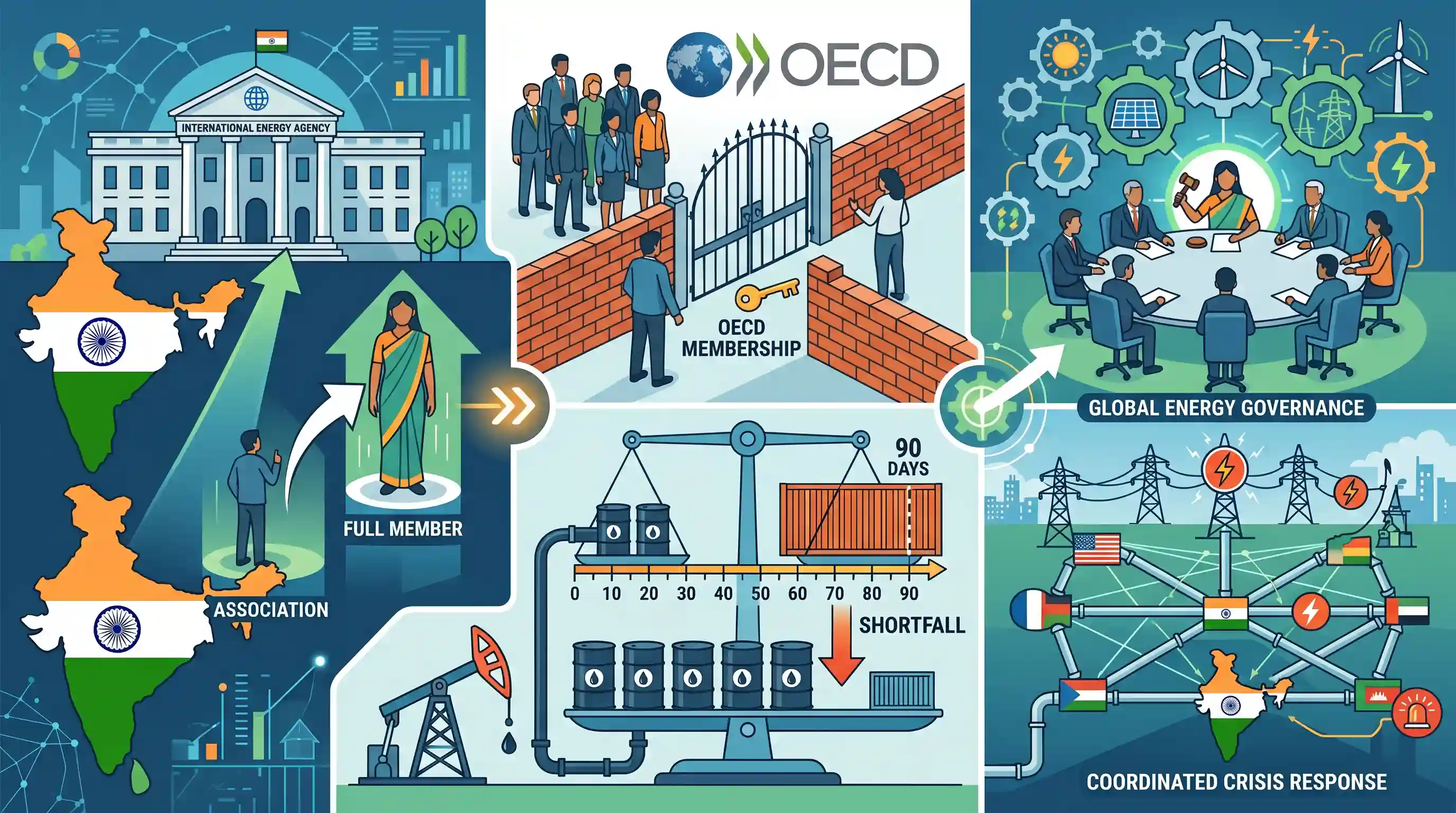
India's bid to transition from an 'Association' country to a full member of the International Energy Agency (IEA) faces significant structural and infrastructural hurdles. The primary challenges are twofold: first, IEA membership traditionally requires the candidate to be a member of the Organisation for Economic Co-operation and Development (OECD), which India is not; second, the IEA mandates that members maintain Strategic Petroleum Reserves (SPR) equivalent to 90 days of their net oil imports. India currently lacks the SPR capacity to meet this stringent 90-day requirement. Despite these hurdles, full membership is a strategic priority for India, as it would cement its role in global energy governance, secure participation in coordinated energy crisis responses, and align with its broader clean energy and energy security goals.
Key Points
- India has formally requested full membership in the International Energy Agency (IEA) to elevate its current 'Association' status held since 2017.
- A major structural hurdle is that IEA membership has traditionally been restricted to countries that are already members of the OECD, which India is not.
- IEA rules mandate that member countries must maintain Strategic Petroleum Reserves (SPR) equivalent to 90 days of the previous year's net oil imports.
- India's current dedicated SPR capacity falls significantly short of the 90-day threshold, complicating its bid for full membership.
- Joining the IEA would grant India—the world's third-largest energy consumer—a formal vote in global energy governance, crisis response mechanisms, and clean energy policies.
Important Terms
International Energy Agency (IEA)

A Paris-based autonomous intergovernmental organization established in 1974 to ensure global energy security, provide market analysis, and coordinate responses to oil supply disruptions. India is currently an "Association" member.
UPSC context
GS-II (International Organizations) & GS-III (Energy Security). Tests India's role in global governance and clean energy transition.
Organisation for Economic Co-operation and Development (OECD)
An intergovernmental organization of 38 high-income countries promoting economic progress and world trade. Membership in the OECD is a mandatory legal prerequisite for full membership in the International Energy Agency.
UPSC context
GS-II (Global Groupings). Relevant for international policy standards and legal hurdles (OECD clause) in India's IEA bid.
Strategic Petroleum Reserves (SPR)
Emergency crude oil stockpiles stored in underground caverns to safeguard against supply shocks. IEA mandates 90 days of import coverage; India’s current strategic capacity covers roughly 9.5 days of demand.
UPSC context
GS-III (Energy Security/Infrastructure). Tests awareness of India's energy vulnerability, storage facilities, and emergency response norms.
Prelims Trap
"India meets the IEA's mandatory 90-day Strategic Petroleum Reserve (SPR) requirement."
India's total oil coverage is ~74 days, but dedicated underground SPR caverns hold only ~9.5 days. India relies on commercial refinery stocks and is seeking an exemption.
Static Concepts Connected
What is the framework of India's Strategic Petroleum Reserve (SPR) programme?
- ISPRL: Managed by Indian Strategic Petroleum Reserves Ltd (ISPRL), a special purpose vehicle under the Ministry of Petroleum and Natural Gas.
- Phase 1 Locations: Phase 1 includes underground unlined rock caverns in Visakhapatnam (Andhra Pradesh), Mangaluru, and Padur (Karnataka).
- PPP Expansion: Phase 2 expansions are approved for Chandikhol (Odisha) and Padur, planned under a Public-Private Partnership (PPP) model.
What is the mandate and structure of the International Energy Agency (IEA)?
- Origins: Created in 1974 to coordinate responses to major oil supply disruptions following the 1973 Arab oil embargo.
- OECD Linkage: Operates autonomously within the OECD framework. By default, an IEA member must be an OECD member country.
- Key Reports: Publishes authoritative reports, most notably the 'World Energy Outlook' and the 'Net Zero by 2050' roadmap.
Cross-Topic Patterns
Global South energy diplomacy
India's elevation to full IEA membership would fundamentally shift the historically OECD-heavy bloc's focus toward the Global South's specific energy transition needs and climate finance realities.
SPRs + Salt Cavern Technology
Links to Geography/Science: India relies on excavated rock caverns for its SPRs, whereas global leaders use salt domes. Rajasthan's salt caverns are actively being evaluated for future SPR expansion.

Expect a Prelims question testing India's exact IEA association status, the OECD membership prerequisite, and Phase 1/2 SPR locations.
Linked PYQs · 2
Linked PYQs · 2
- 2022PrelimsGS1
Consider the following statements : 1. "The Climate Group" is an international non-profit organization that drives climate action by building large networks and runs them. 2. The International Energy Agency in partnership with the Climate Group launched a global initiative "EP100". 3. EP100 brings together leading companies committed to driving innovation in energy efficiency and increasing competitiveness while delivering on emission reduction goals. 4. Some Indian companies are members of EP100. 5. The International Energy Agency is the Secretariat to the "Under2 Coalition". Which of the statements given above are correct?
- 2017MainsGS2
The question of India's Energy Security constitutes the most important part of India's economic progress. Analyze India's energy policy cooperation with West Asian countries.
