Human Oversight and Ethical AI in Military Applications
Source:Indian Express ↗
Why It Matters
The integration of AI in military operations offers significant strategic advantages but poses profound ethical and operational risks. For UPSC aspirants, understanding the 'human-in-the-loop' doctrine and the regulatory challenges of autonomous systems is critical for topics covering defense modernization (GS3), internal security (GS3), and the ethical dimensions of emerging technologies (GS4).
Summary
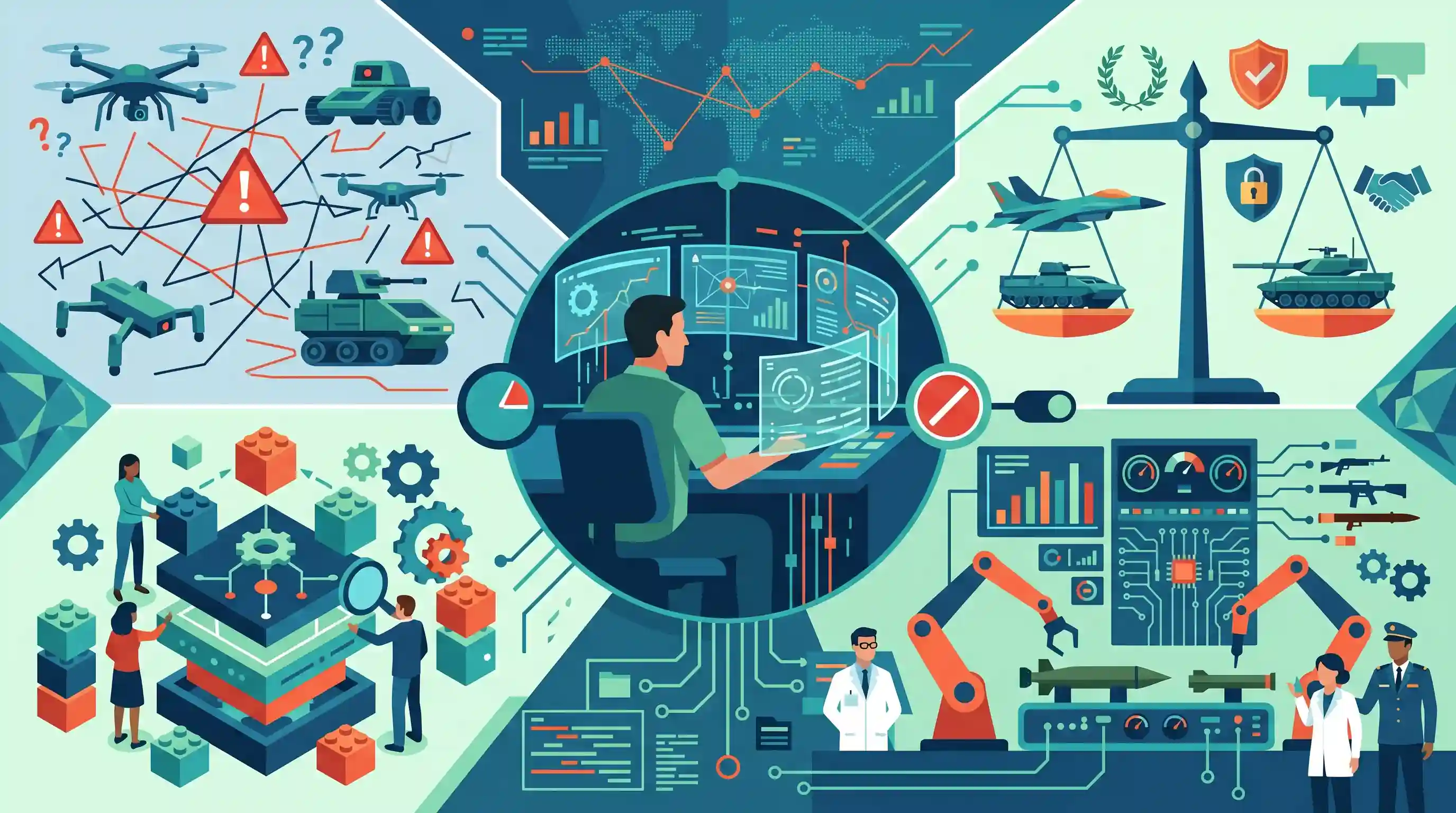
Lt Gen Vipul Shinghal emphasized the critical need for India to institutionalise human oversight over artificial intelligence (AI) systems deployed in military operations. By advocating for a 'human-in-the-loop' framework, he highlighted the risks of fully autonomous weapon systems and stressed that AI military applications must undergo rigorous testing and validation comparable to conventional weapons. This approach aims to balance defense modernization with ethical safeguards, ensuring reliability, safety, and accountability in high-stakes operational environments.
Key Points
- Lt Gen Vipul Shinghal advocates for institutionalising mandatory human oversight over Artificial Intelligence (AI) systems deployed in military operations.
- He emphasizes the necessity of a 'human-in-the-loop' approach to mitigate the risks and ethical dilemmas associated with lethal autonomous weapon systems (LAWS).
- AI-based military systems must undergo rigorous testing and validation protocols, similar to those for conventional weapons, to ensure safety and reliability before procurement.
- The call underscores the intersection of defense modernization and ethics, pushing for robust regulatory frameworks to govern military applications of emerging technologies in India.
Important Terms
Lethal Autonomous Weapons Systems (LAWS)

Military systems capable of identifying, selecting, and engaging targets without human intervention, often colloquially referred to as 'killer robots.'
UPSC context
GS Paper 3 (Security); tests awareness of emerging technology risks and international humanitarian law compliance.
Human-in-the-loop (HITL)
A framework where humans remain actively involved in AI decision-making cycles to ensure accuracy, safety, and ethical accountability.
UPSC context
GS Paper 4 (Ethics); relates to 'Meaningful Human Control' and moral agency in automated warfare.
Verification and Validation (V&V)
Rigorous technical processes (TEVV) used to ensure AI systems perform reliably, predictably, and safely within defined operational envelopes.
UPSC context
GS Paper 3 (S&T); focuses on the reliability of indigenous defense technology and safety standards.
Defense Modernization
The strategic upgrading of military capabilities, currently emphasizing the integration of AI, drone swarms, and cyber-defense systems.
UPSC context
GS Paper 3 (Security); critical for understanding 'Atmanirbhar Bharat' and India's response to regional security challenges.
Revolution in Military Affairs (RMA)
A fundamental shift in the nature of warfare caused by the innovative application of new technologies like AI and robotics.
UPSC context
GS Paper 3; strategic concept testing knowledge of how technology changes combat doctrines and power dynamics.
Responsible AI (RAI)
Ethical principles (governance, accountability, bias-mitigation) ensuring AI deployment in conflict respects human dignity and international norms.
UPSC context
GS Paper 4; examines the intersection of technology, values, and administrative ethics in national security.
Prelims Trap
The Defence AI Council (DAIC) is chaired by the Prime Minister to oversee military AI integration.
The DAIC is chaired by the Defence Minister, not the PM. UPSC frequently swaps the Prime Minister and line ministers in committee chairmanship statements.
Static Concepts Connected
How does International Humanitarian Law (IHL) govern autonomous weapons?
- Proportionality: Attacks must not cause excessive civilian harm compared to the direct and concrete military advantage anticipated.
- Distinction: Weapon systems must successfully distinguish between combatants and non-combatants, a major technical hurdle for autonomous AI.
- Accountability Gap: IHL struggles to assign legal responsibility (programmer, commander, or machine?) for war crimes committed by autonomous systems.
What is the UN CCW and its stance on autonomous weapons?
- Core Purpose: Restricts weapons causing unnecessary suffering or indiscriminately affecting civilians (e.g., landmines, booby traps, blinding lasers).
- LAWS Debate: Currently negotiates LAWS regulations via a Group of Governmental Experts (GGE); no total global ban exists yet.
- India's Stance: India advocates for 'meaningful human control' but opposes blanket technology bans that stifle domestic defense R&D.
Cross-Topic Patterns
Defense Indigenization + AI Ethics
India's push for meaningful human control in AI bridges self-reliance (iDEX, Defence AI Council) with international ethical norms, balancing modernization against the accountability gap.
Cyber Warfare + Algorithmic Vulnerability
Unlike traditional weapons, military AI faces unique cyber threats like 'data spoofing' and adversarial machine learning, linking physical defense procurement directly to the cybersecurity syllabus.

Expect a 2026 GS-3 Mains question on the ethical/accountability gaps of military AI, or a Prelims statement linking UN CCW to LAWS.
Linked PYQs · 4
Linked PYQs · 4
- 2023MainsGS3
Introduce the concept of Artificial Intelligence (AI). How does Al help clinical diagnosis? Do you perceive any threat to privacy of the individual in the use of Al in healthcare?
- 2024MainsGS4
The application of Artificial Intelligence as a dependable source of input for administrative rational decision-making is a debatable issue. Critically examine the statement from the ethical point of view.
- 2023MainsGS3
The use of unmanned aerial vehicles (UAVs) by our adversaries across the borders to ferry arms/ammunitions, drugs, etc., is a serious threat to the internal security. Comment on the measures being taken to tackle this threat.
- 2020PrelimsGS1
With the present state of development, Artificial Intelligence can effectively do which of the following? 1. Bring down electricity consumption in industrial units 2. Create meaningful short stories and songs 3. Disease diagnosis 4. Text-to-Speech Conversion 5. Wireless transmission of electrical energy Select the correct answer using the code given below:
