India HPV Vaccination Drive Crosses One Crore Doses Milestone
Source:Indian Express ↗
Why It Matters
The rapid scaling and high coverage of the HPV vaccination campaign represent a major milestone in India's preventive healthcare and non-communicable disease management, directly aligning with UPSC syllabus topics on social development and health policies.
Summary
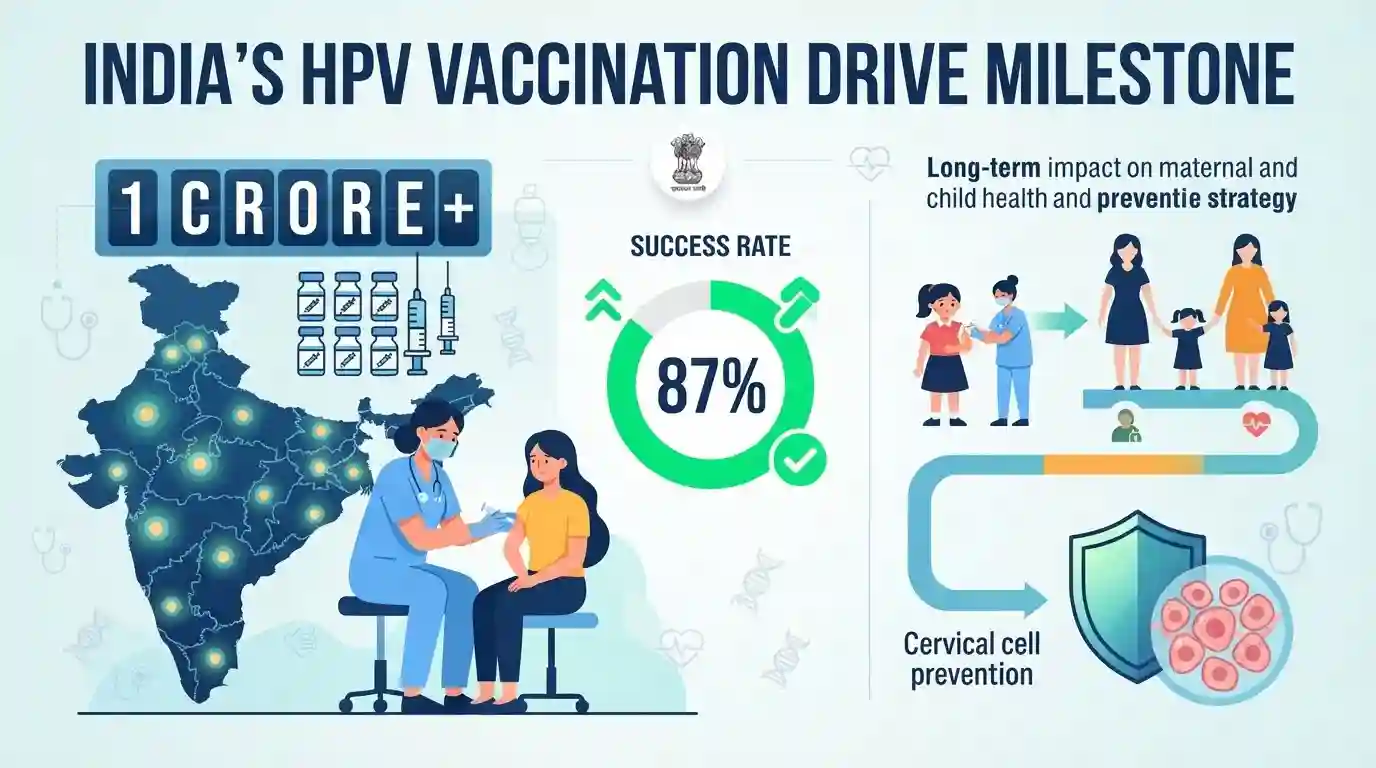
India's nationwide Human Papillomavirus (HPV) vaccination drive has successfully administered over one crore doses, achieving an impressive coverage rate of approximately 87 percent. This milestone marks a significant step forward in India's preventive healthcare strategy, particularly in addressing cervical cancer among women through large-scale public immunization programs.
Key Points
- India's HPV vaccination drive has crossed one crore doses administered nationwide.
- The initiative achieved remarkable coverage rates of around 87 percent in targeted demographics, focusing on preventive healthcare against cervical cancer.
- Cervical cancer is one of the leading causes of cancer mortality among women in India, making large-scale immunization a critical public health priority.
- The scale-up highlights the significance of targeted mass immunization campaigns and public sector health delivery at grassroots levels.
Important Terms
HPV Vaccination Drive

A nationwide public immunization initiative launched to administer free Human Papillomavirus (HPV) vaccines to adolescent girls, primarily targeting the prevention of cervical cancer.
UPSC context
UPSC Mains Paper II (Health Policy, Governance & Social Justice): tests strategies for preventive healthcare, women's health, and tackling non-communicable diseases.
National Health Mission
A flagship program of the Ministry of Health and Family Welfare aimed at strengthening public health systems and providing accessible, affordable healthcare across rural and urban India.
UPSC context
UPSC Mains Paper II (Government Policies & Interventions): important for understanding public healthcare delivery, disease control, and maternal-child health schemes.
Ministry of Health and Family Welfare
The central government ministry responsible for formulating, implementing, and monitoring national health policies, family welfare programs, and public health campaigns in India.
UPSC context
UPSC Mains Paper II (Governance): tests the institutional framework and administrative machinery behind public health policy execution.
Static Concepts Connected
What are the key pillars and target age groups of India's Universal Immunization Programme (UIP) and recent vaccine introductions?
- Core Coverage: UIP targets infants and pregnant women against 12 vaccine-preventable diseases nationally and sub-nationally.
- Mission Indradhanush: Mission Indradhanush aims to achieve 90% full immunization coverage across India, focusing on unvaccinated and partially vaccinated children.
- Adolescent Health: Recent additions like the HPV vaccine target specific adolescent cohorts (e.g., 14-year-old girls) to tackle non-communicable infection-linked cancers.
Cross-Topic Patterns
HPV Vaccination and Digital Public Infrastructure
Large-scale public health drives leverage digital platforms like U-WIN (mirrored on Co-WIN architecture) to track beneficiaries, linking health policy with digital public infrastructure (DPI).
Preventive Healthcare and SDG Targets
Cervical cancer interventions directly intersect with Sustainable Development Goal 3 (Good Health and Well-being) and gender-responsive public expenditure allocations.

U-WIN platform integration + single-dose HPV vaccine strategy for 14-year-olds is a prime target for a multi-statement Prelims question.
Linked PYQs · 5
Linked PYQs · 5
- 2023PrelimsGS1
Consider the following statements in relation to Janani Suraksha Yojana: 1. It is a safe motherhood intervention of the State Health Departments. 2. Its objective is to reduce maternal and neonatal mortality among poor pregnant women. 3. It aims to promote institutional delivery among poor pregnant women. 4. Its objective includes providing public health facilities to sick infants up to one year of age. How many of the statements given above are correct?
- 2023PrelimsGS1
Consider the following statements: Statement-I: India's public sector health care system largely focuses on curative care with limited preventive, promotive and rehabilitative care. Statement-II: Under India's decentralized approach to health care delivery, the States are primarily responsible for organizing health services. Which one of the following is correct in respect of the above statements?
- 2024PrelimsGS1
With reference to the 'Pradhan Mantri Surakshit Matritva Abhiyan', consider the following statements : 1. This scheme guarantees a minimum package of antenatal care services to women in their second and third trimesters of pregnancy and six months post-delivery health care service in any government health facility. 2. Under this scheme, private sector health care providers of certain specialities can volunteer to provide services at nearby government health facilities. Which of the statements given above is/are correct?
- 2024MainsGS2
In a crucial domain like the public healthcare system the Indian State should play a vital role to contain the adverse impact of marketisation of the system. Suggest some measures through which the State can enhance the reach of public healthcare at the grassroots level.
- 2020MainsGS2
In order to enhance the prospects of social development, sound and adequate health care policies are needed particularly in the fields of geriatric and maternal health care. Discuss.
