India holds security dialogue with Saudi Arabia and UAE pacts
Source:The Hindu ↗
Why It Matters
The article is highly relevant for GS2 (International Relations) and GS3 (Security) as it highlights India's delicate geopolitical balancing act in West Asia. It demonstrates how India manages strategic partnerships with competing regional powers (Saudi Arabia and the UAE) while securing its critical energy, economic, and security interests.
Summary
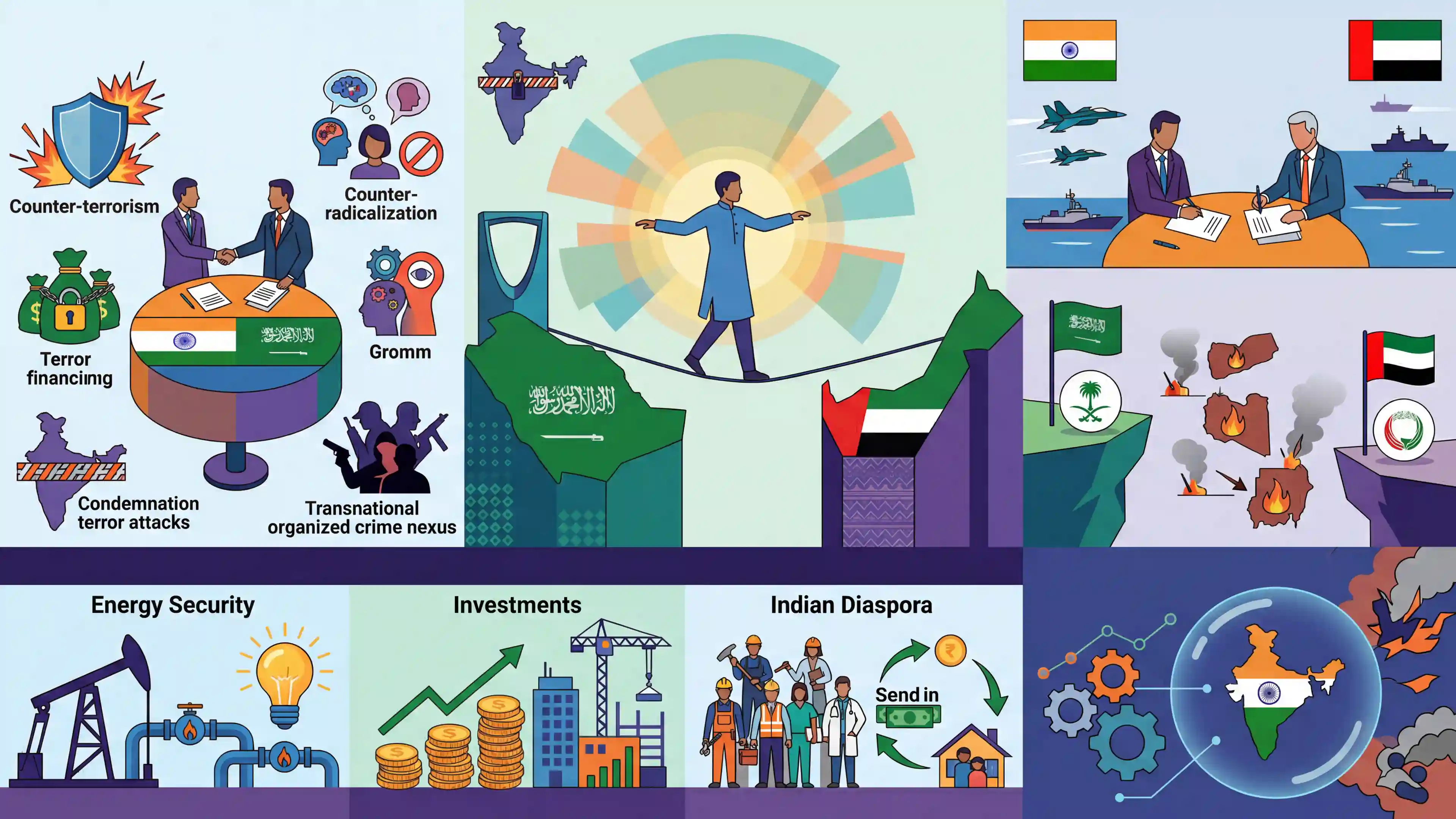
India recently convened the 3rd Security Working Group meeting with Saudi Arabia in Riyadh, reviewing ongoing security cooperation. The talks focused on counter-terrorism, radicalisation, terror financing, and addressing the nexus between transnational organised crime and terrorism, while condemning recent terror attacks in India. The dialogue is notable for its timing, occurring just days after India signed a 'Letter of Intent' for a Strategic Defence Partnership with the UAE. Despite nosediving relations between Saudi Arabia and the UAE over conflicts in Yemen, Libya, and Sudan, India continues to successfully balance ties with both Gulf powers. Foreign Secretary Vikram Misri emphasized that India's defense engagements are a natural evolution of bilateral ties and will not draw India into regional conflicts. The Gulf region remains fundamental to India's strategic interests, particularly concerning energy security, investments, and diaspora remittances.
Key Points
- The 3rd India-Saudi Arabia Security Working Group meeting was held in Riyadh, focusing on comprehensive security cooperation.
- Discussions covered countering extremism, terror financing, the misuse of technology by terrorists, and the nexus between transnational organised crimes and terrorism.
- The meeting holds strategic significance as it occurred days after India signed a Strategic Defence Partnership 'Letter of Intent' with the UAE.
- Saudi Arabia and the UAE are currently experiencing strained relations due to diverging policies in regions like Yemen, Libya, and Sudan.
- Both Saudi Arabia and the UAE remain critical to India for energy security, inward investments, and diaspora remittances.
- India's Foreign Secretary clarified that the defense pact with the UAE is a natural evolution of ties and will not entangle India in future Gulf conflicts.
Important Terms
India-Saudi Arabia Strategic Partnership Council (SPC)

Established in 2019, this high-level institutional mechanism co-chaired by India's Prime Minister and Saudi Arabia's Crown Prince oversees bilateral cooperation through pillars including political-security and economy-investment committees.
UPSC context
GS-2: Bilateral relations. Tests understanding of high-level diplomatic frameworks and institutionalized cooperation with key West Asian partners.
India-UAE Strategic Defence Partnership
A strategic agreement signed in early 2026 to elevate India-UAE ties by enhancing collaboration in defense manufacturing, R&D, cyber security, and counter-terrorism, building upon their 2017 Comprehensive Strategic Partnership.
UPSC context
GS-2: Global groupings and agreements involving India. Tests knowledge of defense diplomacy and evolving strategic footprints in the Gulf.
Transnational Organised Crime-Terrorism Nexus
The symbiotic relationship where terrorist organizations exploit criminal networks (e.g., drug trafficking, money laundering) for funding and logistics, while criminal syndicates gain protection or access to conflict zones.
UPSC context
GS-3: Internal Security. A recurring theme in terrorism and organized crime topics regarding funding and security challenges.
Security Working Group (SWG)
A specialized mechanism under the India-Saudi Strategic Partnership Council that facilitates official-level dialogue on counter-terrorism, radicalization, terror financing, and law enforcement cooperation.
UPSC context
GS-2: Bilateral agreements. Tests knowledge of the specific sub-mechanisms that operationalize broad strategic partnerships.
Energy Security
Reliable access to energy sources at an affordable price. For India, the Gulf region provides over 50% of crude oil imports, making regional stability vital for national growth.
UPSC context
GS-3: Infrastructure/Energy. Essential for understanding India's strategic autonomy and the economic drivers of its West Asia policy.
Indian Diaspora and Remittances
The 8.8 million-strong Indian community in the Gulf which contributes approximately $50-60 billion in annual remittances, vital for India's balance of payments and foreign exchange reserves.
UPSC context
GS-2: Effect of policies/politics of countries on India's interests. Tests appreciation of the socio-economic dimension of foreign policy.
Prelims Trap
India's Strategic Defence Partnership with the UAE includes mutual defense guarantees and regional intervention clauses.
India’s West Asia defense pacts focus on capacity building, counter-terrorism, and interoperability. They strictly avoid military alliances or entanglement in Gulf proxy wars.
Static Concepts Connected
What is "De-hyphenation" in India's West Asia policy?
- Core Principle: Engaging rival nations independently based on mutual interests, avoiding taking sides in their regional conflicts.
- Key Examples: Balancing ties between Israel and Palestine, Saudi Arabia and Iran, and increasingly, managing the geopolitical rift between Saudi Arabia and the UAE.
- Strategic Goal: Securing energy imports, diaspora remittances, and maritime security while maintaining absolute strategic autonomy.
What is the nexus between organized crime and terrorism?
- Financial Symbiosis: Terrorist groups use organized crime networks (narcotics, human trafficking, hawala) to fund their operations while evading formal banking systems.
- Logistical Overlap: Criminal syndicates provide safe transit routes, counterfeit currency, and illicit weapons to terrorist organizations.
- Mutual Protection: Terrorists often provide safe havens or physical protection for criminal cartels operating in ungoverned or conflict-ridden areas.
Cross-Topic Patterns
Gulf proxy wars & Indian energy security
The Saudi-UAE proxy conflicts in Yemen and Sudan risk destabilizing the region, directly threatening India's long-term energy supply chains (like the HPCL-ADNOC deal) and diaspora safety.
IMEEC & Gulf defense diplomacy
Strengthening bilateral defense and security pacts in the Gulf protects long-term Indian geo-economic and connectivity investments, particularly the India-Middle East-Europe Economic Corridor (IMEEC).

Expect a GS2 Mains question evaluating India's strategic de-hyphenation regarding the emerging Saudi-UAE rift over regional proxy conflicts.
Linked PYQs · 4
Linked PYQs · 4
- 2017MainsGS2
The question of India's Energy Security constitutes the most important part of India's economic progress. Analyze India's energy policy cooperation with West Asian countries.
- 2025MainsGS2
"Energy security constitutes the dominant kingpin of India's foreign policy, and is linked with India's overarching influence in Middle Eastern countries.” How would you integrate energy security with India's foreign policy trajectories in the coming years?
- 2022MainsGS3
Discuss the types of organised crimes. Describe the linkages between terrorists and organised crime that exist at the national and transnational levels.
- 2021MainsGS3
Analyse the complexity and intensity of terrorism, its causes, linkages and obnoxious nexus. Also suggest measures required to be taken to eradicate the menace of terrorism.
